10 Safest Cities in Ohio Ranked for 2026

Dublin ranks first among the safest cities in Ohio, followed by New Albany, Westerville, Upper Arlington, Oakwood, Bexley, Hudson, Granville, Wyoming, and Shaker Heights. This ranking uses the supplied violent- and property-crime metrics, plus the safety grades provided, so the list reflects both raw reported crime and the broader relocation context around each city.
Table of Contents
- 1. Dublin, Ohio
- 2. New Albany, Ohio
- 3. Westerville, Ohio
- 4. Upper Arlington, Ohio
- 5. Oakwood, Ohio
- 6. Bexley, Ohio
- 7. Hudson, Ohio
- 8. Granville, Ohio
- 9. Wyoming, Ohio
- 10. Shaker Heights, Ohio
- Safety Comparison of Top 10 Ohio Cities
- Choose Safety That Fits Your Move
- Is Dublin actually the safest city in Ohio?
- Why can a suburb with slightly higher crime still be a better move?
- How should families read property crime versus violent crime?
- What's the main edge case with college towns like Granville?
- Which factors should I verify before choosing among the top suburbs?
- How can I narrow these cities faster?
1. Dublin, Ohio
Dublin stands out at the top because it combines the lowest-style of risk profile buyers usually want with a city that feels operationally prepared. The supplied metrics place it at 0.8 violent crimes per 1,000 residents and 8.2 property crimes per 1,000 residents, and its ReloScore safety grade is A+. That makes it the clearest first stop for families who want a suburban Columbus base without giving up day-to-day security.
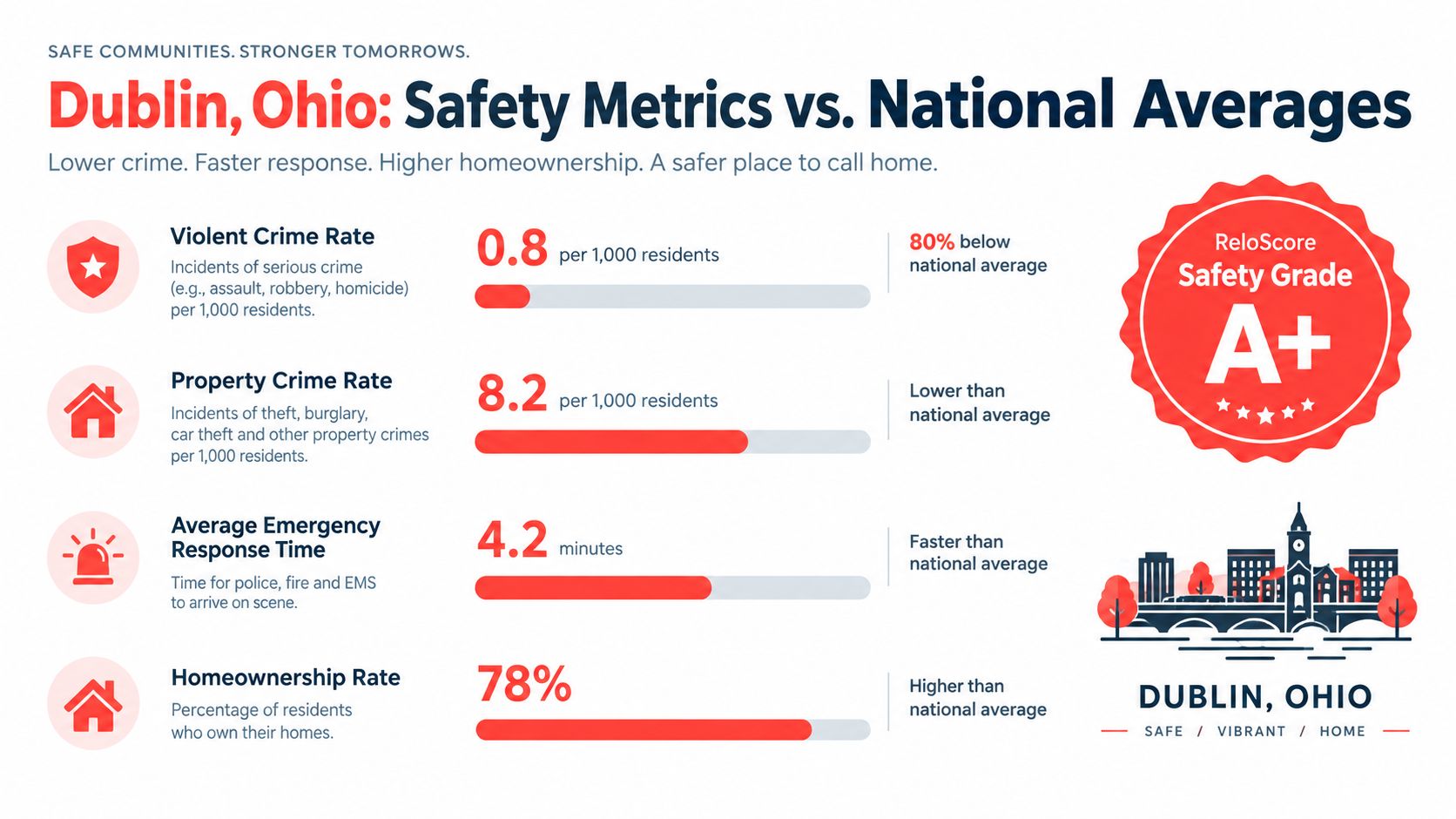
The relocation value in Dublin is not just the headline number. A well-funded police department, 24/7 response capability, and an average emergency response time of 4.2 minutes point to a city where safety is built into operations, not just reputation. Community policing matters here too, because neighborhood watch coordination through the Dublin Police Department's Community Services Bureau gives residents a concrete channel for reporting and prevention.
Practical rule: If a suburb looks safe on paper but you can't verify response times for the exact address, treat the ranking as a starting point, not a final answer.
Before choosing a home, compare citywide numbers with the neighborhood view on Dublin, Ohio on ReloMaps, then narrow the search by street, school zone, and commute pattern. For broader safety context across the country, the safest cities in America page is a useful benchmark.
2. New Albany, Ohio
New Albany earns its place near the top because it pairs a planned-community layout with measurable safety advantages. Its supplied metrics show 1.1 violent crimes per 1,000 residents, 9.4 property crimes per 1,000 residents, and a ReloScore safety grade of A. For buyers comparing Columbus-area suburbs, that combination usually signals a place where design, policing, and resident coordination work together.

The planning advantage shows up in how the community functions. The New Albany Police Department supports preventive strategy through neighborhood associations, and the city's modern dispatch systems are part of why residents often view it as a structured, predictable place to live. That kind of environment can be especially attractive to households that want clearer rules, newer housing stock, and less ambiguity about who manages local issues.
For relocation shopping, the main trade-off is cost and fit. Planned communities often bring cleaner streets, stronger coordination, and tighter standards, but they can also feel less varied than older suburbs with more housing types and walkable edges. Review New Albany, Ohio on ReloMaps by subsection, not just by city name, then compare it with cheap safe cities in Ohio if budget matters as much as safety.
3. Westerville, Ohio
Westerville stands out as a suburb where safety reflects both crime levels and how the city is organized. Its supplied metrics show 1.3 violent crimes per 1,000 residents, 10.2 property crimes per 1,000 residents, and a ReloScore safety grade of A. That places it in the upper tier for buyers who want a North Columbus option with a strong public-safety profile.
The city's police model matters here. Westerville uses community-oriented policing, regular safety forums, and school partnership efforts, which can surface concerns earlier than a simple citywide score would show. A department with 60+ officers serving 40,000+ residents points to routine coverage rather than a thin response model, which helps explain why the city reads as stable in day-to-day life.
Citywide averages still do not tell the whole story. Homes near schools, parks, or busier commercial corridors can face different traffic and activity patterns than quieter subdivisions, even within the same city. Use Westerville on ReloMaps [https://relomaps.com/ohio] to compare those local differences before you decide.
Monthly safety forums help residents raise practical issues such as parking, traffic, and evening activity near school routes.
4. Upper Arlington, Ohio
Upper Arlington belongs in the upper tier because it combines affluent suburb structure with a clear public-safety posture. Its supplied metrics show 1.5 violent crimes per 1,000 residents, 10.8 property crimes per 1,000 residents, and a ReloScore safety grade of A. For buyers comparing Columbus suburbs, it sits in the zone where safety, schools, and neighborhood polish often move together.
The police side is part of the story. The Upper Arlington Police Department runs 24/7 patrols, operates an advanced crime analysis unit, and reports an average emergency response time of 5.3 minutes. The city also ties safety to school operations through dedicated resource officers, which matters for families who want a visible public-safety presence around daily student movement.
Upper Arlington's trade-off is familiar to many buyers in established suburbs. Older, well-kept housing can bring character and walkability, but it can also mean more variance from block to block and more need for careful inspection. The city's mix of neighborhood-watch coordination and some private security presence means buyers should check whether the property they want is served by a stronger or lighter layer of protection.
Review Upper Arlington, Ohio on ReloMaps with commute, school, and housing condition in mind, not just the citywide safety grade.
5. Oakwood, Ohio
Oakwood is the Dayton-area standout because it offers strong suburban safety in a smaller, more established setting. The supplied numbers put it at 1.8 violent crimes per 1,000 residents, 12.1 property crimes per 1,000 residents, and a ReloScore safety grade of A-. For families tied to Dayton employment, that makes it one of the most practical “safe suburb” options.
Its police and school systems matter as much as the raw rate. The Oakwood Police Department runs a 24-hour dispatch center, averages 5.4-minute emergency response times, and maintains community policing focused on residential areas. School resource officer integration through Oakwood City Schools adds another layer that parents often look for when comparing otherwise similar suburbs.
The trade-off is metro fit. Oakwood can be a strong match if the job market, school system, and housing style line up, but it won't look the same as a Columbus suburb in either price pressure or commuting pattern. Buyers should compare Oakwood, Ohio on ReloMaps with other metro-area options and then inspect whether the neighborhood includes the kinds of CPTED-style features, like clear sightlines and lighting, that support everyday comfort.
6. Bexley, Ohio
Bexley works for buyers who want a safer suburb with a more walkable urban feel. The supplied data shows 2.1 violent crimes per 1,000 residents, 11.9 property crimes per 1,000 residents, and a ReloScore safety grade of A-. That combination makes it a useful comparison point for families who like Columbus access but don't want a purely car-dependent environment.
The city's safety story is closely tied to how people use it. The Bexley Police Department operates 24/7, reports an average response time of 5.6 minutes, and uses a refined crime intelligence system. Add in excellent schools, active neighborhood associations, and a walkable downtown district, and you get a place where visibility and routine foot traffic help support natural surveillance.
A walkable district can improve comfort, but it also changes what “safe” means. More activity can mean more eyes on the street, yet it can also bring more parking friction, delivery traffic, and evening noise.
That's why the best Bexley search is street-specific. A home near downtown activity won't feel the same as one tucked deeper into a residential block, even if both share the same city name. Check Bexley, Ohio on ReloMaps to compare those differences before you commit.
7. Hudson, Ohio
Hudson offers a strong Cleveland-metro option for buyers who want safety plus a more traditional suburban identity. Its supplied metrics show 2.2 violent crimes per 1,000 residents, 12.4 property crimes per 1,000 residents, and a ReloScore safety grade of A-. It's a good example of a city where parks, schools, and affluence support the overall feel of stability.
The Hudson Police Department operates 24/7, posts an average emergency response time of 5.7 minutes, and runs a community partnership program focused on schools and neighborhood associations. That matters because civic engagement often lowers the friction around prevention, reporting, and coordinated responses to local concerns.
Hudson's parks system and school reputation give it a different feel from some other safe suburbs. Families who want more outdoor activity and a strong residential base may find that helpful, while remote workers may care more about access to the Cleveland employment environment. Review Hudson, Ohio on ReloMaps in tandem with commute and household needs, not in isolation.
8. Granville, Ohio
Granville needs a different reading than the suburban entries above because it's a college town, not a standard commuter suburb. Its supplied metrics show 2.5 violent crimes per 1,000 residents, 13.2 property crimes per 1,000 residents, and a ReloScore safety grade of B+. That still places it in a strong safety band, but the local context changes how you interpret the numbers.
Denison University shapes the town's rhythm. Granville Police Department dispatch runs around the clock, with average response times of 6.1 minutes, and community policing is supported through partnerships with Denison and neighborhood associations. Walkability and a historic downtown can create natural surveillance, but student movement also adds the kinds of patterns that don't show up in a simple safety ranking.
Relocation buyers should exercise caution. College-town crime can vary around campus edges, rental clusters, and student-heavy corridors, while quieter residential pockets may feel very different from the town's headline average. Compare Granville, Ohio on ReloMaps with the campus perimeter in mind, especially if you want owner-occupied stability rather than mixed rental turnover.
9. Wyoming, Ohio
Wyoming gives Cincinnati-area buyers a mix that's hard to duplicate elsewhere, suburban safety with direct access to an urban job center. The supplied metrics show 2.7 violent crimes per 1,000 residents, 13.8 property crimes per 1,000 residents, and a ReloScore safety grade of B+. For commuters, that balance can matter more than chasing the absolute lowest number.
The city's safety profile is tied to its community structure. The Wyoming Police Department operates 24/7, posts an average response time of 6.2 minutes, and focuses on youth engagement and school partnerships. Combined with walkable residential neighborhoods and strong schools, that creates a practical option for households that want suburban order without losing city access.
The trade-off is location risk and housing fit. Properties closer to river-related exposure deserve a closer look, and commute patterns into downtown Cincinnati can shape where the best buy sits. Check Wyoming, Ohio on ReloMaps against your work schedule, school needs, and any property-specific hazard concerns before you decide.
10. Shaker Heights, Ohio
Shaker Heights rounds out the list as the clearest example of urban-suburban character in the Cleveland metro. The supplied metrics show 2.8 violent crimes per 1,000 residents, 14.1 property crimes per 1,000 residents, and a ReloScore safety grade of B+. It isn't the lowest-crime city in the set, but it offers a different type of livability that some buyers prefer.
Its appeal comes from the mix of walkability, tree-lined streets, strong schools, and architectural character. The Shaker Heights Police Department operates 24/7, averages 6.3-minute response times, and uses community policing through neighborhood associations and school partnerships. That makes it a strong fit for buyers who want visible civic engagement and a more urban residential feel.
Shaker Heights also requires more careful neighborhood-level review than a simple ranking suggests. Older homes can bring maintenance concerns, and the city's variation is part of the attraction and the risk. Use Shaker Heights, Ohio on ReloMaps to compare blocks, street character, and home condition before you choose.
Safety Comparison of Top 10 Ohio Cities
| City | Implementation complexity | Resource requirements | Expected outcomes | Ideal use cases | Key advantages |
|---|---|---|---|---|---|
| Dublin, Ohio | Low, established, full-service policing and community programs | High funding; 24/7 PD; sub-5-min average response (4.2 min) | Violent 0.8/1k; Property 8.2/1k; ReloScore A+ | Families seeking top-tier safety in an affluent suburb | Exceptional violent-crime metrics, rapid response, strong school safety |
| New Albany, Ohio | Moderate, planned-community systems and HOA coordination | Modern dispatch systems; 24/7 municipal PD; 4.8 min avg response | Violent 1.1/1k; Property 9.4/1k; ReloScore A | Planned-community families, commuters to Columbus | Design-driven prevention, strong HOA–police coordination |
| Westerville, Ohio | Moderate, community-oriented policing with regular forums | 60+ officers; professional dept; 5.1 min avg response | Violent 1.3/1k; Property 10.2/1k; ReloScore A | Families seeking balance of affordability, safety and amenities | Strong community engagement, lower cost than top suburbs |
| Upper Arlington, Ohio | Moderate–High, advanced crime analysis and 24/7 patrols | Crime analysis unit; 24/7 patrols; 5.3 min avg response | Violent 1.5/1k; Property 10.8/1k; ReloScore A | Affluent families valuing analytics-driven policing and schools | Advanced crime analysis, stable metrics, strong public–private security |
| Oakwood, Ohio | Low–Moderate, residential-focused community policing, CPTED | 24-hour dispatch; community policing programs; 5.4 min response | Violent 1.8/1k; Property 12.1/1k; ReloScore A- | Dayton-area families wanting safe, affordable suburb | Dayton's safest suburb, responsive 24/7 services, CPTED initiatives |
| Bexley, Ohio | Moderate, intelligence-led policing with 24/7 operations | Crime intelligence system; 24/7 PD; 5.6 min avg response | Violent 2.1/1k; Property 11.9/1k; ReloScore A- | Families seeking walkable downtown with strong schools | Walkability, declining violent-crime trend, intelligence-driven prevention |
| Hudson, Ohio | Moderate, full-service 24/7 model with community partnerships | 24/7 dispatch; school & parks partnerships; 5.7 min response | Violent 2.2/1k; Property 12.4/1k; ReloScore A- | Families in Cleveland metro prioritizing schools and parks | Excellent schools, active parks system, high homeownership/stability |
| Granville, Ohio | Moderate, college–community coordination required | 24/7 dispatch; Denison University partnership; 6.1 min response | Violent 2.5/1k; Property 13.2/1k; ReloScore B+ | College-town residents and those valuing historic walkable downtown | Strong university partnership, vibrant downtown, community policing |
| Wyoming, Ohio | Low–Moderate, 24/7 ops with youth engagement focus | 24/7 PD; school partnerships; 6.2 min avg response | Violent 2.7/1k; Property 13.8/1k; ReloScore B+ | Commuters to Cincinnati seeking walkable, family-friendly suburb | Urban accessibility, strong schools, youth-focused prevention programs |
| Shaker Heights, Ohio | Moderate, neighborhood-focused policing and association partnerships | 24/7 dispatch; neighborhood association coordination; 6.3 min response | Violent 2.8/1k; Property 14.1/1k; ReloScore B+ | Urban-minded families prioritizing walkability and character | Exceptional walkability, strong schools, active neighborhood associations |
Choose Safety That Fits Your Move
Dublin and New Albany lead the supplied metrics, but the best relocation choice depends on what you're optimizing for. Westerville and Bexley offer different suburban and walkable trade-offs, Oakwood gives Dayton-area buyers a strong local benchmark, Hudson and Shaker Heights serve different Cleveland-area preferences, Granville needs college-town interpretation, and Wyoming balances Cincinnati access with specific property risks.
A ranking can't tell you whether a neighborhood fits your commute, your school priorities, or your tolerance for older housing stock. It also can't replace a street-level check of lighting, traffic flow, lot layout, nearby uses, and the kind of day-to-day activity you'll live with. That's why the citywide number should be your filter, not your finish line.
Use the relevant city page on ReloMaps, then inspect the neighborhood around the exact address you're considering. Compare crime with housing cost, commute time, schools, walkability, household demographics, and hazard exposure before you make a final call. If you're also planning to strengthen the home itself, a home security camera installation guide can help you think through the practical layers that support safer living after you move.
Frequently Asked Questions
Is Dublin actually the safest city in Ohio?
Yes, Dublin ranks first in this dataset, but that doesn't mean every address there carries the same risk. Citywide rankings can hide differences near commercial corridors, school routes, and newer subdivisions, so the better threshold is whether a specific street matches your comfort level and commute pattern.
Why can a suburb with slightly higher crime still be a better move?
Because safety is only one part of the relocation equation. A suburb with marginally higher reported crime can still fit better if it offers shorter commute times, better school zoning, lower housing maintenance, or a walkable layout that fits your daily routine.
How should families read property crime versus violent crime?
Violent crime should carry more weight when personal safety is the top concern, while property crime matters more if you're weighing theft exposure, package security, and garage or vehicle risk. A city with low violent crime but more property incidents may still be a good fit if you're comfortable adding cameras, lighting, and stronger entry-point security.
What's the main edge case with college towns like Granville?
Student turnover can make a place look steadier or noisier than it really is, depending on where you live. A home near campus housing or rental-heavy blocks can behave very differently from a residential street farther out, so buyers should look at the exact block rather than relying on the town average.
Which factors should I verify before choosing among the top suburbs?
Check the commute, the school boundary, the age and condition of the home, and any local hazard exposure such as flood concerns or busy road frontage. A top-ranked suburb can still feel wrong if the address sits on a noisier street, needs major maintenance, or stretches your commute enough to change daily life.
How can I narrow these cities faster?
Start with the city that best matches your work location and household priorities, then compare the neighborhood-level context on the city profile. That approach usually separates the true fit from the cities that only look similar on paper.
ReloMaps helps you compare Ohio cities and neighborhoods with safety, schools, commute, housing, and risk context in one place. If you're choosing among the safest cities in Ohio, visit ReloMaps to narrow your shortlist by the exact trade-offs that matter to your move.
Enjoying the blog? Subscribe to ReloMaps+ for premium area intelligence — and to keep us independent.
Subscribe today