10 Safest Cities in New York for 2026

The lowest supplied violent-crime figures in this list belong to Tuxedo Park, Bronxville, and Cold Spring Harbor, but the best choice depends on whether you prioritize gated infrastructure, NYC access, affordability, walkability, or neighborhood-level consistency. Rye's SafeWise profile reports 0.1 violent crimes and 2.5 property crimes per 1,000 people, showing why the safest cities in New York can look very different depending on the dataset and the decision behind the move.
Safety is a ranking, not a guarantee. The list below weighs the supplied violent- and property-crime figures alongside jurisdiction, policing, neighborhood variation, access, housing tradeoffs, commuting realities, and waterfront or disaster-insurance exposure. A village, town, hamlet, city, and gated private community also aren't perfectly comparable units, so a low rate should guide your questions rather than end your research.
For broader security planning, Overton Security's New York guide provides additional context on professional protection services. ReloMaps adds a different layer, with city and neighborhood context covering safety grades, commuting, housing, demographics, and hazard indicators.
Table of Contents
- How to read this safety ranking
- 1. Scarsdale, Westchester County
- 2. Manhasset, Nassau County
- 3. Garden City, Nassau County
- 4. Bronxville, Westchester County
- 5. Port Washington, Nassau County
- 6. Tuxedo Park, Orange County
- 7. Rye, Westchester County
- 8. Cold Spring Harbor, Suffolk County
- 9. Hastings-on-Hudson, Westchester County
- 10. Great Neck, Nassau County
- Top 10 Safest Cities in New York, Comparison
- Turn the Ranking Into a Location Test
- Frequently Asked Questions
- Which New York community is best for a gated-community lifestyle?
- Which safe New York location is most practical for a Manhattan hybrid worker?
- How should waterfront buyers compare safety with insurance risk?
- Does a Great Neck crime rate apply equally across every neighborhood?
- What should buyers verify when a listing has a Bronxville address?
- Which safety metric should remote workers prioritize?
How to read this safety ranking
Crime rates are useful because they create a common starting point, but they don't describe the same lived environment in every jurisdiction. A compact commuter village can record incidents around a train station or commercial center, while a gated community may limit access through private infrastructure and report activity through a different policing structure.
The supplied figures also come from different methodologies. SafeWise reported Rye at 0.1 violent crimes per 1,000 people and 2.5 property crimes per 1,000 people, while another 2026 dataset reported a total crime rate of 182.5 per 100,000 and a violent-crime rate of 78.2 per 100,000 for Rye. Those figures shouldn't be blended into one score, but their broader direction is consistent. Rye sits near the top of New York safety comparisons. SafeWise's 2026 New York ranking explains the rate-based context.
Independent comparisons reinforce the need to cross-check. SafeHome identifies places including Lewisboro Town, Coxsackie Village, Windham Town, Shawangunk Town, Montgomery Town, and New Castle Town among New York's lowest-crime communities, while OpenCrime includes Shawangunk Town, Sleepy Hollow Village, Scarsdale Village, Harrison Town, Mamaroneck Town, Lewisboro Town, New Castle Town, Rye, Fishkill Town, and East Hampton Town among the safest by violent rate. SafeHome's New York safety tables are useful for benchmarking, but the safest shortlist should still be checked against jurisdiction and neighborhood boundaries.
Practical rule: Compare the exact police jurisdiction, not only the mailing address.
New York City deserves separate treatment. Official reporting said the city recorded 688 shooting incidents in 2025, 66 fewer than the previous record low of 754 set in 2018, and described New York City as the safest big city in the nation. The governor's announcement supports a meaningful decline in gun violence, but that doesn't mean every crime category or neighborhood has changed in the same way. NYPD's safety-year report makes that distinction important for people comparing suburban relocation with city living.
1. Scarsdale, Westchester County
Scarsdale is a strong choice for buyers who want affluent suburban stability, established civic institutions, and access to New York City. The supplied figures place its violent crime rate at 0.8 per 1,000 residents and property crime at 2.1 per 1,000, creating a balanced profile rather than one driven only by exceptionally low violence.
The safety experience can still differ by street. Residential watch groups, school-based safety programs, and local police engagement may be strongest where residents actively participate, while areas closer to commercial movement can face a different exposure to theft and visitor traffic. Buyers should treat village-wide reputation as a starting point, then request recent incidents for the specific block.
What buyers should verify
Scarsdale works best for households that value predictable suburban routines over lower-cost entry points. It also offers the kind of local context that broad “safest cities” lists often miss. ReloMaps' safest cities in America comparison can help place Scarsdale alongside communities outside New York using consistent location categories.
Before making an offer, ask:
- Jurisdiction: Confirm that the property is covered by the expected village police authority.
- Street-level participation: Ask whether the neighborhood watch is active on the target street.
- Insurance treatment: Request a quote based on the actual address rather than assuming low crime automatically lowers premiums.
- School and commuting context: Test the morning and evening route, because a safe neighborhood can still create an impractical daily schedule.
Scarsdale's central tradeoff is straightforward. You may gain a stable, highly serviced environment, but you shouldn't assume every residential pocket has identical access, traffic, or property exposure.
2. Manhasset, Nassau County
Manhasset suits buyers who want North Shore suburban living with a practical connection to Manhattan. Its supplied violent-crime rate is 1.2 per 1,000 residents, while property crime is 1.8 per 1,000, making property protection a particularly strong part of the profile.
The hamlet's safety picture is shaped by more than household affluence. Commercial districts, private associations, school facilities, and waterfront activity create different patterns of movement across the community. A quiet residential road won't have the same exposure as a business area or a station-oriented route, even when both fall under the same broader Manhasset label.
Access matters as much as the rate
A Manhattan commuter should evaluate the actual door-to-door routine. The supplied planning data identifies Long Island Rail Road service as averaging 52 minutes for the Midtown trip, but the useful question is whether the station, parking arrangement, and final walk fit your work schedule. A short rail ride can become a long commute if the home is distant from the station or if the household needs a second car.
Request incident reports for North Shore, Central Manhasset, and Harbor Park rather than relying on a single hamlet-wide impression. Also confirm who controls security at any private development and what visitor procedures apply. Waterfront proximity may improve access to amenities, but it introduces insurance questions that crime data won't answer.
Manhasset is strongest for buyers who prioritize polished suburban infrastructure and Manhattan connectivity. It isn't automatically the best value for someone who wants lower housing costs, a car-light lifestyle, or minimal exposure to waterfront risks.
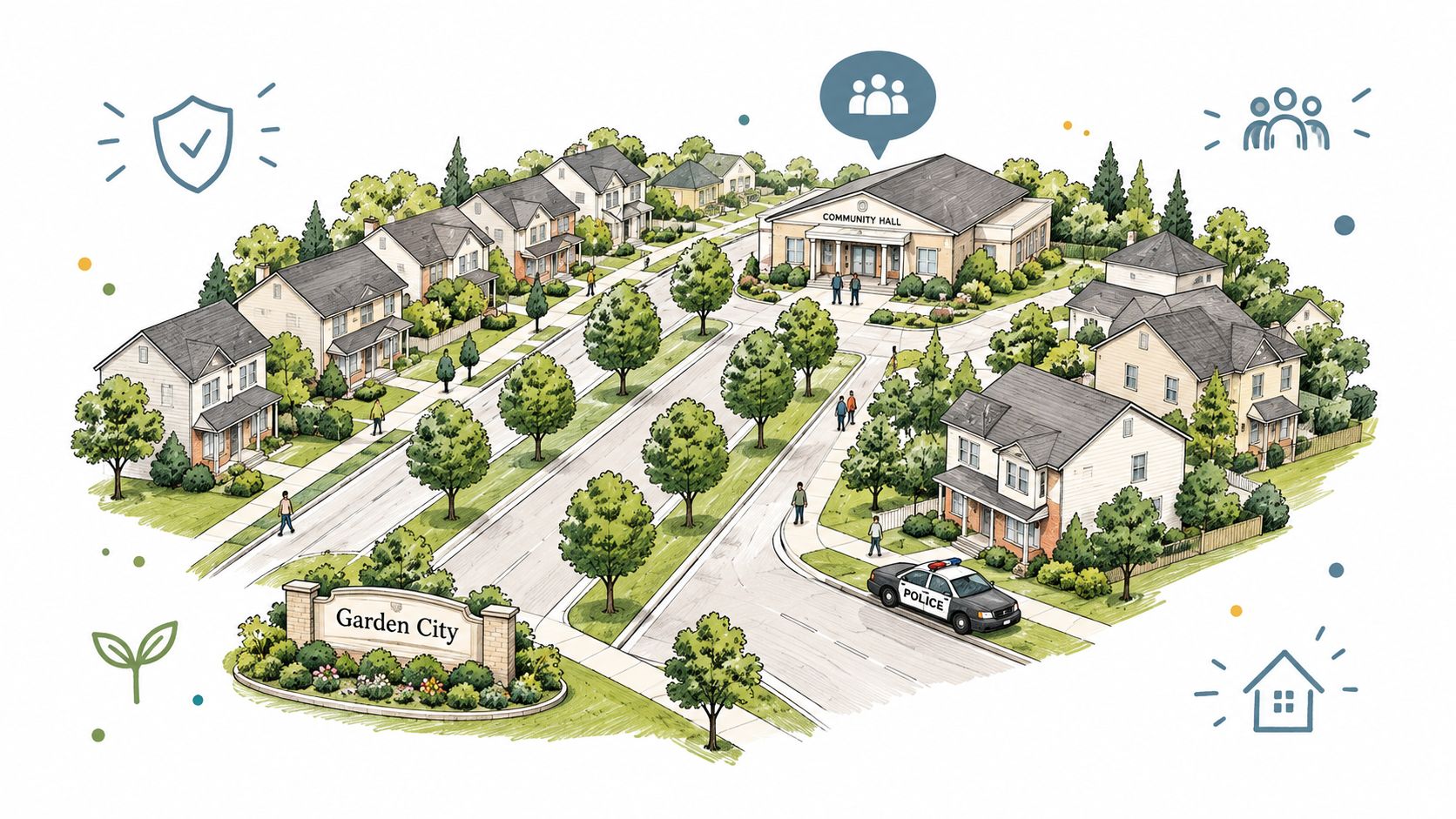
3. Garden City, Nassau County
Garden City's appeal comes from the interaction between design and safety. The supplied violent-crime rate is 0.9 per 1,000 residents, and the property profile includes a burglary rate of 1.3 per 1,000. Planned boulevards, defined residential zones, neighborhood associations, and limited through-traffic can make streets easier to observe than less structured suburban layouts.
That design doesn't eliminate variation. Buyers should ask for incidents by neighborhood, especially when comparing central areas with locations near busier roads or commercial activity. A planned community can feel uniform while still producing different patterns around schools, shopping, and commuter routes.
A better way to evaluate the purchase
Walk the block at different times rather than visiting only during a weekend showing. Look at lighting, sightlines, parking turnover, and whether sidewalks draw traffic from outside the immediate neighborhood. Those observations help explain why two properties in the same municipality can feel different despite sharing a safety reputation.
Garden City may be particularly attractive to families who want strong local engagement and a conventional suburban environment. It may be less suitable for buyers seeking a lower-cost market or a highly urban lifestyle. The safest choice isn't always the one with the lowest isolated figure. It may be the community where policing, neighborhood design, schools, and daily routines fit together without creating hidden friction.
4. Bronxville, Westchester County
Bronxville combines one of the lowest supplied violent-crime figures in this comparison, 0.6 per 1,000 residents, with an exceptionally low property-crime figure of 0.4 per 1,000. Its small, walkable form changes how residents experience safety. More homes, shops, civic facilities, and transit connections sit within a compact environment, increasing visibility and reducing the need for long car trips.
The main caution is jurisdiction. A property that uses a Bronxville mailing address may not fall within Bronxville Police Department coverage. Boundary differences can affect patrol responsibility, emergency coordination, school context, and the practical meaning of a village-level crime statistic.
Why walkability changes the decision
A buyer should map the route from the home to the village center, station, schools, and daily services. Walkability can support natural observation and reduce isolated driving, but station areas also bring visitors and periodic activity that a quiet residential street won't experience.
Bronxville is a strong fit for a commuter who values a compact village and wants to remain close to New York City. Metro-North capacity and scheduling still deserve a test run during the hours you expect to travel. Visit the station at peak times, check the return trip, and calculate the walk or parking routine before treating rail access as a solved problem.
A low municipal rate is most useful when the home, school route, station, and emergency jurisdiction all line up.
5. Port Washington, Nassau County
Port Washington offers a different safety proposition from inland suburbs. Its supplied violent-crime rate is 1.1 per 1,000 residents, and property crime is 1.5 per 1,000. Waterfront geography, marinas, civic associations, and commuter infrastructure produce a community that can feel active and connected rather than secluded.
That activity creates the key tradeoff. Harbor-area properties may benefit from visible engagement and marine patrols, while commercial and station-adjacent areas can experience more visitor movement than purely residential streets. Buyers should compare Harbor Park, Bayside, and Sunset Park instead of treating Port Washington as one uniform risk environment.
Waterfront safety isn't the same as waterfront risk
Crime figures don't measure flooding, storm exposure, wind damage, or insurance restrictions. A waterfront home can look excellent in a safety ranking and still require more expensive or complicated hazard underwriting. Ask for current insurance quotes, flood-zone information, and the property's elevation and drainage history before comparing it with an inland alternative.
Commuters should also verify the station relationship. A residence near the Long Island Rail Road may reduce driving, but a home farther from the station can turn a convenient rail connection into a daily parking or car trip. Port Washington fits buyers who want Long Island access, community activity, and a harbor setting. It demands more diligence from anyone who sees waterfront living as a purely lifestyle upgrade.
6. Tuxedo Park, Orange County
Tuxedo Park has the lowest supplied violent-crime figure in the list, 0.3 per 1,000 residents, alongside property crime of 0.2 per 1,000. Those numbers make it a benchmark for controlled-access living, but they also illustrate why rankings need jurisdictional context. A gated private community isn't directly comparable with an open municipality that has public roads, broader commercial activity, and different reporting conditions.
The gates are part of the safety model, not merely an amenity. Visitor verification, private patrols, architectural controls, and limited commercial activity can reduce through-traffic and make the community more predictable. The same controls can create inconvenience for residents who frequently host guests, contractors, deliveries, or service providers.
The infrastructure comes with obligations
Ask how emergency services are divided before buying. Private police coverage may differ from ambulance, fire, county, or hospital response, and the legal authority of each service matters more than a marketing description.
A Tuxedo Park buyer should also review:
- Guest access: Learn how regular visitors receive authorization and how delivery drivers enter.
- Design approvals: Confirm whether renovations, fences, additions, or exterior changes require architectural review.
- Road access: Test the route to work, schools, medical care, and essential shopping.
- Hazard exposure: Compare wooded, rural, and potentially storm-affected locations separately from crime risk.
Tuxedo Park is the clearest choice for someone who prioritizes controlled access above convenience. It may be a poor fit for a buyer who wants an open neighborhood, spontaneous visitors, or an easy urban commute.
A visual overview of the community's safety profile can help buyers distinguish controlled access from broader relocation convenience.
7. Rye, Westchester County
Rye is the strongest example of why a municipality-wide ranking can't replace neighborhood analysis. SafeWise placed Rye at No. 1 in its 2026 New York ranking, with 0.1 violent crimes per 1,000 people and 2.5 property crimes per 1,000 people. A separate dataset reported 182.5 total crimes per 100,000 and 78.2 violent crimes per 100,000, demonstrating how different denominators can describe the same broad safety position without being interchangeable.
Rye's property exposure is more concentrated than its citywide reputation suggests. Commercial activity and the train station can attract petty theft and visitor traffic, while residential areas may offer a quieter experience. That makes the exact location especially important for buyers who want walkability but dislike station-area activity.
The best fit depends on the block
Use ReloMaps' safest places to live on the East Coast comparison to widen the comparison, then return to the specific Rye property. Ask for incidents by neighborhood, confirm school boundaries, and visit both the downtown core and the residential street during commuting hours and evenings.
Rye works well for a household seeking a waterfront commuter city with established services and a strong safety profile. It requires flood and storm-insurance review because waterfront advantages don't remove physical hazard exposure. The question isn't whether Rye is safe in the abstract. The question is whether the chosen home balances station access, neighborhood consistency, insurance, schools, and the household's actual commute.
8. Cold Spring Harbor, Suffolk County
Cold Spring Harbor combines the list's third-lowest supplied violent-crime figure, 0.7 per 1,000 residents, with property crime of 1.1 per 1,000. Its waterfront setting, stable residential character, school resources, and institutional presence create a low-crime environment that appeals to buyers seeking privacy without a fully gated model.
The main relocation risk isn't necessarily crime. Waterfront insurance, storm exposure, and access to the nearest commuter hub can materially change the cost and convenience of ownership. A home that looks ideal on a crime comparison may become less attractive after insurance underwriting and daily travel are included.
Test the commute and the association
Northport is the relevant Long Island Rail Road hub for many residents, so buyers should measure the actual drive, parking process, and return trip. The home's position within Cold Spring Harbor can change that routine enough to affect whether rail commuting remains realistic.
Community associations also matter. Ask whether membership is automatic, optional, or required, and review meeting records for recurring concerns about roads, drainage, security, or maintenance. Cold Spring Harbor is best for buyers who value an exclusive waterfront environment and can absorb the practical responsibilities that come with it. It's less compelling for someone whose priority is simple, low-maintenance access to Manhattan.
9. Hastings-on-Hudson, Westchester County
Hastings-on-Hudson provides one of the more walkable options in the ranking. Its supplied violent-crime rate is 1.4 per 1,000 residents, and property crime is 2.3 per 1,000. The village's Main Street, station, river setting, schools, and neighborhood associations create a strong daily-life environment, but the same concentration of activity can produce different incident patterns from those found on residential hillsides.
Downtown and station-adjacent locations deserve special scrutiny. A buyer who wants cafés, rail access, and a short walk to services may accept more foot traffic and property-crime exposure in exchange for convenience. A buyer who prioritizes quiet streets should compare residential areas away from the commercial core.
Walk the route before judging the lifestyle
Visit during both busy and quiet periods. Check lighting, station activity, parking turnover, pedestrian routes, and how the walk home feels after dark. These observations reveal tradeoffs that a village-wide rate cannot show.
Hastings-on-Hudson is a practical fit for hybrid workers who want rail access without giving up a village atmosphere. It may be less suitable for a household that needs abundant parking, a large lot, or minimal nonresident traffic. Buyers should also request incident reports for the precise neighborhood and confirm whether the property falls under the expected village jurisdiction.
10. Great Neck, Nassau County
Great Neck is a useful choice for buyers who want Long Island access but need more neighborhood and housing flexibility than a single affluent village may provide. Its supplied violent-crime rate is 1.0 per 1,000 residents, with property crime at 1.9 per 1,000. Those figures cover a group of distinct communities, so the label “Great Neck” doesn't describe one uniform street environment.
The LIRR and commercial areas are central to the tradeoff. Station-adjacent properties may make Manhattan commuting easier but can experience more evening and weekend foot traffic. Residential enclaves can offer a quieter experience while adding driving time and potentially narrowing access to shops and transit.
Treat Great Neck as a neighborhood search
Compare Great Neck Estates, Russell Gardens, and Great Neck Plaza separately. The supplied planning data places property crime around 1.2 to 1.5 per 1,000 in the first two areas and 2.8 per 1,000 around Great Neck Plaza. These figures show why a community-wide average can conceal the difference between a quieter residential enclave and a busier commercial district.
Use ReloMaps' safest places to live in the Mid-Atlantic comparison to compare the broader regional alternatives, then verify school boundaries, police coverage, parking, and commute timing for the exact listing. Great Neck is strongest for buyers who prioritize access and choice. It isn't the simplest option for someone who wants one clearly defined jurisdiction and a uniform residential experience.
Top 10 Safest Cities in New York, Comparison
| Location | Safety metrics (violent / property per 1,000) | Resources (police ratio & security) | Expected outcomes (trend & predictability) | Ideal for (use cases) | Key advantages |
|---|---|---|---|---|---|
| Scarsdale, Westchester County | 0.8 / 2.1 | 70 officers for 18,000 (1:257); strong community policing; gated/private security | Violent crime −35% over 10 years; stable low rates | Affluent families seeking suburban safety near NYC | Exceptionally low violent crime, high police visibility, top schools |
| Manhasset, Nassau County (Long Island) | 1.2 / 1.8 | 45 officers for 8,000 (1:178); Nassau County precinct + private commercial patrols | Flat to slight decline (≈−8% over 5 years); stable | Families and retail-oriented communities on Long Island North Shore | Low violent crime, no gang presence, strong commercial security |
| Garden City, Nassau County | 0.9 / 1.3 (burglary) | 73 officers for 22,000 (1:~301); active civic safety committees | Violent crime −28% over 10 years; low property rates | Planned-community seekers and families | Planned design with natural surveillance and strong police–community ties |
| Bronxville, Westchester County | 0.6 / 0.4 | 25 officers for 6,300 (1:~252); village PD with Westchester backup | Stable/declining; property crime essentially negligible | Small, walkable village near NYC commuters | Very high officer ratio, minimal property crime, strong community cohesion |
| Port Washington, Nassau County (Long Island) | 1.1 / 1.5 | Nassau County precinct + Harbor Patrol; active marina security | Violent crime −12% over 8 years; property crime seasonal (summer uptick) | Waterfront/marina residents and commuter families | Harbor Patrol, waterfront boundaries, comparatively more affordable |
| Tuxedo Park, Orange County | 0.3 / 0.2 | Private Tuxedo Park PD 12 officers for 3,500 (1:292); gated access & verification systems | Consistently ultra-low (stable for 12+ years); near-zero property crime | Ultra-affluent buyers seeking exclusive gated community | Lowest crime rates, controlled access, dedicated private police |
| Rye, Westchester County | 1.3 / 2.2 | 62 officers for 15,800 (1:~255); active community policing & SROs | Violent crime −22% over 5 years; property crime concentrated downtown | Waterfront city with downtown amenities and commuters | Comprehensive police coverage, diverse housing, vibrant downtown |
| Cold Spring Harbor, Suffolk County (Long Island) | 0.7 / 1.1 | 20 officers for 4,500 (1:225); active community association & planned access points | Violent crime −30% over 10 years; stable low property crime | Waterfront/nature-oriented households and remote workers | Low crime, strong civic engagement, waterfront setting |
| Hastings-on-Hudson, Westchester County | 1.4 / 2.3 | 15 officers for 7,800 (1:~520); village PD; downtown surveillance | Violent crime −18% over 7 years; property crime seasonal and downtown-focused | Walkable village commuters seeking affordability & charm | Short commute to NYC, walkable Main Street, more affordable entry points |
| Great Neck, Nassau County (Long Island) | 1.0 / 1.9 | Nassau County precinct + private plaza patrols; neighborhood variation in coverage | Violent crime −15% over 8 years; property crime varies by zone (downtown higher) | Commuters seeking neighborhood variety and relative affordability | LIRR access, diverse neighborhood options, active community groups |
Turn the Ranking Into a Location Test
The safest cities in New York aren't interchangeable. Tuxedo Park and Bronxville lead this list for the lowest supplied violent-crime figures, but they represent opposite lifestyles. Tuxedo Park emphasizes controlled access, privacy, and private-community infrastructure. Bronxville emphasizes compact walkability, village services, and commuter access. The better choice depends on whether you want a managed perimeter or a connected daily environment.
Scarsdale and Garden City fit buyers seeking affluent suburban stability, civic participation, and established residential systems. They're stronger candidates for families who value predictable neighborhood routines, but buyers should still examine the exact street, school route, police jurisdiction, and property-insurance quote. A broad reputation can't confirm how a particular home handles visitors, parking, lighting, or through-traffic.
Great Neck and Port Washington make the most sense for Long Island access. Great Neck offers multiple neighborhood types and a more varied housing search, while Port Washington adds a waterfront and harbor dimension. Both require station analysis. A home that looks close to rail service on a map may still create a burdensome walk, parking routine, or second-car requirement.
Hastings-on-Hudson and Rye serve buyers who want walkable commuter settings. Their commercial cores and stations add convenience, but they can also concentrate property incidents and nonresident movement. Compare a quiet residential block with the station area at the times you'll really use the neighborhood.
Rye deserves special caution in comparisons because the supplied sources use different denominators and methods. SafeWise's profile reports 0.1 violent crimes per 1,000 and 2.5 property crimes per 1,000, while another dataset reports rates per 100,000. Treat the figures as separate benchmarks, not as inputs to an improvised combined calculation.
Before choosing, verify four things:
- Jurisdiction: Identify the police, fire, ambulance, school, and municipal authorities serving the exact property.
- Neighborhood concentration: Request incidents around stations, commercial areas, waterfronts, and residential streets.
- Total relocation cost: Price housing, insurance, parking, tolls, rail fares, and commuting time together.
- Hazard exposure: Check flood, storm, wildfire, and other local risks, particularly for waterfront or wooded properties.
ReloMaps can support this process with city and neighborhood profiles that bring together safety, cost, demographics, commuting, quality of life, and hazard context. Its ReloScore framework uses category grades for side-by-side comparisons, while property-context lookup can connect a Zillow or Redfin listing with surrounding location information. That approach is more useful than choosing a municipality from a crime list alone because it keeps safety inside the larger relocation decision.
Frequently Asked Questions
Which New York community is best for a gated-community lifestyle?
Tuxedo Park is the clearest fit for buyers who prioritize controlled access, but private infrastructure should be evaluated as a service arrangement rather than treated as a universal guarantee. Ask for the gate access agreement, emergency-service responsibilities, guest procedures, architectural-review rules, and maintenance obligations before signing.
Which safe New York location is most practical for a Manhattan hybrid worker?
Bronxville, Rye, Hastings-on-Hudson, Manhasset, Port Washington, and Great Neck offer commuter-oriented settings, but the best choice depends on the specific station routine. Test the complete trip from the home to the platform and from the platform to the workplace, including parking, walking, evening return, and days when trains or driving conditions are less convenient.
How should waterfront buyers compare safety with insurance risk?
Waterfront buyers should request an address-specific insurance quote and hazard review before treating a low crime rate as evidence of low overall risk. Rye, Port Washington, and Cold Spring Harbor can offer strong safety profiles while still requiring careful review of flood, storm, drainage, elevation, and coverage conditions.
Does a Great Neck crime rate apply equally across every neighborhood?
A Great Neck-wide figure shouldn't be used as a substitute for neighborhood screening. The supplied comparison identifies property crime around 1.2 to 1.5 per 1,000 in Great Neck Estates and Russell Gardens, compared with 2.8 per 1,000 around Great Neck Plaza, so buyers should request incidents for the precise address and nearby commercial routes.
What should buyers verify when a listing has a Bronxville address?
They should verify the governing police jurisdiction, school district, municipal services, and emergency-response structure before comparing the property with another Bronxville listing. Mailing addresses and municipal boundaries don't always align, and that difference can affect both everyday services and the relevance of village-level safety statistics.
Which safety metric should remote workers prioritize?
Remote workers should prioritize the combination of violent crime, property crime, neighborhood consistency, internet and infrastructure needs, insurance exposure, and proximity to essential services. A very low crime figure may matter less than a home's street-level environment, emergency coverage, hazard profile, and ability to support daily life without an impractical commute.
ReloMaps helps you compare New York cities and neighborhoods through safety grades, cost, demographics, commute context, and hazard indicators in one location-intelligence workflow. Build a shortlist from the exact communities above, check the surrounding neighborhood, and visit ReloMaps before you make a relocation decision.
Enjoying the blog? Subscribe to ReloMaps+ for premium area intelligence — and to keep us independent.
Subscribe today