Quotes on Sovereignty: 8 Ideas Shaping Where You Live

Sovereignty is the final authority to make binding rules over a people or a person. The quotes below trace that idea from 1576 to 1981, and each one can be tested against where you choose to live.
Who holds the final say over a household, a home, and the rules that shape both? The answer changes depending on whether you mean a national government, a state legislature, a city council, a court, or the individual.
That distinction matters for anyone researching quotes on sovereignty as part of a relocation decision. Jean Bodin emphasizes one final lawmaker. John Locke places life, liberty, and property before government. Jean-Jacques Rousseau shifts authority toward the people collectively. Louis Brandeis brings the discussion into personal privacy, while Ronald Reagan frames it as a question of governmental limits.
These ideas aren't interchangeable. Each creates a different place-choice test involving property rights, tax burden, privacy, firearms, food independence, or civic participation. A city can offer strong political voice but impose restrictive land-use rules. Another can have low headline taxes while shifting costs into sales taxes, property taxes, or fees.
The practical test is local. Compare the policies and conditions shown on ReloMaps city pages, including Austin, Texas on ReloMaps, rather than treating a quotation as a promise of unlimited freedom. For broader background, what sovereignty means for MUN offers a useful introduction to the international concept.
Table of Contents
- 1. Jean Bodin, Six Books of the Commonwealth, 1576
- 2. Thomas Hobbes, Leviathan, 1651
- 3. John Locke, Second Treatise of Government, 1689
- 4. Jean-Jacques Rousseau, The Social Contract, 1762
- 5. Thomas Jefferson and the Declaration of Independence, 1776
- 6. Thomas Paine, Common Sense, 1776
- 7. Louis Brandeis, Dissent in Olmstead v. United States, 1928
- 8. Ronald Reagan, First Inaugural Address, 1981
- Sovereignty Quotes: 8-Source Comparison
- Turning Eight Quotes Into a Relocation Shortlist
- Frequently Asked Questions
- How does the SALT cap change the math in a high-property-tax market?
- Which eminent-domain rules should I verify before buying land?
- How can I check whether a town makes budget decisions in open meetings?
- Does a no-income-tax state automatically offer the most tax freedom?
- What should raw-milk buyers verify beyond state legality?
- What should I compare if firearm freedom is a deciding factor?
- Can personal sovereignty mean complete independence from government?
- How should a remote worker test a city beyond its work-from-home rate?
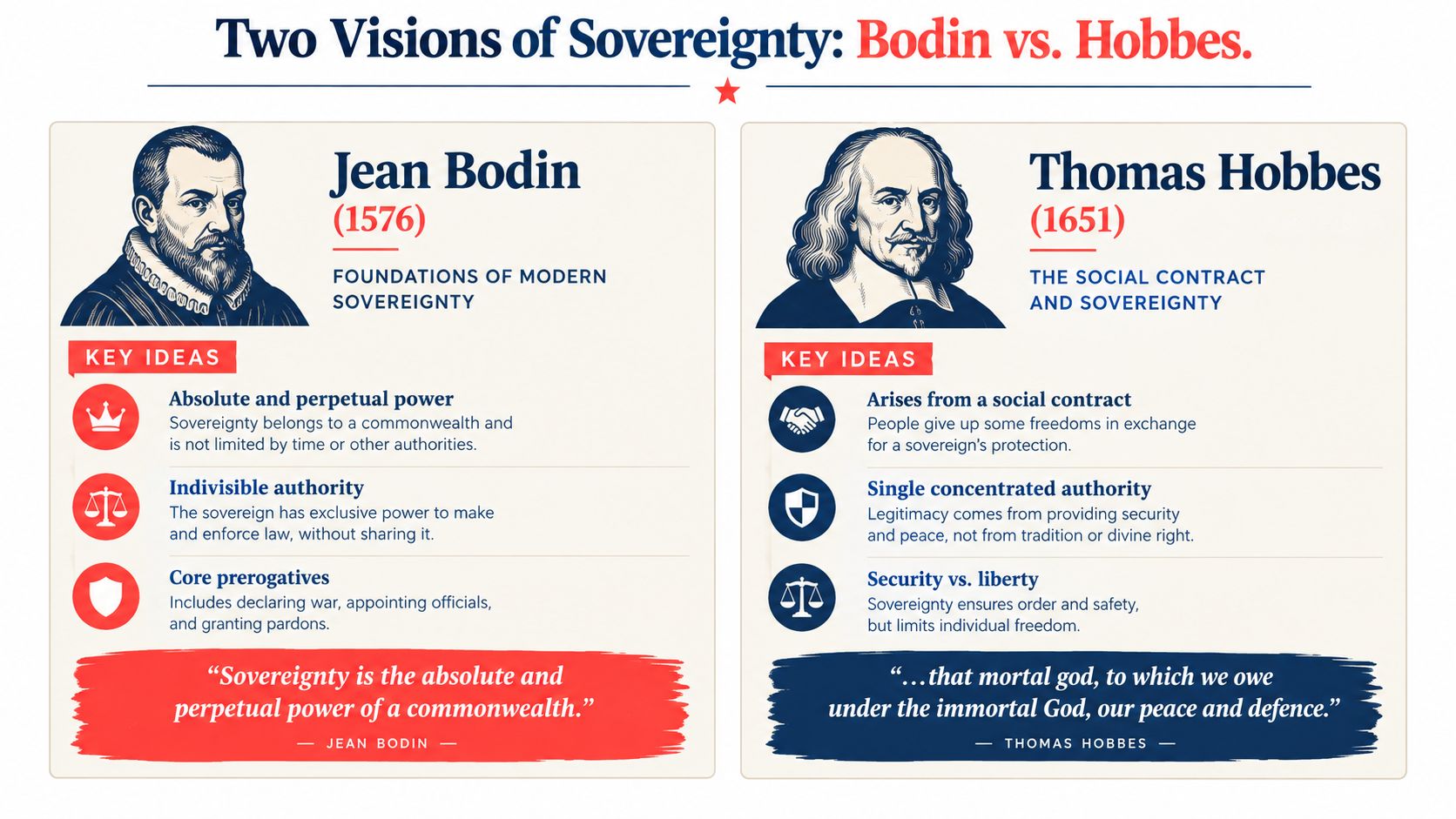
1. Jean Bodin, Six Books of the Commonwealth, 1576
Jean Bodin treated sovereignty as the supreme and enduring power to make law within a territory. His concern was practical: a commonwealth needs a recognized final authority, or competing commands can produce instability and civil conflict.
That model works cleanly on paper. It becomes more complicated in the United States, where authority is layered across federal, state, county, and municipal institutions. A homeowner may answer to federal environmental rules, state property law, county assessment procedures, and city zoning requirements at the same time.
Bodin's single-lawgiver model therefore creates a useful relocation question: which level of government controls the decision that matters most to you?
The place-choice test
If property rights are your priority, don't stop at a state reputation. Check the city or county's zoning code, building-permit process, subdivision rules, nuisance regulations, and restrictions affecting agricultural or residential use.
If tax freedom matters, separate state policy from local policy. A state may have an attractive income-tax position while a county, municipality, or special district adds recurring costs through property taxes, assessments, or service fees.
Practical rule: Identify the government that can actually deny, condition, tax, or regulate the action you care about. That authority, not the state slogan, determines your day-to-day sovereignty.
The United Nations Charter framework later formalized a different form of sovereignty. Article 2(1) recognizes the “sovereign equality” of member states, while the Charter also ties independence to obligations such as peaceful dispute settlement and respect for territorial integrity. The United Nations grew from 51 founding members in 1945 to 193 member states today, but formal equality hasn't eliminated unequal political influence because the Security Council's five permanent members retain veto power.
That distinction helps with relocation research. Legal authority, political influence, and practical freedom are separate dimensions. ReloMaps city pages can help you inspect the local layer, but no city exists outside the larger legal systems that govern it.

2. Thomas Hobbes, Leviathan, 1651
Thomas Hobbes begins with fear of disorder. In his account, people accept a sovereign because peace and protection are impossible without an authority capable of enforcing rules.
The relocation version of that argument is straightforward: how much autonomy are you willing to exchange for security and predictable enforcement? A place with more public regulation may restrict some personal choices while providing clearer standards for roads, emergency response, building safety, or public order. A place with lighter regulation may offer flexibility but leave households carrying more responsibility for risk management.
Hobbes doesn't tell a buyer which trade-off is correct. He provides a checklist.
Security is part of sovereignty
A household that values personal autonomy may focus on firearms, privacy, land use, and homeschooling. That same household still needs to evaluate crime and safety conditions, emergency access, disaster exposure, and the reliability of basic services.
A city profile should therefore be read across categories rather than through one freedom label. ReloMaps combines indicators on crime and safety, quality of life, strategic location, hazards, and personal sovereignty, allowing a buyer to compare freedom preferences with the conditions that make those freedoms usable.
The COVID-19 pandemic made Hobbes's tension visible without resolving it. Emergency measures raised questions about how far public authorities should go to protect health and how much individual discretion residents should retain. The durable lesson is not that one side always wins. It is that emergency authority, ordinary regulation, and personal choice should be evaluated separately.
Ask what protection costs
When comparing cities, look for the rule that affects your household directly:
- Public safety: Does the local environment support the level of risk you're prepared to accept?
- Regulatory flexibility: Can you build, work, operate a home business, or use land without excessive approvals?
- Emergency authority: Which state and local officials can impose temporary restrictions, and under what legal framework?
- Private responsibility: Would a less regulated location leave you paying more for insurance, security, maintenance, or emergency preparation?
Hobbes's sovereign protects by commanding. A relocation decision should test whether that command produces a service level your household values, not just whether the government appears large or small.
3. John Locke, Second Treatise of Government, 1689
John Locke reverses Bodin's starting point. Government doesn't create the underlying claims to life, liberty, and property. Legitimate government exists to protect them, and it loses authority when it violates the trust that gives it legitimacy.
That makes Locke especially useful for property research. Owning a home doesn't mean controlling every future use of the parcel. Zoning, eminent domain, environmental rules, road projects, building codes, and neighboring land-use decisions can all limit what ownership means in practice.
The Supreme Court's decision in Kelo v. City of New London became a major reference point in debates over eminent domain for economic development. The practical question for a buyer is narrower and more useful than the political argument: what can this jurisdiction take, restrict, or condition, and what compensation or review process applies?
Test the property-rights layer
Before buying land for a homestead, workshop, farm, or retreat, review:
- Eminent-domain statutes: Determine whether state law adds protections beyond the federal constitutional baseline.
- Local zoning: Check permitted uses, accessory structures, minimum lot rules, and home-business limits.
- Future public works: Look for planned roads, utilities, transmission corridors, or redevelopment areas.
- Enforcement history: Ask whether the local government actively enforces the rules that appear on paper.
Locke's principle also applies to household self-sufficiency. A buyer interested in food production should distinguish the right to own land from the legal permission to use it for livestock, wells, gardens, farm stands, or home processing. The guide to best towns for homesteading can help narrow candidates, but local ordinances still require direct verification.
Property ownership gives you an asset. It doesn't automatically give you unrestricted authority over the asset.
ReloMaps can supply city and neighborhood context around home values, homeownership, costs, education, hazards, and personal-sovereignty indicators. Use those signals to build a shortlist, then read the applicable county and municipal rules before making an offer.
4. Jean-Jacques Rousseau, The Social Contract, 1762
Jean-Jacques Rousseau places sovereignty in the people collectively. His concept of the general will treats legitimate law as an expression of the community rather than the command of a monarch or an isolated officeholder.
That sounds empowering, but collective authority creates its own trade-off. A majority can participate directly in decisions that shape daily life, while minorities may still face rules they opposed. Popular control isn't identical to individual control.
New England town meetings offer a recognizable example of local participation. Residents may debate budgets, ordinances, and public priorities in a setting closer to direct democracy than a distant state capital. For some movers, that access is part of quality of life. For others, frequent local decision-making may feel intrusive or unpredictable.
Measure civic voice before moving
A town's formal structure tells only part of the story. Check whether residents can attend open budget meetings, propose ballot initiatives, speak during public hearings, or influence planning decisions before policies become difficult to reverse.
Look at the level where the decision is made. Statewide election results won't tell you whether a city council listens to neighborhood objections about development, whether school-board meetings are accessible, or whether a county publishes understandable budget documents.
A place can offer strong participation and still produce rules you dislike. Civic sovereignty means having a voice, not guaranteed agreement.
The broader history supports this distinction. In 1800, almost everyone lived under systems classified as closed autocracies, and no country qualified as a democracy under the Our World in Data classification. By 2025, about 1.6 billion people lived in electoral democracies and another 600 million lived in liberal democracies, according to Our World in Data's democracy analysis. The Economist Intelligence Unit separately reported that 45.3% of the world's population lived in a democracy of some kind, while 36.9% lived under authoritarian rule.
For relocation, the lesson is practical. Compare municipal participation, accountability, and service delivery, not only broad political identity. ReloMaps city pages can help you compare local context, while meeting calendars, agendas, and public-record procedures reveal how much influence residents have.

5. Thomas Jefferson and the Declaration of Independence, 1776
What should residents do when government stops reflecting their consent? The Declaration of Independence answers through two connected ideas: political authority rests on consent, and people may alter or replace a government that persistently violates its purpose.
For relocation, that becomes a test of responsiveness. Can residents influence a rule before officials adopt it? Can voters replace decision-makers through ordinary elections? Do public hearings affect the outcome, or do they merely record objections after the practical decision is settled?
Texas illustrates why state reputation is only a starting point. Municipalities, counties, school districts, and special-purpose authorities can apply different rules and costs. A comparison of a Texas suburb such as Plano should include cost of living, safety, quality of life, housing conditions, and the precise jurisdiction where a property sits.
Consent is local and concrete
Read the Declaration's grievances as an audit of authority, not only as historical prose. Its complaints address local institutions, courts, administration, and representation. Those same categories help a prospective resident test how a place operates today.
Ask four practical questions:
- Representation: Which elected body controls the rule affecting your household?
- Access: Can residents address that body before adoption?
- Exit: If the policy remains unacceptable, how difficult is it to move within the region?
- Transparency: Are budgets, zoning proposals, enforcement standards, and meeting records easy to find?
Political consent and market consent are different. Choosing a city does not mean voting for every policy it applies. A household may accept a local tax structure because it values schools, roads, parks, or emergency services. The trade-off becomes clearer when those costs and services are compared together.
Property rights, privacy, firearms, and civic participation add another layer to the decision. The best towns for gun owners can help identify candidates, but firearm rules should be checked alongside ownership restrictions, privacy protections, tax obligations, and local access to decision-makers. A strong result in one category does not erase an unfavorable rule in another. ReloMaps city pages can provide a starting point for comparing local conditions, after which residents should confirm the governing jurisdiction's current policies.
6. Thomas Paine, Common Sense, 1776
Thomas Paine argued that government is necessary because society needs organized protection and administration, but government should remain limited and accountable to the people who created it.
For a homeowner, Paine's argument is easiest to test through the tax bill. A government can keep one tax low while funding services through another. A state without an income tax may rely more heavily on sales taxes, property taxes, fees, severance taxes, or local assessments. The household experiences the combined burden, not the headline label.
California's Proposition 13, adopted in 1978, reflects skepticism about unchecked property-tax growth by capping property-tax rates. The policy also shows why a single tax limit doesn't answer every affordability question. Buyers still need to understand purchase-price assessments, local charges, service levels, insurance, utilities, and the cost of replacing public services privately.
Follow the money to the household
Use ReloMaps to compare cost of living, home values, rents, income context, homeownership, and local quality of life. Then build a separate tax worksheet for each finalist.
The Tax Foundation's 2025 comparison evaluates more than 40 measures covering state tax rates, collections, and burdens across all 50 states. Its analysis shows why sales tax and property tax matter. Among the 45 states and the District of Columbia with a statewide sales tax, Colorado had the lowest state-level rate at 2.9%, while California had the highest state rate at 7.25%, including a mandatory statewide local add-on. The comparison also measures property-tax collections as a share of personal income for 80% of its property-tax subindex, with capital-stock taxes making up the remaining 20%. See the Tax Foundation's 2025 state tax comparison for the methodology.
The cheapest tax rate isn't necessarily the cheapest place to live. Calculate the complete recurring cost of the household.
Paine's limited-government test works when it forces a clear service-and-cost comparison. It fails when a buyer treats one tax category as a complete measure of government extraction.
7. Louis Brandeis, Dissent in Olmstead v. United States, 1928
Louis Brandeis moved sovereignty inward. In his dissent in Olmstead v. United States, he framed privacy as a constitutional protection for personal life, not merely a rule about physical property or trespass.
That idea matters to movers because privacy is broader than whether police can enter a home. It includes data collection, consumer profiling, electronic surveillance, facial-recognition systems, license-plate readers, public-record exposure, and the ability to live without unnecessary government observation.
A state may offer strong property rights but weaker consumer privacy protections. Another may protect personal data more aggressively while imposing more rules on businesses, landlords, or public agencies. The relevant question isn't which state is universally private. It is private from whom, through which mechanism, and with what remedy?
Check the surveillance and data layer
A privacy-focused relocation review should examine:
- Consumer privacy law: Does state law give residents rights to access, delete, correct, or limit the use of personal data?
- Police technology: Does the city or county use automated license-plate readers, facial recognition, drones, or other surveillance tools?
- Public records: Which home, business, vehicle, or ownership details can others obtain?
- Remedies: Can residents challenge misuse, or must they rely on internal agency procedures?
ReloMaps can help you compare the broader location context, including personal-sovereignty indicators and civic conditions. It won't replace a review of a city's surveillance contracts or a state's statutory text, but it can prevent privacy from disappearing beneath housing and tax comparisons.
The practical risk is assuming that “personal sovereignty” means total independence. It doesn't. Modern authority remains constrained by constitutions, courts, statutes, and international obligations. The Stanford Encyclopedia of Philosophy's discussion of sovereignty emphasizes sovereignty as supreme authority within a territory while recognizing that legitimate authority can derive from constitutional, natural-law, hereditary, or international sources.

8. Ronald Reagan, First Inaugural Address, 1981
Ronald Reagan's first inaugural address made limited government a concise political argument. Government, in this view, often creates problems when it expands beyond the functions citizens need it to perform.
The relocation test is federalism in practice. Who funds and controls schools, roads, housing rules, public safety, health regulation, and land use? Which level of government can adapt services to local preferences, and which level provides a consistent baseline across jurisdictions?
A small-government preference can support lower taxes and fewer regulations. It can also mean more variation in school quality, infrastructure, emergency response, public transportation, or code enforcement. Devolution gives communities room to choose, but it makes comparison more important.
Compare the service model, not just the slogan
A buyer should compare how candidate places handle the same essential service. Review school funding and performance, road maintenance, utility reliability, emergency access, and local permitting. Ask whether the household would need to purchase private substitutes for services supplied publicly elsewhere.
Tax differences became more visible after the 2017 Tax Cuts and Jobs Act capped the federal state and local tax deduction at $10,000. That cap can affect the effective housing cost of high-property-tax markets, depending on a household's tax position. It shouldn't be treated as a universal result, but it belongs in the comparison for buyers considering expensive homes or high-tax jurisdictions.
Use ReloMaps to filter by affordability, income, home values, rents, commute times, work-from-home rates, education, and quality of life, then layer in sovereignty indicators. The collection of affordable small towns for conservatives can support an initial search, but every candidate still requires a local service and tax review.
Reagan's argument works when it makes the cost of government visible. It doesn't work when “less government” is treated as a guarantee of lower total household costs or better public outcomes.
Sovereignty Quotes: 8-Source Comparison
| Item | Core idea | Implementation complexity | Resource requirements | Expected outcomes | Ideal use cases |
|---|---|---|---|---|---|
| Jean Bodin, Six Books of the Commonwealth (1576) | Sovereignty as absolute, perpetual, and indivisible | Structurally simple (single final authority) but politically difficult to centralize | Strong enforcement apparatus and centralized bureaucracy | Clear legal hierarchy and stability; risk of authoritarian rule and limited checks | State formation, crisis consolidation, contexts prioritizing order |
| Thomas Hobbes, Leviathan (1651) | Social contract yields concentrated sovereign to secure peace | Moderate, requires legitimizing concentrated authority and social acquiescence | Significant security institutions and administrative capacity | Order and predictable enforcement; potential suppression of dissent and civil liberties | Post-conflict stabilization, emergency governance, high-crime environments |
| John Locke, Second Treatise (1689) | Government limited by natural rights; consent and right to replace rulers | High, needs institutional checks, rule of law, and accountable mechanisms | Independent judiciary, legislative checks, property-regulatory frameworks | Protection of life, liberty, and property; avenues for redress; investment stability | Liberal democracies, property-rights regimes, places seeking investor confidence |
| Jean-Jacques Rousseau, The Social Contract (1762) | Sovereignty resides in the people; law expresses the general will | High, direct participation is complex to scale in large polities | Civic institutions, participatory mechanisms, broad civic education | Strong civic engagement and common-good policies; risk to minority protections | Small communities, town meetings, participatory governance experiments |
| Declaration of Independence (1776) | Sovereignty transferred to the people; legitimacy via consent and natural rights | Moderate, foundational principle guiding constitution-building and legitimacy claims | Constitutional frameworks, electoral systems, institutions to operationalize consent | Popular legitimacy, cultural emphasis on rights; tension where application is unequal | Independence movements, constitutional founding, legitimacy-building efforts |
| Thomas Paine, Common Sense (1776) | Government is a necessary but limited institution accountable to the people | Moderate, requires electoral accountability, transparency, and limits on power | Robust electoral processes, transparency measures, decentralized administration | Limited government, fiscal restraint, active public scrutiny; possible underinvestment in public goods | Tax-limitation movements, limited-government reforms, contexts valuing small government |
| Louis Brandeis, dissent in Olmstead v. United States (1928) | Personal sovereignty as privacy right limiting state intrusion | Moderate, developed through jurisprudence and statutory law over time | Strong judiciary, privacy statutes, regulatory oversight of surveillance tech | Enhanced privacy protections and legal remedies against unwarranted intrusion | Technology-rich jurisdictions, privacy-focused policy design, civil liberties advocacy |
| Ronald Reagan, First Inaugural Address (1981) | Government often hinders rather than helps; favor devolution and deregulation | Moderate, policy shifts via legislation, deregulation, and devolution to subnational governments | Private-sector capacity, state/local administrative resources, fiscal adjustments | Reduced federal role, varied service delivery across jurisdictions; possible public-good gaps | Deregulation campaigns, fiscal-conservatism policies, federalism emphasizing local control |
Turning Eight Quotes Into a Relocation Shortlist
The eight quotes describe different holders of authority. Bodin asks who has the final legal command. Hobbes asks what protection justifies obedience. Locke asks whether government protects preexisting rights. Rousseau and Jefferson focus on collective consent. Paine emphasizes limited administration and fiscal accountability. Brandeis protects a private sphere, while Reagan tests the boundary between government and individual responsibility.
Turn those ideas into a shortlist by ranking your household's actual priorities. Don't start with the place that best matches your political identity. Start with the policy failure you can least tolerate.
A practical ranking might include:
- Tax burden: Compare income, sales, property, fees, assessments, insurance, and the services those costs fund.
- Property rights: Verify eminent-domain rules, zoning, building permits, agricultural uses, and future infrastructure plans.
- Privacy: Review state consumer protections, public-record exposure, and local surveillance practices.
- Firearms: Distinguish permit requirements, training and background-check rules, prohibited locations, concealed carry, and open carry.
- Food independence: Check whether raw milk is available through retail sale, direct farm sale, delivery, herd share, or another lawful channel.
- Civic participation: Confirm how residents influence budgets, zoning, school policy, and local ordinances.
- Safety and hazards: Compare crime, emergency access, wildfire, flood, tornado, hurricane, and other location risks.
- Daily practicality: Include commute distance, work-from-home conditions, schools, healthcare access, airports, and proximity to major cities.
The Cato Institute's Freedom in the 50 States methodology offers a useful model for transparent comparison. It combines more than 230 state and local policy variables across economic, regulatory, and personal-freedom domains, uses an estimate of the “victim costs” of restrictions, and makes its underlying variables and sources publicly available. Its historical series extends to 2000 for many components. The lesson for any sovereignty score is methodological: preserve the raw indicator, identify its date and direction, document the weighting, and show category-level results instead of hiding everything inside one label. See the Freedom in the 50 States methodology for that approach.
Personal sovereignty also has a demand signal. Penn State's Mood of the Nation Poll, fielded May 11–19, 2022, found that more than half of Americans believed they had lost ground on individual self-determination during the previous decade, while roughly two-thirds expected to lose more over the following ten years. Only about one in ten expected to gain more liberties, and roughly one in five expected no change. The Penn State liberty and freedom survey supports treating autonomy as a concrete relocation concern, not just inspirational language.
Food and firearm examples show why labels need detail. Federal law requires milk sold in interstate commerce to be pasteurized, while states regulate intrastate raw-milk sales. In the 2025 update, 18 states banned raw-milk sales outright and 32 allowed sales subject to conditions, according to the National Agricultural Law Center's raw-milk update. A separate public-health survey identifies five common regulatory models, including retail sales, direct-to-consumer sales, herd shares, pet-consumption labeling, and prohibition for human consumption. It reports that seven states and Washington, D.C. explicitly prohibit sales for human consumption. Those classifications differ because legal channels matter.
Firearm comparisons require the same care. Every U.S. state and the District of Columbia authorizes concealed carry in some form, but 21 states generally require a state-issued permit. The other 29 states generally allow concealed carry in most public spaces without a permit, background check, or safety training, subject to eligibility rules and location restrictions. The Giffords concealed-carry analysis also notes that 23 states prohibited firearms to some degree in state capitols, statehouses, or state offices as of its cited 2025 analysis.
Use ReloMaps to make the first comparison efficient. Its Grid and Map interfaces let you filter U.S. cities and towns by ReloScore and category grades. City pages combine context on affordability, affluence, crime and safety, population, quality of life, strategic location, home values, rents, education, commute, hazards, and personal-sovereignty indicators. You can also paste a Zillow or Redfin listing URL to retrieve neighborhood and city context around a specific property.
The result shouldn't be a universal ranking of “free” places. It should be a defensible shortlist where each trade-off is visible and tied to the household making the move.
Frequently Asked Questions
How does the SALT cap change the math in a high-property-tax market?
The SALT cap limits the federal deduction for state and local taxes to $10,000, so buyers in high-property-tax markets should compare after-tax housing costs rather than relying on the advertised mortgage payment. The effect depends on filing status, income, itemization, and other deductions, so calculate the federal treatment separately from the local tax bill and compare the result with a lower-tax candidate offering different services.
Which eminent-domain rules should I verify before buying land?
Verify whether the state restricts eminent domain for economic development, how it defines public use, and whether local redevelopment authorities receive special powers. Also check the county's plan, planned transportation corridors, utility easements, and condemnation procedures, because a strong state statute will not eliminate every acquisition risk associated with roads, utilities, or genuine public projects.
How can I check whether a town makes budget decisions in open meetings?
Check the town's meeting calendar, agenda archive, public-notice procedure, budget documents, and rules for public comment before relocating. A useful threshold is whether the municipality publishes the proposed budget and supporting materials early enough for residents to review them before the hearing, rather than posting only a final vote notice or a summary after the decision.
Does a no-income-tax state automatically offer the most tax freedom?
No, a no-income-tax state can shift the burden to sales taxes, property taxes, fees, assessments, or taxes on business activity. Compare the full recurring household burden, including local taxes and the private cost of services the public system doesn't provide, instead of treating one missing tax as a complete fiscal score.
What should raw-milk buyers verify beyond state legality?
Verify the permitted sales channel, producer eligibility, labeling, testing, delivery rules, donation restrictions, and whether the product can be sold through a grocery store or only from a farm. Utah's 2025 amendment illustrates the detail involved because it established contamination thresholds that can trigger testing for E. coli, listeria, salmonella, and campylobacter, effective May 7, 2025, as described in the public-health survey of raw-milk regulation.
What should I compare if firearm freedom is a deciding factor?
Compare permit requirements, training, background checks, prohibited locations, magazine or weapon restrictions, and the separate treatment of concealed and open carry. Don't assume a permitless-carry rule applies inside government buildings, schools, transit facilities, private businesses, or public events, because location-specific restrictions can change the practical result.
Can personal sovereignty mean complete independence from government?
No, personal sovereignty is usually a normative or metaphorical description of autonomy, while legal sovereignty concerns an institution's recognized authority to make and enforce law. A household can seek greater privacy, property control, fiscal flexibility, or self-sufficiency, but no city can remove the federal, state, county, and local rules that govern ownership and residence.
How should a remote worker test a city beyond its work-from-home rate?
A remote worker should test internet availability at the actual address, backup connectivity, commute requirements for occasional office visits, airport access, power reliability, and the tax treatment of working across state lines. ReloMaps can narrow candidates using commute, work-from-home, strategic-location, affordability, and hazard indicators, but the final check belongs at the property and employer level.
UK emigration tax and residency tips can provide a separate perspective on how residency and tax rules complicate moves across borders. For a U.S. relocation, the same principle applies domestically: sovereignty is never just a quote. It is the combined effect of the institutions, policies, costs, and risks that govern the place where your household lives.
ReloMaps helps you turn these sovereignty ideas into a practical U.S. relocation shortlist with city-level context, transparent ReloScore grades, tax and property-rights indicators, firearm and raw-milk policy signals, safety data, hazard exposure, and neighborhood insight from Zillow or Redfin listings. Visit ReloMaps to compare candidate cities against the freedoms, costs, and civic trade-offs your household values.
Enjoying the blog? Subscribe to ReloMaps+ for premium area intelligence — and to keep us independent.
Subscribe today