How Much Money to Save Before Moving Out of State Guide
Most households should plan to save $4,000 to $10,000 minimum plus 3 to 6 months of living expenses before moving out of state. The exact number depends on three things: the move itself, your upfront housing cash, and whether your income is secured when you arrive.
If you're staring at lease dates, scrolling apartments in another state, and trying to decide whether your savings are enough, stop looking for one magic number. A cheap move with a signed job offer is one target. A speculative move into an expensive rental market is a completely different risk profile. The right way to answer how much money to save before moving out of state is to build your number in layers, then adjust it for the city you're moving to.
Table of Contents
- How Much You Really Need to Move Out of State
- Building Your Three Layer Moving Budget
- Adjusting Your Target for Cost of Living Taxes and Hidden Fees
- Creating a Realistic Savings Timeline That Actually Works
- Smart Ways to Cut Costs and Avoid Budget Surprises
- Frequently Asked Questions
- How much extra cash should I keep for rent overlap when moving out of state
- Is $5,000 enough to move out of state
- How does a signed job offer change the savings target
- What upfront housing charges catch people off guard
- Should I move for lower taxes alone
- What re-establishment costs should I expect after I arrive
How Much You Really Need to Move Out of State
Generic advice fails because it treats every interstate move like the same transaction. It isn't. A move from a small apartment into a low-cost city with employer-backed income can be tight but manageable. A move into a high-cost market with deposits, utility setup, and a few weeks of income gap can drain your account fast.
The first hard reality is that the move itself already takes real cash. The American Moving and Storage Association benchmark puts an interstate move at about $4,300 to $4,890 for a standard household shipment traveling roughly 1,000 miles or more, while moving within the same city averages about $2,300 according to this relocation cost benchmark. That benchmark matters because it's a floor, not a full safety target.
Why one number is the wrong question
The better question is, "How much cash do I need to get through the move, the landing, and the first stretch of instability?"
Your target should cover three separate cash layers:
- The move itself. Truck, movers, travel, packing, and route expenses.
- The landing period. Deposits, first month's rent, utility setup, groceries, and any overlap between old and new housing.
- Your reserve. Cash you don't touch unless the job starts late, a deposit runs higher than expected, or your car decides to fail in a new state.
If you're moving somewhere expensive, the destination can matter more than the mileage. Before you commit to a market like California, look at local rent pressure and household costs, not just the moving quote.
Most people under-save because they budget for the truck and forget the keys, deposits, and first month of living on the other side.
My direct recommendation
Use this rule. If your job is locked in and your move is modest, aim for the lower end of the $4,000 to $10,000 moving range plus a shorter reserve. If your employment is uncertain, your destination is expensive, or you expect any rent overlap, push well above the minimum and treat your reserve as essential.
Building Your Three Layer Moving Budget
Set your target in three cash layers, then pressure-test it against your destination. A renter heading to a cheaper city can move with one number. A renter heading to a tighter market with rent overlap needs a very different number. That is why a flat savings rule fails.
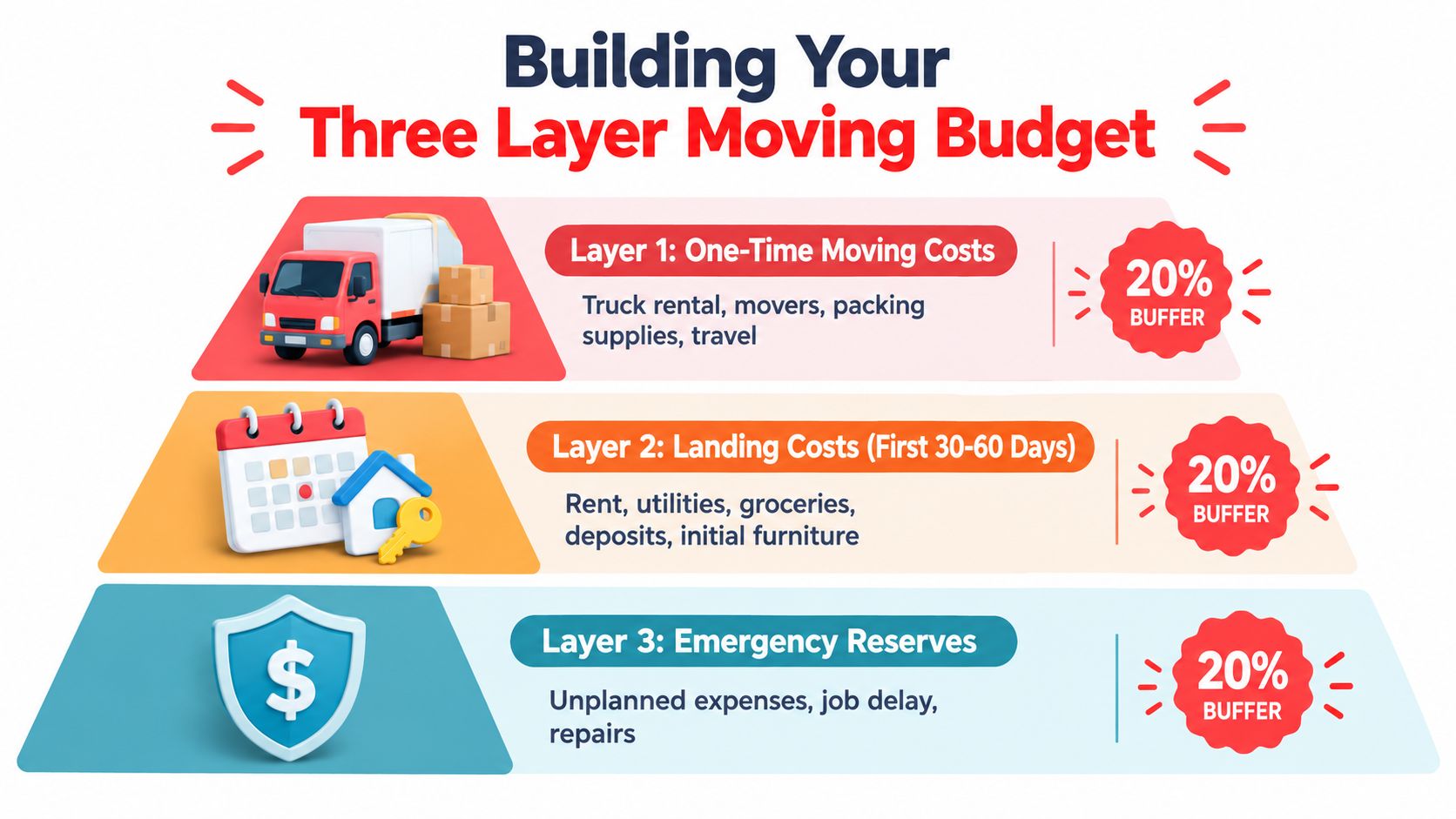
Start with the move. Add the landing costs. Then fund a reserve. Price each layer separately and add a 20% buffer to each category, as recommended in this relocation budgeting guide.
Layer 1 one-time moving costs
Layer 1 covers the physical move from one state to another. Use real quotes, not rough guesses from memory.
Industry moving estimates compiled by Forbes put local moves in the low thousands and long-distance moves much higher, with cross-country totals often climbing into several thousand dollars depending on distance, shipment size, and service level, according to Forbes Home's moving cost guide. For planning purposes, that means your truck or mover quote is only the starting point.
Build Layer 1 from these line items:
- Mover or truck cost: Get written estimates with inventory, mileage, and insurance spelled out.
- Travel cash: Budget for gas or airfare, hotels, meals, tolls, parking, and pet transport.
- Packing and loading: Boxes, tape, blankets, dollies, mattress covers, and paid labor if you need help.
- Delivery risk: Hold back cash for storage, delayed arrival, or last-minute schedule changes.
If your quotes vary a lot, use the second-highest one for your budget. The cheapest quote is often the least realistic.
Layer 2 landing costs for the first 30 to 60 days
Layer 2 is where under-saving usually happens. You arrive, then the cash demands stack up fast.
Independent renter guidance notes that the move itself can range from about $1,200 to $12,000+, while move-in costs alone can stack to roughly $3,500 to $6,000 on a mid-priced unit when you add first month's rent, security deposit, fees, and utility setup, as outlined in this renter-focused breakdown.
Use a simple landing worksheet:
| Cost bucket | What to include |
|---|---|
| Housing upfront | First month's rent, security deposit, application or admin fees |
| Setup costs | Electricity, internet, water, trash, utility deposits |
| Daily living | Groceries, transportation, basic household restock |
| Overlap risk | Old rent, storage, hotel nights, early utility shutoff timing |
This layer should reflect the city you are moving into, not a national average. A city-level tool like ReloMaps can help you estimate the cost-of-living delta before you set the number, especially if the new market has higher rents, utility deposits, or car costs than your current one.
My recommendation is simple. Fund Layer 1 and Layer 2 in full before you book anything.
Layer 3 emergency reserves
Layer 3 keeps a move from turning into credit card debt. It covers the job that starts two weeks late, the apartment that needs a larger deposit, the car registration bill you forgot, or the hotel nights you did not plan for.
One standard emergency-fund rule is 3 to 6 months of living expenses. A PNC example shows that if monthly living costs are $2,500, adding a $100-$300 cushion brings the monthly total to $2,800, and three months equals an $8,400 minimum emergency fund, according to this emergency savings example.
Use a shorter reserve only if your job start date is signed, your housing is secured, and you have no rent overlap. If even one of those is shaky, increase the reserve.
My blunt advice is this. If you cannot cover all three layers, delay the move, shrink the move, or pick a lower-cost destination. The reserve is part of the move budget, not a bonus.
Adjusting Your Target for Cost of Living Taxes and Hidden Fees
You can leave one city with what looks like a solid savings cushion and still land short a week after arrival. The miss usually comes from two places. Your new monthly burn is higher than expected, and your first 30 days include fees you never counted.

Compare the city, not just the state
Set your target using the city you are leaving, the city you are entering, and the gap between them. State averages are too blunt to be useful. Dallas and El Paso are not the same move. Albany and Manhattan are not the same move.
Use a city comparison tool before you lock your number. ReloMaps Explore for city-level cost, rent, commute, and tax comparisons helps you estimate the cost-of-living delta that should be added to your savings target, especially if the destination has higher rent, utility setup costs, parking, or car dependence.
Check the categories that change cash flow fastest:
- Housing: rent, security deposit, application fees, pet fees, parking, HOA move-in charges
- Transportation: gas, tolls, transit passes, parking, insurance changes, second-car pressure
- Utilities and groceries: setup deposits, seasonal power bills, internet install, higher food prices
- Healthcare and insurance: new deductibles, network changes, renter's insurance, auto premiums
Here is the rule I give clients. If your new city is clearly more expensive, increase your Layer 2 and Layer 3 targets before you book the move. Do not assume you'll "figure it out" after arrival.
Run the break-even test for tax moves
A lower-tax state does not automatically make your move financially smart. You need a payback period.
Use a simple formula. Add your total relocation cost, then divide it by your estimated annual savings from lower taxes or a lower cost of living. Earlier guidance on break-even analysis puts the income threshold for tax-motivated moves fairly high, often around the point where tax savings are large enough to overcome relocation friction. Below that level, the move may still be worth it for career, family, or quality of life reasons. It usually does not pencil out as a pure tax play.
Be honest about motive. If the move is really about a better job, being near family, or getting out of an expensive housing market, say that. Don't inflate small tax savings into a justification for a move that will take years to pay back.
Hidden fees that quietly change the answer
This is the part that drains checking accounts.
After you arrive, you may owe vehicle registration, a new driver's license, utility deposits, internet installation, mailbox setup, cleaning supplies, basic furniture, and restocking costs you postponed during the move. If your lease starts before your old one ends, overlap risk can add storage, hotel nights, duplicate rent, and extra commuting costs on top.
Recent renter guidance in this moving financial plan recommends a shorter reserve only with stable employment and a larger cushion when income is uncertain. That is the right way to treat hidden fees too. If your job start date, lease timing, or deposit amount is still unsettled, raise the target now.
My recommendation is blunt. Add a dedicated hidden-fee buffer to your number. A few hundred dollars is often too low. In a higher-cost city or a move with overlap risk, plan for four figures, not spare change.
Creating a Realistic Savings Timeline That Actually Works
You pick a move date six months out, assume you'll "save hard," and then three weeks before the truck arrives you're still short on deposit cash. That is how people end up financing a move on credit.
Your timeline has to match the three cash layers, your destination's cost-of-living jump, and your overlap risk. A move from Columbus to Indianapolis needs a different savings pace than a move from Phoenix to Seattle. Use city-level numbers from ReloMaps to set the target first. Then build a calendar that can hit it.
Set milestones, not one giant savings goal
A single big number is too abstract. Break it into deadlines.
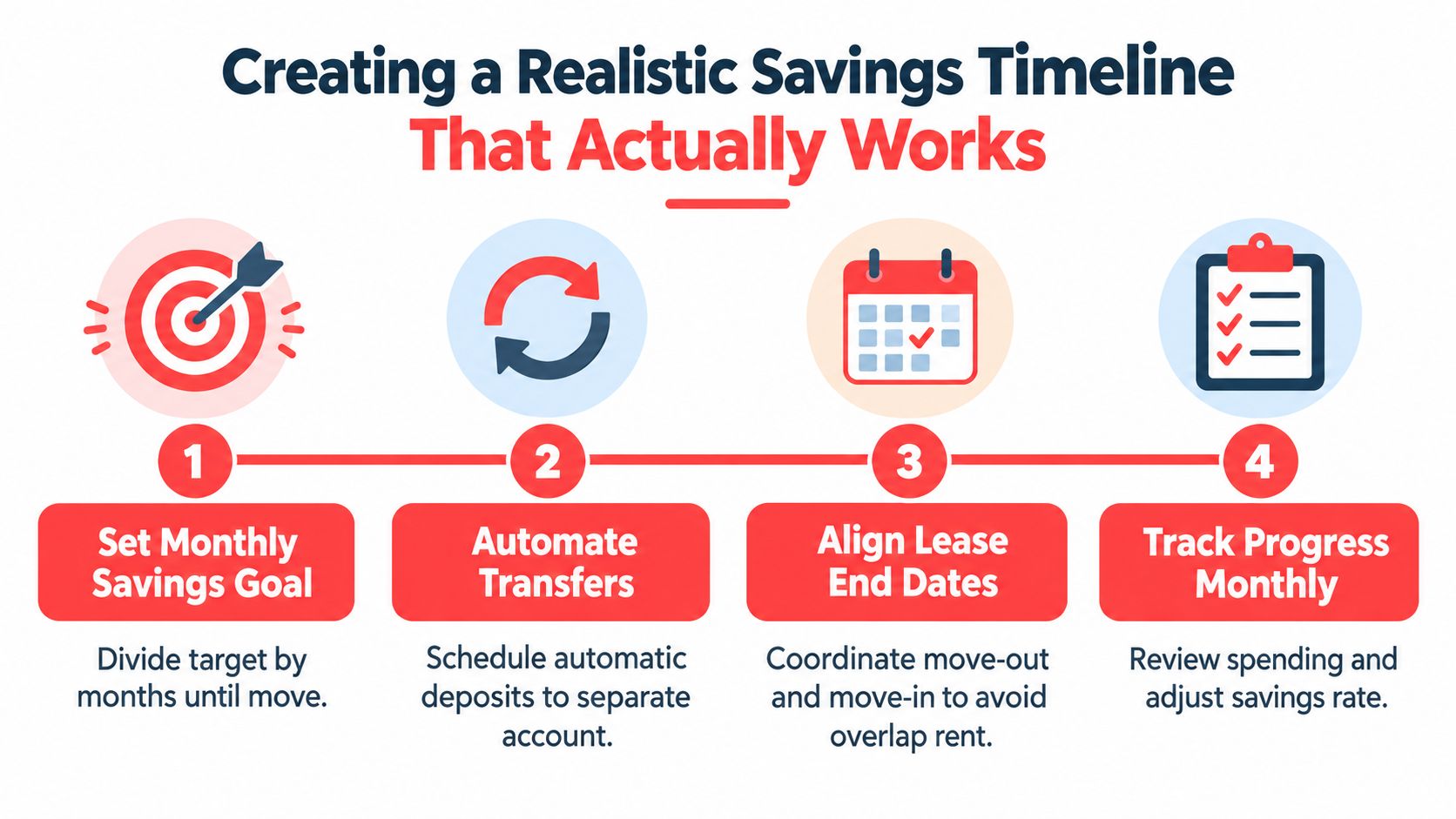
First, fund the housing layer by your lease-signing date. That is the money for deposits, first month, and any application or utility setup costs due before move-in. After that, fund the moving layer by the week your travel and transport need to be booked. Build the reserve layer last, but finish it before you give notice or commit to a final moving date.
That order matters because housing cash decides whether the move happens at all. The truck does not matter if you cannot get the keys.
Independent moving guidance says renters should be ready for first month's rent plus a security deposit, and sometimes three months of rent upfront, according to this renter savings advice. Treat that amount as an early checkpoint, not your full target.
Match the timeline to your income, not your optimism
Here is the standard I give clients:
- 3 months out: You should already know your target number, including your cost-of-living increase and any rent overlap.
- 2 months out: Your housing layer should be mostly funded.
- 1 month out: Your moving layer should be fully funded, with bookings made.
- Before departure: Your reserve layer should be intact and untouched.
If your current savings rate cannot hit those checkpoints, change the plan. Push the move date, cut the move scope, or pick a cheaper housing option. Do not keep the same date and hope discipline will appear later.
Use a savings pace that survives real life
Automate transfers into a separate moving account. Weekly works better than monthly for many movers because you can correct faster if you fall behind.
Add one stress test. If one paycheck disappears, can you still make the move without draining your reserve? If the answer is no, your timeline is too tight.
Income uncertainty changes the rule. If the job is not locked in, or your start date could slip, finish a larger reserve before you sign anything. A fast move with thin cash works only when income, lease terms, and timing are unusually stable.
Your real go or no-go date
You are ready when all three layers are funded on schedule and your first month in the new state does not depend on a credit card.
If you only have enough for the deposit and the truck, you do not have a moving plan yet. You have a deadline.
Smart Ways to Cut Costs and Avoid Budget Surprises
A lot of expensive moves look cheap at first. Then the second utility deposit shows up, the landlord wants the full security deposit instead of a partial hold, and you realize replacing a couch would have cost less than hauling it across three states.

The fastest way to cut moving costs is to protect the three cash layers you already built. Keep your housing cash for housing, your moving cash for transportation and setup, and your reserve for actual emergencies. People get into trouble when they blur those lines and use reserve money to cover a nicer truck, a bigger apartment, or furniture they could buy later.
Cut the costs that actually matter
Start with the big-ticket decisions.
- Move less stuff: If an item is bulky, cheap, and easy to replace, sell it or leave it. This is especially true for particle-board furniture, older mattresses, low-end desks, and anything that costs a lot to move but adds little value.
- Price all three move types: Get quotes for full-service movers, moving containers, and truck rental plus labor. One option is often clearly cheaper once fuel, mileage, stairs, and loading help are added.
- Ask landlords blunt questions before you apply: Find out the exact deposit, admin fees, pet fees, utility setup requirements, parking charges, and earliest move-in date. Do this before you pay application fees.
- Reduce overlap risk: If you can time your exit and move-in without paying for two places, do it. A short overlap can cost more than the truck.
- Wait on setup purchases: Curtains, shelving, bar stools, and decor can wait. Cash is more useful than a fully finished apartment in week one.
One source that outlines a typical out-of-state moving budget also recommends adding extra room for surprise costs in this out-of-state moving budget guide. That's the right approach. Surprise costs are standard moving costs that have not shown up yet.
Use city data before you commit to the wrong bill
Generic advice fails here. Your savings target should change based on the city pair, your rent jump, and the chance of overlap. A move from Tulsa to Kansas City is a different financial problem than a move from Phoenix to Seattle.
Use local market research before you sign anything. The ReloMaps blog with relocation planning and city comparison examples can help you pressure-test neighborhoods, commute trade-offs, and listing context before you send deposits.
Set a few hard rules and follow them:
- Reject listings that push your monthly fixed costs too high. A lower move-in special does not fix an unaffordable rent payment.
- Price the commute, not the map estimate. Gas, tolls, parking, and extra childcare time can erase the savings from a cheaper neighborhood.
- Treat neighborhood fit as a money decision. If the area feels wrong and you move again in six months, the cheap lease was expensive.
- Verify fee-heavy buildings carefully. A building with valet trash, package fees, amenity charges, and required parking can blow up your monthly budget fast.
Good movers do not win by clipping coupons. They win by choosing the right city block, the right lease terms, and the right amount of stuff to bring.
Frequently Asked Questions
How much extra cash should I keep for rent overlap when moving out of state
Keep enough cash to survive a 30 to 60 day overlap if there's any chance you'll pay for two places at once. That's the hidden cost most one-number moving guides miss, and it's why move-in costs can feel much bigger than the transportation bill alone when deposits, fees, and utility setup stack up.
Is $5,000 enough to move out of state
Yes, sometimes, but only for a lower-risk move with controlled housing costs and secured income. A practical benchmark for many out-of-state moves is $4,000 to $10,000 minimum, and that still doesn't replace the need for a separate reserve if your paycheck timing, job start date, or lease terms aren't locked down.
How does a signed job offer change the savings target
It lowers the reserve target from a worst-case plan to a controlled plan. Recent moving guidance puts the minimum closer to 3 months of expenses with a signed job offer, while 6 months or more is the safer threshold when employment is uncertain, especially if you're moving into a market with higher deposits or slower hiring.
What upfront housing charges catch people off guard
Utility deposits, application fees, and multi-month rent demands are the usual traps. Some renter guidance warns that households may need first month's rent plus a security deposit, and sometimes three months of rent upfront, which means the lease signing cash can exceed what many people set aside for the move itself.
Should I move for lower taxes alone
Usually not unless your income is high enough for the tax savings to outweigh the friction. One break-even benchmark says tax-motivated relocations often need roughly $200,000+ household income before the savings materially offset the cost and hassle of moving, so most households should treat lower taxes as one factor, not the whole case.
What re-establishment costs should I expect after I arrive
Plan for administrative and setup costs immediately after arrival. Vehicle registration, driver's license changes, utility deposits, household basics, and small replacement purchases can add hundreds more, which is why a move that looked funded on paper can still create cash stress in the first few weeks.
If you're serious about moving, don't rely on national averages alone. ReloMaps helps you compare U.S. cities and neighborhoods with the kind of local cost, tax, commute, and quality-of-life context that changes your savings target. Use it to pressure-test your destination before you sign a lease and find out too late that the move was underfunded.
Enjoying the blog? Subscribe to ReloMaps+ for premium area intelligence — and to keep us independent.
Subscribe today