Grand Lake California: A Neighborhood Profile
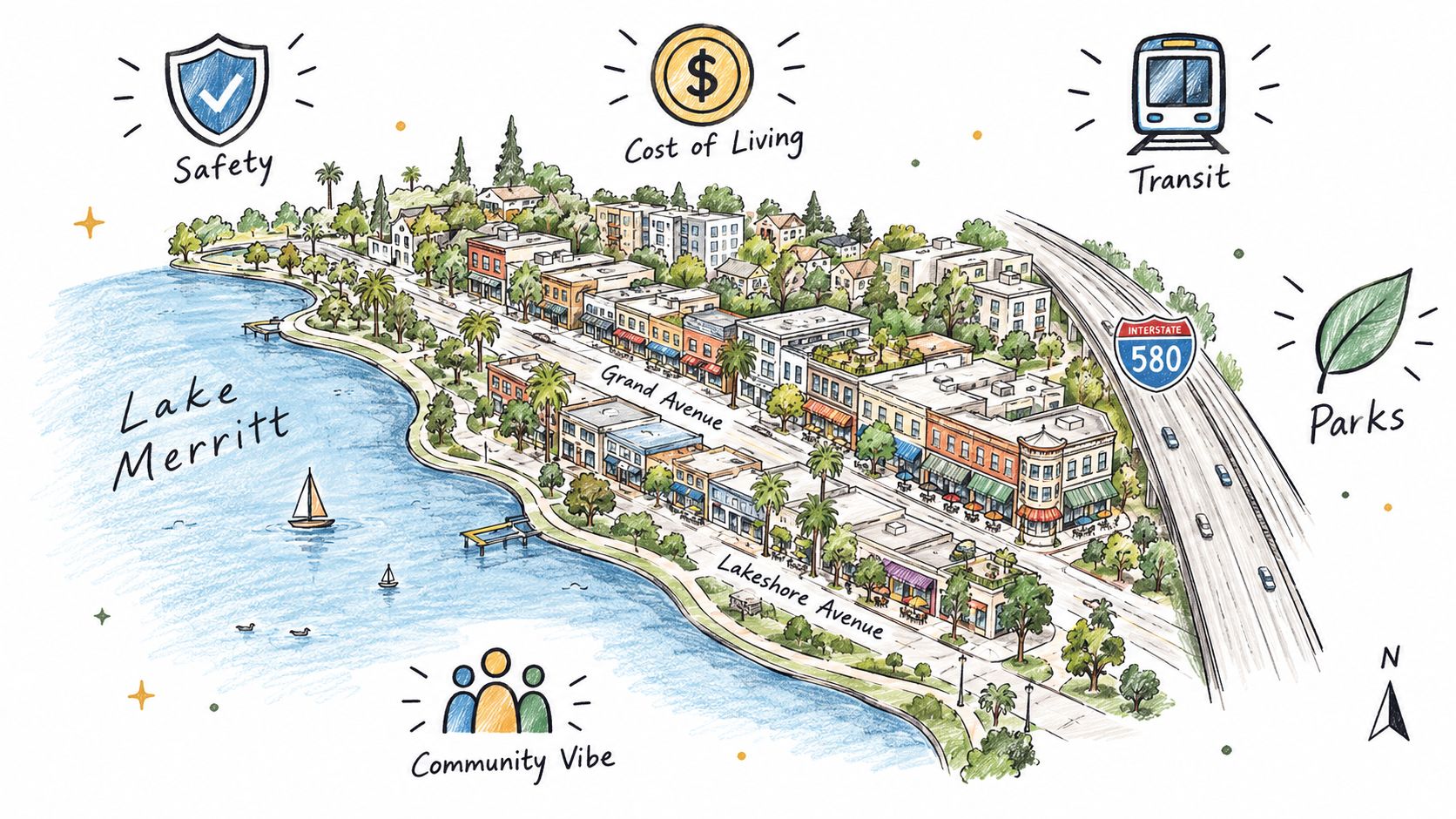
Grand Lake, California isn't an inland lake town, it's an Oakland neighborhood centered on the northeastern edge of Lake Merritt, where Grand Avenue, Lakeshore Avenue, and Interstate 580 shape daily life. That distinction matters because the place works more like an urban mobility node than a resort district, and the best relocation questions here are about transit, housing type, and exposure, not shoreline scenery.
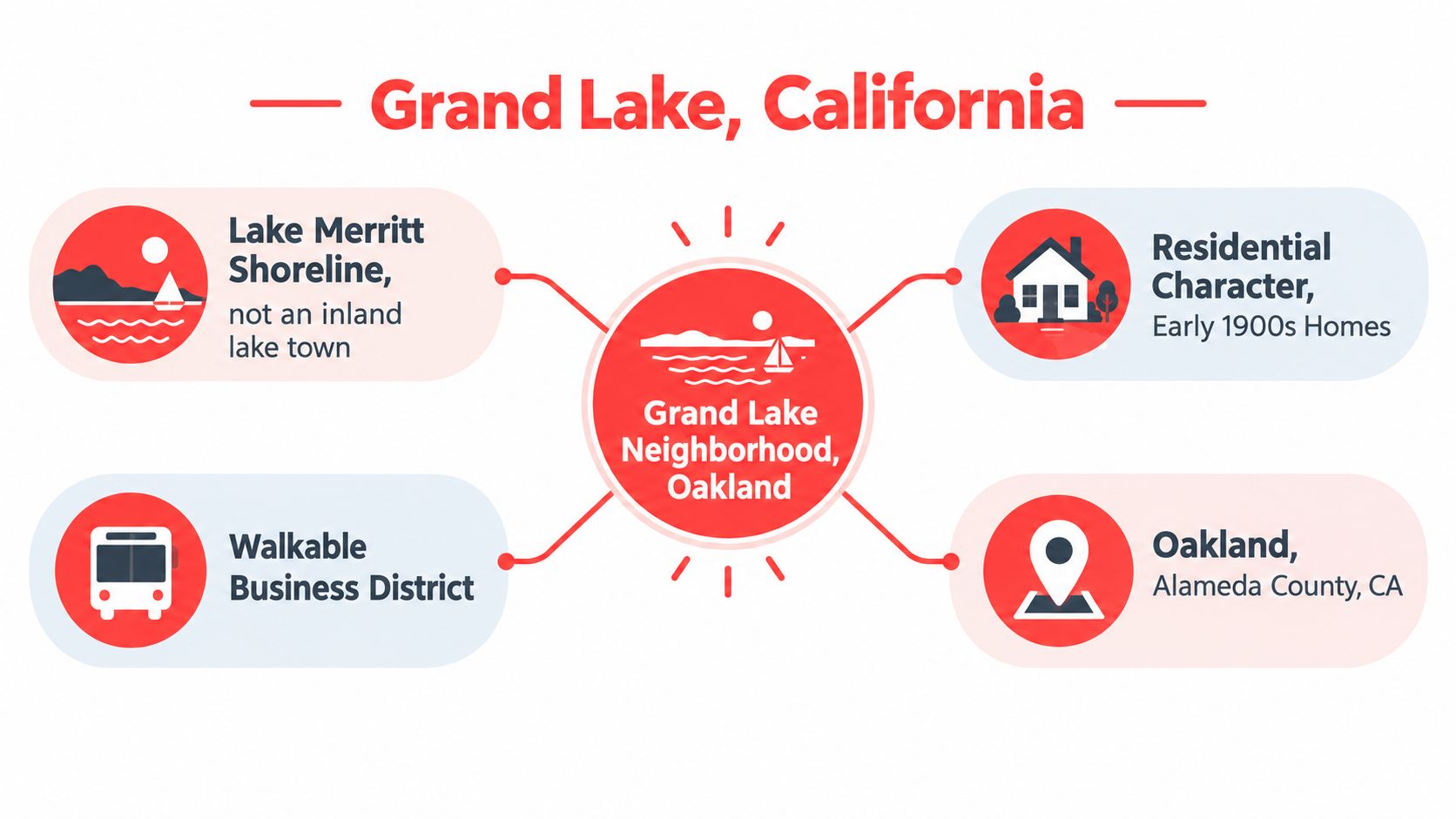
Table of Contents
- What Grand Lake California Means as a Place
- How Grand Lake Took Shape
- Demographics and Housing Composition
- Commute, Transit, and the I-580 Effect
- Climate, Elevation, and Disaster Exposure
- Cost of Living and Daily Amenities
- Is Grand Lake a Fit for Your Household
What Grand Lake California Means as a Place
Grand Lake, California is an Oakland neighborhood with a name that sounds more like a lake town than an urban district. It sits on the northeastern edge of Lake Merritt, where Grand Avenue, Lakeshore Avenue, and I-580 meet a compact street grid. That position matters because it places Grand Lake inside Oakland's core rather than outside it, which affects how residents weigh transit access, street noise, and housing choice. Oakland's Grand Lake neighborhood location
The map explains the trade-offs
Grand Lake functions like a corridor neighborhood wrapped around a lakeside edge. One side opens toward the water and public space around Lake Merritt, while the other side is shaped by traffic movement and the commercial streets that handle everyday errands. The result is a district that feels active and densely connected, even though the name can suggest a quieter retreat.
The geographic split also helps explain the practical differences between blocks. Addresses closer to the lake usually trade on access to open space and a more visible civic setting, while addresses nearer the freeway face a different mix of mobility access and noise exposure. For relocation analysis, that means the question is less about whether Grand Lake is scenic and more about which part of the neighborhood fits a household's tolerance for traffic, walkability, and daily convenience.
Oakland's broader history is part of that reading. The city incorporated in 1854, and later grew through railroad and urban transit investment that left a lasting mark on street pattern and land use. In Grand Lake, that legacy shows up in the way housing, commerce, and movement sit close together rather than being sorted into separate zones. Oakland and the Grand Lake Theater history
The neighborhood's identity also depends on its landmarks and public setting. Lake Merritt gives Grand Lake a clear civic anchor, while the surrounding commercial corridors keep the area busy enough to support errands on foot. For people deciding whether to live here, the more useful question is how much proximity to the lake and major roads they want, since both shape the rhythm of daily life.
Grand Lake on ReloMaps gives a useful Oakland-level view of that position and helps separate the neighborhood's image from its actual urban mechanics.
How Grand Lake Took Shape
Grand Lake formed through early 20th-century Oakland expansion, when streetcar lines tied the area to the city's growing residential and commercial districts. That origin still matters. Neighborhoods built around transit usually keep a denser, more mixed-use pattern than places that grew later around large lots and car access. Grand Lake still reflects that logic, with housing and local commerce woven together instead of separated into fixed zones.
Streetcars, public space, and a landmark that stayed visible
Two milestones help explain the neighborhood's public identity. Lake Merritt's “Necklace of Lights” was installed in 1925, with more than 3,000 decorative bulbs strung between 126 lampposts, and the Grand Lake Theater opened in 1926 as a durable marker of the district's entertainment history. Both are part of the same pattern. They show a place that developed around visible civic and commercial features, and those features still shape how people read the area today. Oakland's incorporation, the Necklace of Lights, and the Grand Lake Theater
The theater remains a strong clue about how the neighborhood functions. A district that keeps a historic entertainment anchor usually supports walkability, evening activity, and street-facing business rather than hiding daily life behind parking lots. Grand Lake is not quiet, and it is not low-density. It is organized around a corridor that feels like a destination, especially near Grand Avenue.
Streetcar-era growth also left a specific physical pattern behind. Smaller blocks, tighter street grids, and closer links between homes and retail are common in neighborhoods shaped that way, and Grand Lake still shows those traits near the theater and the lakefront edges.
The result is a neighborhood that behaves less like a generic residential enclave and more like an urban district with a clear public center. That history explains why people who want identity, foot traffic, and a strong sense of place often focus on Grand Lake. It also explains why the area continues to feel like somewhere people move through on purpose, with later freeway access layered on top of an older streetcar framework.
Demographics and Housing Composition
Grand Lake looks dense, renter-heavy, and highly educated when you read it as a relocation dataset rather than a lifestyle brand. One recent profile estimates roughly 4,850 residents, with 68.3% of occupied homes rented compared with 34.8% nationally, and an average household size of 1.73 versus 2.65 nationally. The same profile estimates that 68.9% of adults 25 and older hold at least a bachelor's degree, compared with 35.6% nationally. Grand Lake demographic estimates
What those numbers actually imply
Those figures point to a neighborhood built around small households, not large family compounds. An average household size of 1.73 usually means a mix of singles, couples, and roommates, and the rental share suggests that apartments, condos, and smaller multi-unit properties do most of the housing work here. For people comparing relocation options, that combination tends to favor flexibility over space.
The profile also reports 3.8% unemployment, versus 5.4% nationally, and an 11.4% housing vacancy rate versus 9.6% nationwide. Those numbers don't tell you what any one block feels like, but they do reinforce the picture of an urban neighborhood with a specialized housing market rather than a broad suburban one. The vacancy figure also hints that availability can exist even in a compact area, but it doesn't mean the right unit will fit every household type.
A useful relocation lens here is household composition. If you need multiple bedrooms, a yard, or long-term ownership space for a growing family, Grand Lake will often ask you to compromise. If you want a centrally located urban base with rental options and short internal trips, it makes more sense.
| Indicator | Grand Lake estimate |
|---|---|
| Residents | roughly 4,850 |
| Rented occupied homes | 68.3% |
| Average household size | 1.73 |
| Adults 25+ with at least a bachelor's degree | 68.9% |
| Unemployment | 3.8% |
| Housing vacancy | 11.4% |
Practical rule: A neighborhood with a high renter share and small average household size usually rewards households that value flexibility more than square footage.
The educational attainment figure is especially important for readers trying to infer neighborhood rhythm. High educational attainment often correlates with a strong professional base, but the more immediate relocation takeaway is simpler, this is a place that supports people living urban-first lives, especially if they don't need a lot of indoor space. That's a different housing logic than the one you'd use for family suburbs or ownership-heavy neighborhoods.
Commute, Transit, and the I-580 Effect
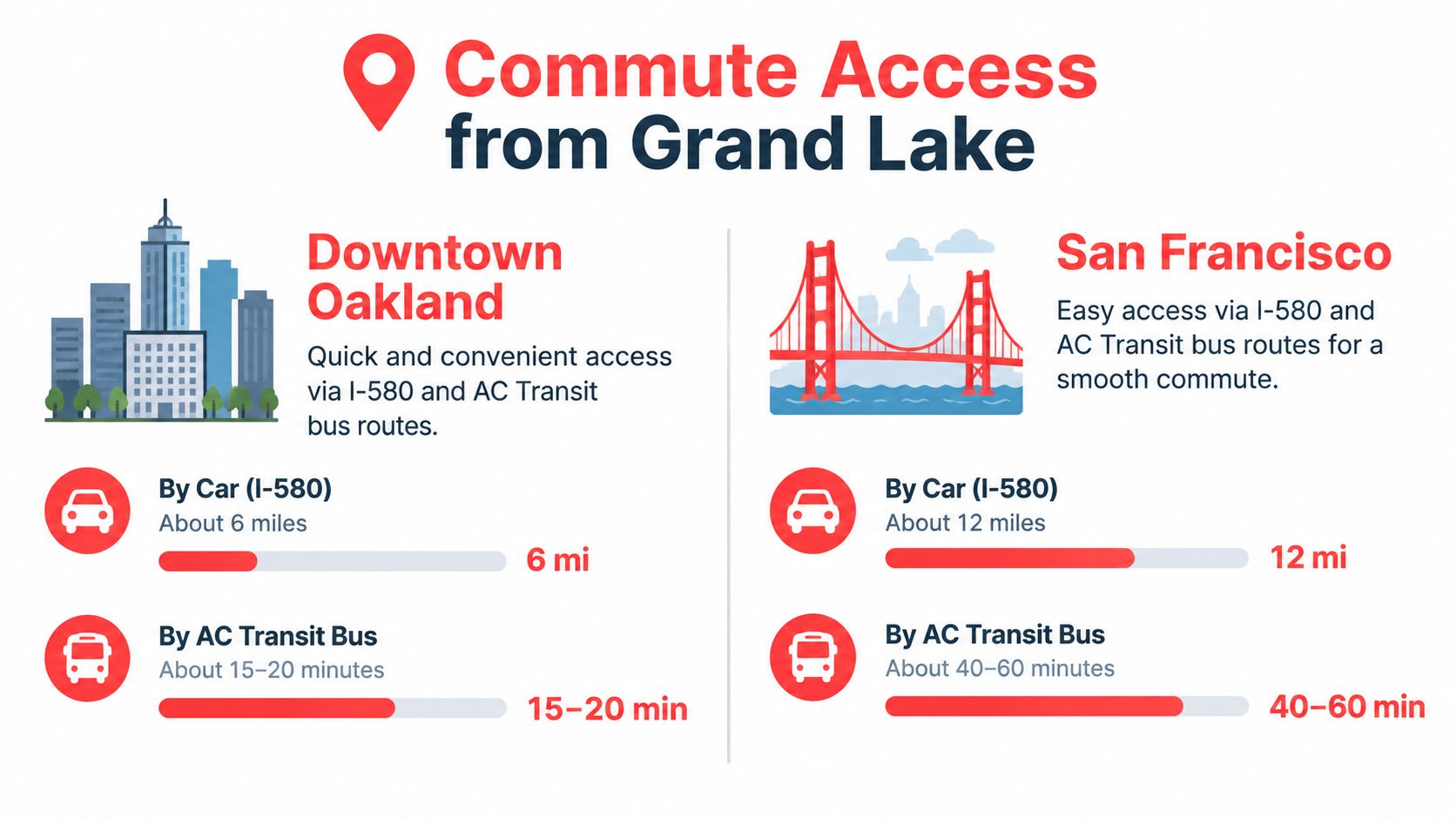
Grand Lake's transportation geometry is one of its biggest assets, and one of its biggest filters. Downtown Oakland is roughly 10 minutes away by car, San Francisco is about 12 miles away, and a BART trip from the nearby 19th Street station reaches San Francisco in approximately 30 minutes. Those are useful baseline figures, but they're not door-to-door guarantees because traffic, station access, transfers, and parking can change the actual outcome fast. Grand Lake commute access
Why proximity doesn't mean the same thing for every household
For hybrid workers, that geometry can be a real advantage. Grand Lake gives you a neighborhood setting with regional reach, which means you can live in a dense urban district without giving up access to downtown Oakland or the wider Bay Area. The nearby 19th Street station also makes the area more workable for commuters who want to reduce driving rather than organize their lives around it.
The I-580 presence is the trade-off built into the neighborhood. It gives fast regional connectivity, but it also creates a sharp boundary in noise, emissions, and pedestrian continuity between blocks that are otherwise close together. That means the best block for one household can be a poor fit for another, especially if freeway-adjacent sound or air quality is a concern.
Not every short commute is a good commute, if the path to the station, the freeway edge, or the parking search adds friction every day.
A closer look at the transportation pattern also shows why Grand Lake appeals to urban professionals rather than to people trying to avoid the city entirely. The neighborhood is close enough to downtown Oakland to support short local trips, close enough to San Francisco to make BART a realistic option, and structured enough around major roads that car access remains practical. That combination is useful if your week mixes office days, city meetings, and local errands.
A commute from this area isn't just about travel time, it's about whether your daily routine can absorb the neighborhood's traffic edges and still feel efficient. If your household is sensitive to noise, garage searching, or station access, the exact block matters a lot more than the neighborhood name.
A deeper city-level comparison on San Francisco, California helps frame Grand Lake as part of a broader East Bay-to-peninsula mobility pattern rather than an isolated pocket.
Climate, Elevation, and Disaster Exposure
Grand Lake's risk profile is shaped by location as much as weather. As noted earlier, the neighborhood sits at a relatively low elevation, roughly 49 to 52 feet above sea level, and its position near Lake Merritt means flood exposure, drainage, and seismic retrofit status deserve attention at the parcel level. Grand Lake elevation and exposure context
Why block-level screening matters here
The key distinction is between low-lying or lake-adjacent blocks and ground that rises farther away. Two homes in the same neighborhood can face different drainage patterns, different noise from I-580, and different maintenance expectations. For relocation decisions, the parcel matters more than the neighborhood label.
Wildfire risk is less direct than in hillside communities, but smoke and air-quality events still affect the Bay Area. Older urban housing can also raise seismic questions. Proximity to a fire station does not tell you whether a building is prepared, because roof condition, gutters, driveway access, and evacuation bottlenecks can matter more than a map pin.
Practical rule: In a low-lying urban neighborhood, ask about drainage, retrofit status, and block-level access before you ask about the neighborhood as a whole.
That approach helps avoid broad assumptions based on city names. Grand Lake combines lakeside adjacency, freeway influence, and dense urban form, so the key question is which addresses sit on the more exposed side of those trade-offs.
The same logic applies to seismic and smoke considerations. A well-located unit can still carry practical risk if the building has deferred maintenance or if the block sits in a more exposed pocket near the freeway or the lake. A relocation decision here works best when it is based on the parcel, the building, and the access routes, not just the neighborhood title.
Cost of Living and Daily Amenities
Grand Lake tends to behave like an urban amenity premium neighborhood. The combination of high educational attainment, a strong renter share, and small households suggests a market where people pay for location, convenience, and form factor rather than land. If you're budgeting for the area, the right comparison isn't just rent versus mortgage, it's whether the neighborhood's mix of walkable errands and transit access offsets the smaller interiors and tighter parking reality.
A practical way to judge the fit
Start with household size. A 1.73-person average household implies the local housing stock fits compact living better than family-scale sprawl, so your budget should reflect whether you're paying for one person's convenience, a couple's shared base, or roommates splitting space. Then compare that to your need for privacy, storage, and commuting flexibility.
The daily amenity inventory is strongest along Grand Avenue and Lakeshore Avenue, where the neighborhood's commercial life is most visible. That's where the district tends to over-deliver for people who want restaurants, coffee, and neighborhood-level errands within an easy walk. If you need room for larger shopping trips, school logistics, or a yard-centered routine, you may still leave the neighborhood for some of those needs.
One useful way to think about affordability is to compare the neighborhood against broader California options rather than only against nearby East Bay hotspots. A citywide affordability comparison like the cheapest cities in California on ReloMaps helps you see how much of Grand Lake's price proposition is about location, not just housing basics.
For households that need outside help with the practical side of moving, local property managers can also be useful when you're sorting unit quality, lease terms, and tenant expectations. A resource like Edinhart Realty and Property Management can be a helpful example of the kind of hands-on property context movers sometimes need when comparing rentals, even if the neighborhood itself demands a much more urban decision process.
Checklist: If you're evaluating Grand Lake seriously, compare storage, parking, walkability, and transit access before you compare square footage alone.
The neighborhood rewards people who use their surroundings often. If your day already depends on cafes, short errands, transit, and a compact living setup, Grand Lake can feel efficient. If your household budget is tighter and your needs are more space-heavy, the premium is easier to question.
Is Grand Lake a Fit for Your Household
Grand Lake fits best for small households, renters, hybrid workers, and urban-first buyers who want lakeside adjacency without giving up access to downtown Oakland and San Francisco. It's weaker for households that need more indoor space, a yard, or a block-by-block guarantee of quiet away from I-580. The neighborhood rewards people who value movement and convenience more than land.
Large families and freeway-sensitive households should look harder at the exact block, the building condition, and the commute path. A place can look ideal on a map and still miss the mark if noise, drainage, or parking friction becomes part of the daily routine.
If you want a relocation read that treats Grand Lake like a data puzzle, pull the Oakland context, compare the housing mix, and test the block against your commute, household size, and risk tolerance. ReloMaps is built for that kind of decision, with neighborhood context, hazard screening, and city-level comparisons that help you see what a place delivers. Visit ReloMaps to compare Grand Lake with other Oakland and Bay Area options before you move.
Enjoying the blog? Subscribe to ReloMaps+ for premium area intelligence — and to keep us independent.
Subscribe today