Cost of Living in Dayton Ohio: A 2026 Relocation Guide

Dayton's total cost of living runs roughly 3% below the U.S. average, driven by housing that is about 16% below the national benchmark, while utilities run roughly 9% above it. That split is the whole decision. If you capture the housing discount without adding a second car, a drafty older house, or a long commute, Dayton saves you real money. If you don't, the cheap listing becomes an expensive household.
I've reviewed enough Midwestern budgets to distrust any city ranking built on one index. Households don't buy an index. They pay a specific rent or mortgage, heat a specific building, drive a specific route, and lose a specific slice of each paycheck to local tax. Judge the cost of living in Dayton, Ohio that way and the picture gets sharper, less flattering in places, and much more useful.
Table of Contents
- What a Day in Dayton Actually Costs in 2026
- Dayton's Cost Picture Against Ohio and the U.S.
- Housing in Dayton and What Neighborhoods Reveal
- Where Cheap Housing Stops Being Cheap
- Reading Dayton's Neighborhood Tradeoffs
- Taxes, Wages, and What Your Paycheck Actually Does
- What Dayton Costs for Your Household Type
- Frequently Asked Questions
What a Day in Dayton Actually Costs in 2026
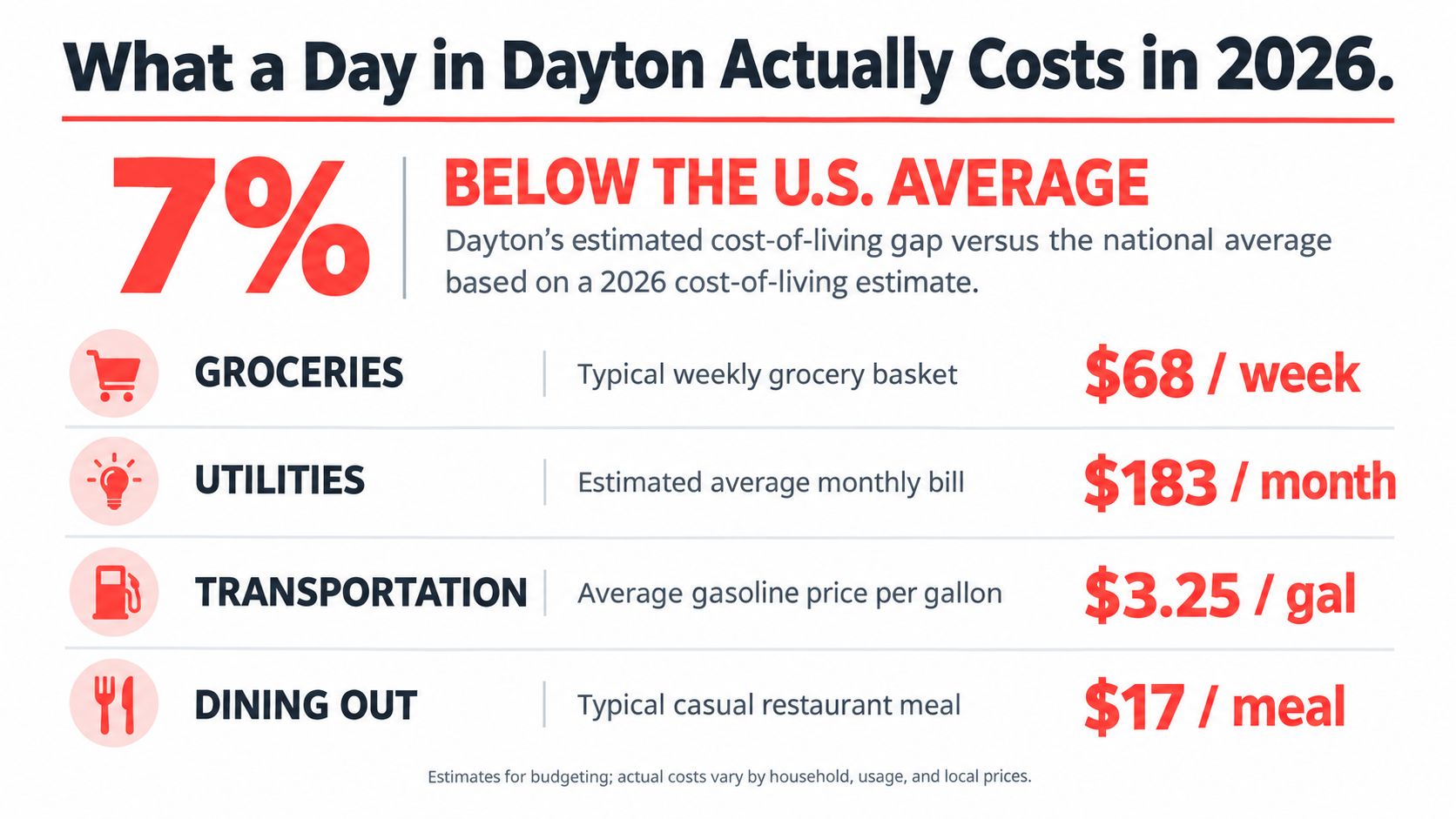
The headline for Dayton is modest overall savings with a large housing advantage underneath it. One current comparison places the total cost at roughly 3% below the national average, with housing about 16% below and utilities approximately 9% above that benchmark in Redfin's Dayton cost of living calculator. That's not a half-price city. It's a city where one category does almost all the work.
That matters because your basket isn't the index basket. A renter who works from home, keeps one car, and lives in an efficient unit keeps most of the housing gain. A buyer who purchases an older detached house, heats it through winter, insures two vehicles, and commutes daily gives part of it back every month.
How to Use the Headline Number
Build your estimate in this order.
- Start with tenure: Price the actual rent or the full owner payment, not a city median.
- Add shelter operating costs: Include energy, water, internet, insurance, taxes, and repairs before groceries or dining.
- Price movement separately: Count vehicles, fuel, insurance, maintenance, and commute time as one transportation block.
- Check take-home pay last: Convert the budget to a share of after-tax income, because gross salary flatters every city.
Practical rule: If housing, utilities, and transportation together don't improve after the move, Dayton's headline discount won't rescue the budget.
Groceries, healthcare, and everyday services still matter, but they rarely decide a Dayton move. Housing creates the opportunity. Utilities, property condition, and car dependence determine whether you keep it. Treat any source that stops at a single percentage as marketing copy, not relocation analysis.
Dayton's Cost Picture Against Ohio and the U.S.
Dayton wins decisively on occupied housing costs. Census QuickFacts reports a median owner-occupied home value of $100,600 and median gross rent of $918 per month for 2020 to 2024 in U.S. Census Bureau QuickFacts for Dayton city, Ohio. A Census-based national comparison in that data places the U.S. median home value near $332,700 and median gross rent at $1,413, leaving Dayton about 70% lower on home value and about 35% lower on rent.
Those Census figures describe typical occupied units, not today's asking prices. Use them for cross-market scale, then price live listings separately. Confusing a median occupied value with a current purchase budget is one of the fastest ways newcomers misread Dayton.
Dayton vs Ohio vs U.S. by Spending Category
| Category | Dayton vs U.S. | Ohio vs U.S. | Decision Implication |
|---|---|---|---|
| Housing | Well below on Census medians | Compare city by city, since Ohio markets vary widely | Your largest potential saving |
| Utilities | Above in one basket, below in another measure | Building efficiency matters more than a state label | Model the actual property and season |
| Groceries | No decisive verified citywide edge in the data used here | Broadly a household-basket question | Don't justify the move on food savings |
| Transportation | Depends on vehicle count and commute distance | Dispersed employment raises car exposure | Price the route, not the metro |
| Overall | Slightly below nationally | State context helps, but city choice decides | Use Ohio on ReloMaps to compare places on consistent terms |
Utility comparisons are where methodology bites. One dataset reports a utility regional price parity of 95.4, or 4.6% below the U.S. average, in the Dayton housing and price parity breakdown. Another comparison puts Dayton utilities above the national benchmark. Both can reflect different service baskets, consumption assumptions, and geographic boundaries.
Don't average away that disagreement. Ask what's included. Electricity only is not the same basket as electricity, gas, water, sewer, trash, phone, and internet. A small efficient apartment and an older detached house also consume energy very differently, even on the same street.
Groceries and routine services should be treated as secondary unless your household has unusual medical, childcare, or dietary costs. They can move a tight budget, but they won't create Dayton's advantage. The calibrated baseline is simple. Housing is the win, utilities are contested, and transportation is personal.
Housing in Dayton and What Neighborhoods Reveal
A city median hides the Dayton market more than it explains it. The 2024 American Community Survey figures cited in the regional breakdown report a median gross rent of approximately $941 and a median owner-occupied home value of $171,200, with a housing regional price parity of 72.7, roughly 27.3% below the U.S. average. ZIP-level estimates in that same breakdown range from about $75,100 median home value and $907 median rent in 45417 to $238,700 and $1,070 in 45429.
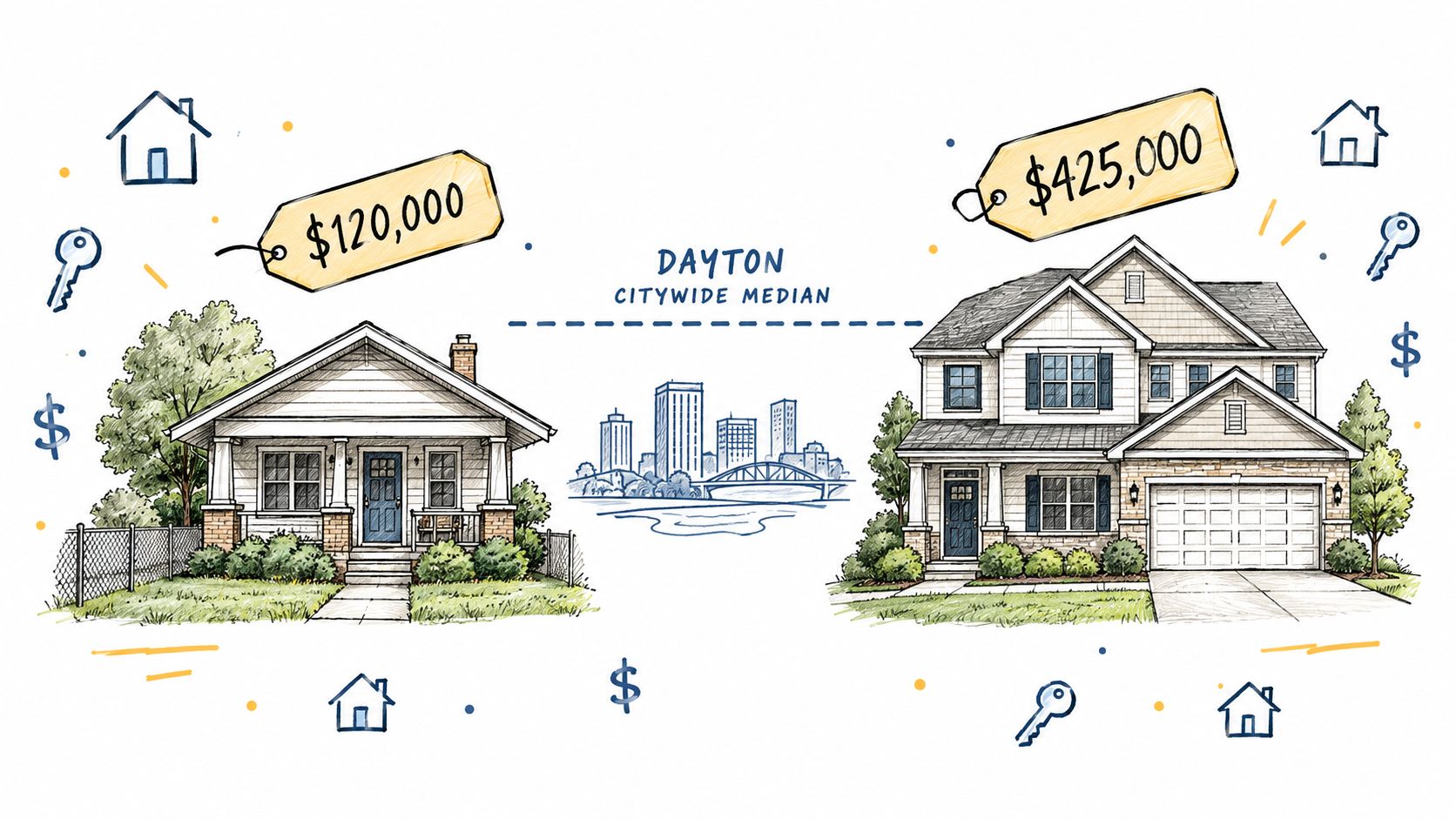
The image below captures the core problem with quoting one Dayton price. Two households can both claim they bought cheaply and still face completely different monthly obligations.
Why the Spread Is So Wide
- Property condition: A renovated house and a deferred-maintenance house can sit in the same broad market while requiring very different cash reserves.
- Employment access: Proximity to downtown, Wright-Patterson Air Force Base, hospitals, universities, and suburban job centers changes both price and commute cost.
- Property type: Condos, small older houses, and larger historic homes don't carry the same insurance, utility, or repair profile.
- Resale liquidity: A low purchase price helps less if the future buyer pool is thin or the property needs major work before resale.
Other published estimates widen the warning further. Available figures range from a median home value of $86,200 in one ACS-based profile to $228,600 in another estimate, and neighborhood examples range from roughly $107,000 condos to $425,000 homes in Oregon, in Homes.com rental and housing context for Dayton. Different methods explain part of that gap. Neighborhood and condition explain the rest.
A cheap Dayton house is only cheap after taxes, insurance, repairs, utilities, and commuting still leave you ahead.
For renters, do the income math cleanly. The regional breakdown's $941 median rent equals about $11,292 annually. Against its cited median household income of $67,088, that's a gross rent-to-income ratio near 16.8%, below the conventional 30% housing-burden threshold. That's a strong median outcome, but your wage and your unit decide your outcome.
My recommendation is blunt. Rent first if you don't know Dayton's neighborhoods block by block. Buying early locks in the region's best feature, low acquisition cost, but it also locks in the repair risk before you've learned which streets, housing vintages, and commute patterns fit your life.
Where Cheap Housing Stops Being Cheap
Take a $70,000 Dayton house and a $140,000 rival as an example: the cheaper address can outspend the pricier one when the inspection reads like a work order. Older Midwestern stock can hide deferred maintenance, inefficient heating, tired roofs, sewer problems, and electrical updates that never show in listing photos. Buy the payment and the house can bill you later.
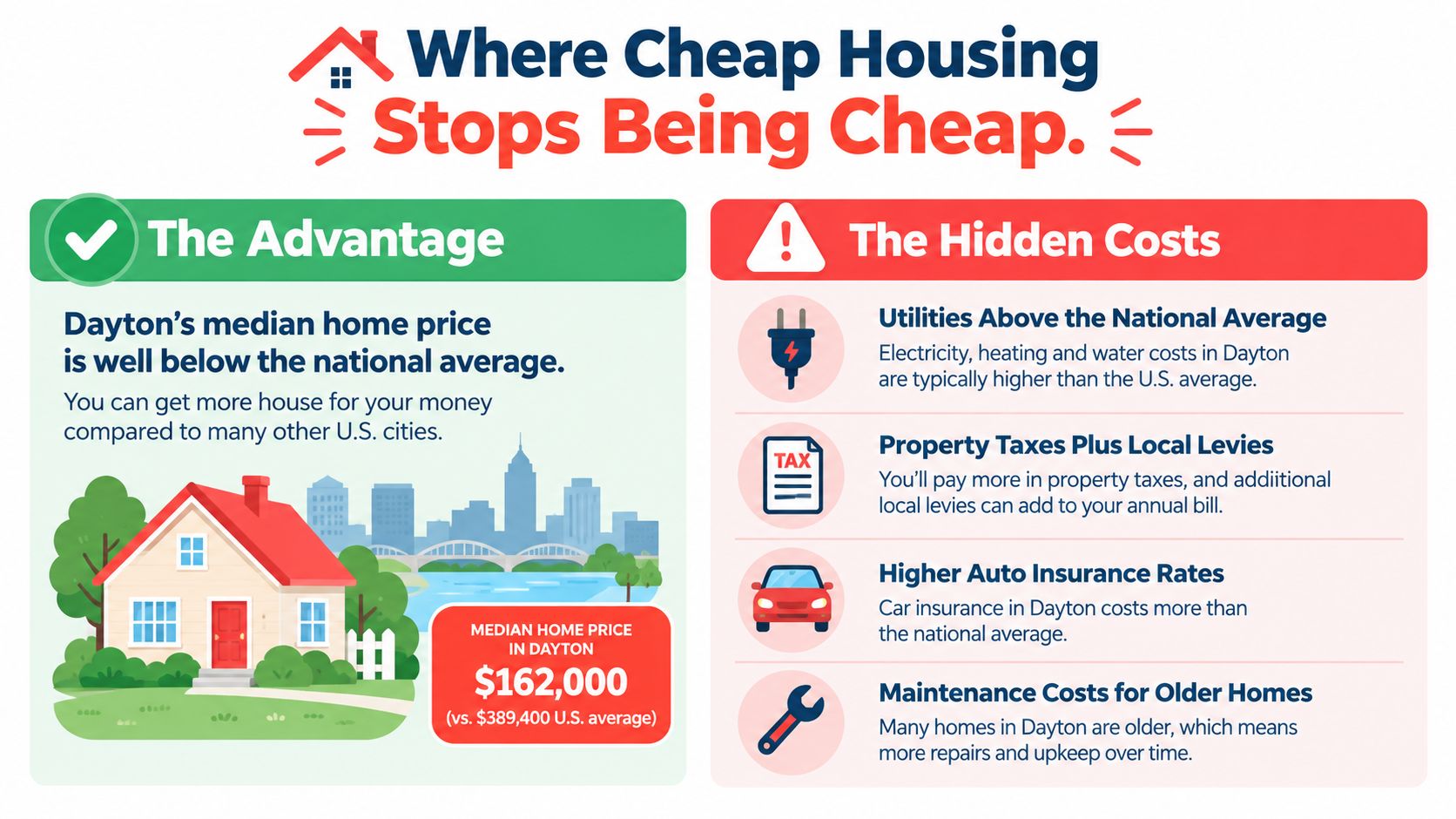
Utilities deserve the first hard look. One Dayton guide estimates utilities about 6% above the national average alongside average rent of $1,009 per month in Apartments.com's Dayton local guide. Ask for actual winter and summer bills, then price insulation, windows, furnace age, and water heater condition before you call the offer affordable.
Ownership cost is a stack, not a sticker. Taxes, insurance, system lifespan, lot drainage, parking, and daily driving all sit on top of principal and interest. I would rather see a buyer pay more for a tighter envelope and shorter route than grab the cheapest listing and spend the difference at the mechanic. Compare candidate neighborhoods against the cheapest safe cities in Ohio so a low price does not crowd out safety or access.
The short video below is a useful visual check before you build a final monthly stack.
Tenure changes the math. Median monthly owner costs were $1,147 with a mortgage and $458 without one in U.S. Census Bureau QuickFacts for Dayton city, Ohio. Paying off a modest Dayton home can produce rare fixed-cost control; buying a neglected one with thin reserves does the reverse.
Reading Dayton's Neighborhood Tradeoffs
Take two Dayton households with the same income. One rents near work and pays more for access. The other buys a lower-priced home farther from routine errands, then absorbs repair risk, insurance, extra driving, and time. The cheapest payment and the cheapest month often sit at different addresses.
Judge each neighborhood archetype at the household level. A higher-priced east-side or inner-ring suburb charges more for convenience, housing condition, or established services. A lower-priced west-side or northwest area can reduce rent or purchase price. It also requires closer scrutiny of property condition, insurance, commute route, and nearby retail.
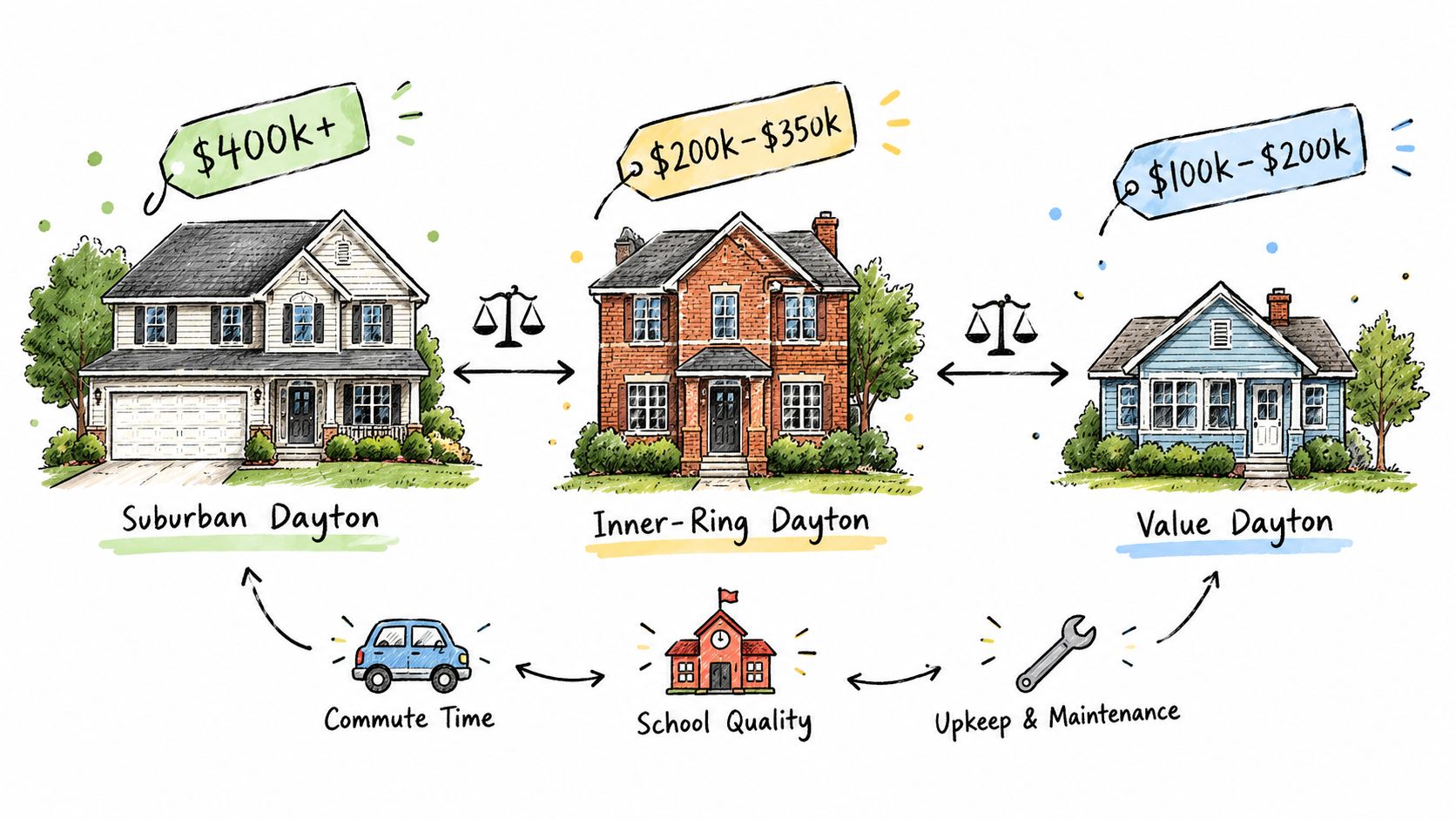
| Neighborhood archetype | What the payment can buy | Cost pressure to verify |
|---|---|---|
| Convenient city address | Shorter routine trips and less dependence on a second vehicle | System age, parking, insurance, and utility use |
| Established inner-ring suburb | Property condition, service access, and route predictability | A larger payment plus the usual ownership stack |
| Lower-priced west or northwest area | Lower upfront rent or purchase price | Deferred maintenance, weaker retail access, and heavier vehicle use |
Use the table as a first screen, then test a real address. Kettering's cost and quality-of-life profile is a useful comparison beside a city neighborhood when you want to know whether a higher housing payment buys back time, service access, or lower monthly friction. Prove the answer line by line. Do not assume the suburb wins.
ReloMaps is one screening option because it places city-level cost, safety, quality-of-life, and location context in one comparison view. Use it to shortlist areas, then verify the specific property through bills, inspection findings, property records, and an insurance quote. A city score cannot reveal a roof, sewer line, or electrical panel nearing the end of its life.
Address test: If you cannot state the housing payment, likely utility pattern, vehicle count, and commute route for an address, you do not know its cost of living yet.
My priority order is condition first, route second, purchase price third. A sound house in a workable location protects the budget every month. A neglected bargain that adds driving only looks better on closing day.
Taxes, Wages, and What Your Paycheck Actually Does
Dayton's municipal income tax is the first payroll adjustment to price into a move. The City lists a 2.5% income-tax rate, made up of a 2.25% base rate and a 0.25% increase effective January 1, 2025, in the City of Dayton tax information and forms. Judge the offer on net pay after that local layer, because gross salary overstates the monthly cushion.
Paycheck order: Start with salary, subtract Dayton tax, then subtract shelter, utilities, insurance, transportation, and food. Savings count only if the earlier lines leave room.
Residence and Work Location Decide the Tax Answer
Dayton residents owe the municipal tax on wages, salaries, commissions, business income, rental income, and other compensation. Nonresidents generally owe it on work or services performed inside city limits. Two households can therefore accept identical offers and finish with different take-home pay because one lives in Dayton and the other does not.
Remote and hybrid work deserve a written answer. A home outside Dayton combined with a Dayton employer does not settle withholding by itself. Residence, actual work location, and employer payroll policy all matter. Ask payroll which municipality it will withhold for before choosing a lease around a projected paycheck.
Check the Income Categories People Forget
Include self-employment and rental receipts in the local-tax review. Dayton also taxes resident winnings from lotteries, gambling, sports wagering, and other games of chance regardless of where the winnings were received. If any income arrives outside ordinary wages, confirm the treatment before filing time turns it into a surprise bill.
The Wage Side Narrows the Bargain
Dayton's lower housing prices look strongest against salaries imported from elsewhere. Local pay is less forgiving. The Census income figure cited earlier remains modest relative to the monthly ownership stack, so a household below that level can still have little room for repairs, childcare, or a second vehicle even when the purchase multiple appears low.
Property tax needs the same address-level discipline. A statewide assumption or a neighborhood average can miss the bill attached to a parcel. Pull the current property record, exemptions, levies, and likely reassessment effect, then place the annual amount beside insurance and utilities.
That gives you the affordability order I recommend: verify net pay first, test the parcel second, and approve the move only if savings remain after both.
What Dayton Costs for Your Household Type
One published renter estimate puts basic household expenses at roughly $4,733 monthly, while a separate comfortable-living estimate for a single adult reaches about $74,000 before taxes, in Apartments.com's Dayton local guide. The gap is the point. Dayton can look cheap at the shelter line, then utilities, car count, childcare, commute shape, and repair risk decide whether the discount survives your actual household.
Use this household read before you commit.
| Household type | Where Dayton saves | Where Dayton punishes | Approval test |
|---|---|---|---|
| Remote worker on an outside salary | Housing discount stays intact and commuting exposure stays low | An inefficient house can still tax the budget through winter and upkeep | Best case when the job stays outside Dayton and the property is efficient |
| Dual income, no childcare | Fixed housing, utility, and vehicle costs spread across two paychecks | Two commutes or a second car can quietly absorb the gain | Works when both routes stay short and parking is simple |
| Wright-Patterson household | A near-route address protects time, fuel, and schedule control | Gate timing, winter driving, and partner transportation can raise the real cost | Choose the address around the actual route, not the map pin |
| Single earner | Low rent can create room that pricier Ohio metros do not | One paycheck still carries utilities, insurance, food, vehicle, and local tax | The full monthly stack must leave savings after tax |
| Family with childcare | Larger space costs less than in many markets | Care, square footage, utility use, and multiple drives can dominate the math | Price the exact home size and care arrangement first |
| Retiree or fixed-income owner | Low buy-in and possible mortgage-free living improve control | Repair shocks, winter energy, upkeep, and driving dependence hit cash flow | Favor smaller, efficient space or predictable rent over a cheap larger house |
My ranking is direct. Remote salary and dual-income households get the cleanest Dayton advantage. Wright-Patterson households can match it if the route stays short. Single earners and families need proof, not optimism: one income and childcare are the two fastest ways the low-cost label breaks.
Retirees should judge winter cash flow and maintenance capacity before purchase price. A paid-off house is only calm if the roof, furnace, driveway, and energy bill stay calm too.
Move to Dayton for a defined advantage: a home you can heat, a route you can sustain, and income already matched to local tax. Keep vehicle count low, avoid repair-heavy stock, and reject any budget that works only before real life starts.
Frequently Asked Questions
What income threshold should a single renter use before signing a Dayton lease
A single renter should require the full housing, utility, transportation, food, insurance, and tax stack to fit inside take-home pay with savings left over. Don't use rent alone as the gatekeeper. Add a buffer for seasonal energy bills and car repairs, because those two categories are the ones most likely to break an otherwise workable Dayton lease.
When does buying beat renting in Dayton despite the low purchase prices
Buying beats renting when the property is move-in ready, the inspection shows no major near-term system failures, and you expect to stay long enough to spread closing and moving costs. Keep a separate repair reserve after closing. If the down payment empties your cash, renting is safer even when the mortgage payment looks lower.
What should a Wright-Patterson commuter test before choosing a neighborhood
A Wright-Patterson commuter should drive the exact route at the required arrival time before signing a lease or offer. Include gate access, parking, winter road conditions, and the return trip in that test. Also verify whether the address requires a second vehicle for a partner, because that added car can erase a lower rent.
Which hidden relocation costs catch Dayton newcomers most often
Utility deposits, lease-break fees, renters insurance, vehicle title and registration changes, and short-distance moving costs catch newcomers most often. Budget cash for connection fees and overlapping housing payments during the transition month. For older rentals, confirm which utilities are tenant-paid and whether prior bills are available before you commit.
Compare Dayton against nearby suburbs and other Ohio cities with the same housing, safety, quality-of-life, and cost metrics before you lock in a neighborhood. Visit ReloMaps to build a shortlist around your household budget, commute, and property priorities, then verify each finalist at the address level.
Enjoying the blog? Subscribe to ReloMaps+ for premium area intelligence — and to keep us independent.
Subscribe today