7 Cheapest Places to Live in Oklahoma

Enid, Lawton, Midwest City, Tulsa, Norman, Oklahoma City, and Holdenville form the strongest affordability shortlist, with Enid showing a median home value of $78,554 and Lawton $129,991. Holdenville adds a small-town value case, with a reported median home price of $58,838 and median rent of $665, but the cheapest place for you depends on whether you rent, buy, pay local taxes, or prioritize safety, commute, and quality of life.
That distinction matters because Oklahoma's statewide affordability can make several markets look attractive at first glance. MERIC's 2026 composite cost-of-living index places Oklahoma at 84.7, with a housing subindex of 68.8, but a low housing figure doesn't automatically mean a good relocation fit. A cheap address can still create problems through limited healthcare, a long commute, storm exposure, weak rental inventory, or a poor match with your household's lifestyle.
This comparison treats affordability rankings as starting points, not verdicts. It weighs rent, home-sale evidence, housing-to-income pressure, taxes, daily-life tradeoffs, and ReloScore dimensions such as safety, commute, demographics, quality of life, and strategic location. The linked sources also use different dates, geographies, and measures. Redfin, Clever Real Estate, SoFi, Rent.com, Niche, and BudgetLeases shouldn't be treated as interchangeable, so verify current figures before moving. For a broader construction-budget comparison, see this guide to average barndominium cost by state.
Table of Contents
- 1. ReloMaps
- 2. Redfin
- 3. Clever Real Estate
- 4. SoFi
- 5. Rent.com
- 6. Niche
- 7. BudgetLeases
- Cheapest Places in Oklahoma, 7-Source Comparison
- Turn a Cheap Address Into a Defensible Shortlist
- Frequently Asked Questions
- How much should I reserve for hidden relocation costs in a cheap Oklahoma town?
- When should a low housing price trigger a safety or commute check?
- How should renters use dated rent rankings?
- How can hybrid workers test commute exposure before choosing a low-cost town?
- Is a very low home value enough for a retiree to choose a town?
1. ReloMaps
ReloMaps is the strongest starting point when the question isn't just "Where is rent lowest?" but "Which affordable place still works for my household?" Its ReloScore framework gives cities, towns, and neighborhoods an A+ to F grade, then separates the result into categories such as cost of living, affluence, crime and safety, quality of life, and strategic location.
That structure helps expose why the seven-place shortlist isn't a simple price ranking. Enid and Lawton have documented low housing signals, while Midwest City, Tulsa, Norman, and Oklahoma City may appeal to households that need broader employment access or urban services. Holdenville can look compelling for a renter or buyer with a very tight housing budget, but a smaller labor market and longer trips for specialized services may change the calculation.
ReloMaps' Grid and Map views let users filter locations by affordability, commute, demographics, education, home values, rents, remote-work patterns, and homeownership. Its quick filters also support more specific searches, including family-friendly, off-grid, prepper, conservative, and progressive preferences. That matters because two households can look at the same low-cost town and reach opposite conclusions.
The missing context behind a cheap listing
The platform adds local context that listing portals often leave out, including tax burden, property rights, policy indicators, FEMA risk, wildfire, flood, tornado, and hurricane exposure, plus proximity to airports, major cities, and other hazards. You can also paste a Zillow or Redfin URL to assess the city and neighborhood context around a specific property.
Use ReloMaps' affordable cities exploration page to build the first shortlist, then compare each candidate rather than accepting a single ranking. Free browsing covers the Grid, Map, and city pages, while the site indicates that property reports and partner options may be paid. No public price tiers were available in the supplied platform information, so confirm current pricing directly before purchasing a report.
Practical rule: Treat the lowest home price as an invitation to investigate safety, commute, hazard exposure, and services, not as proof that a place is the best value.
2. Redfin
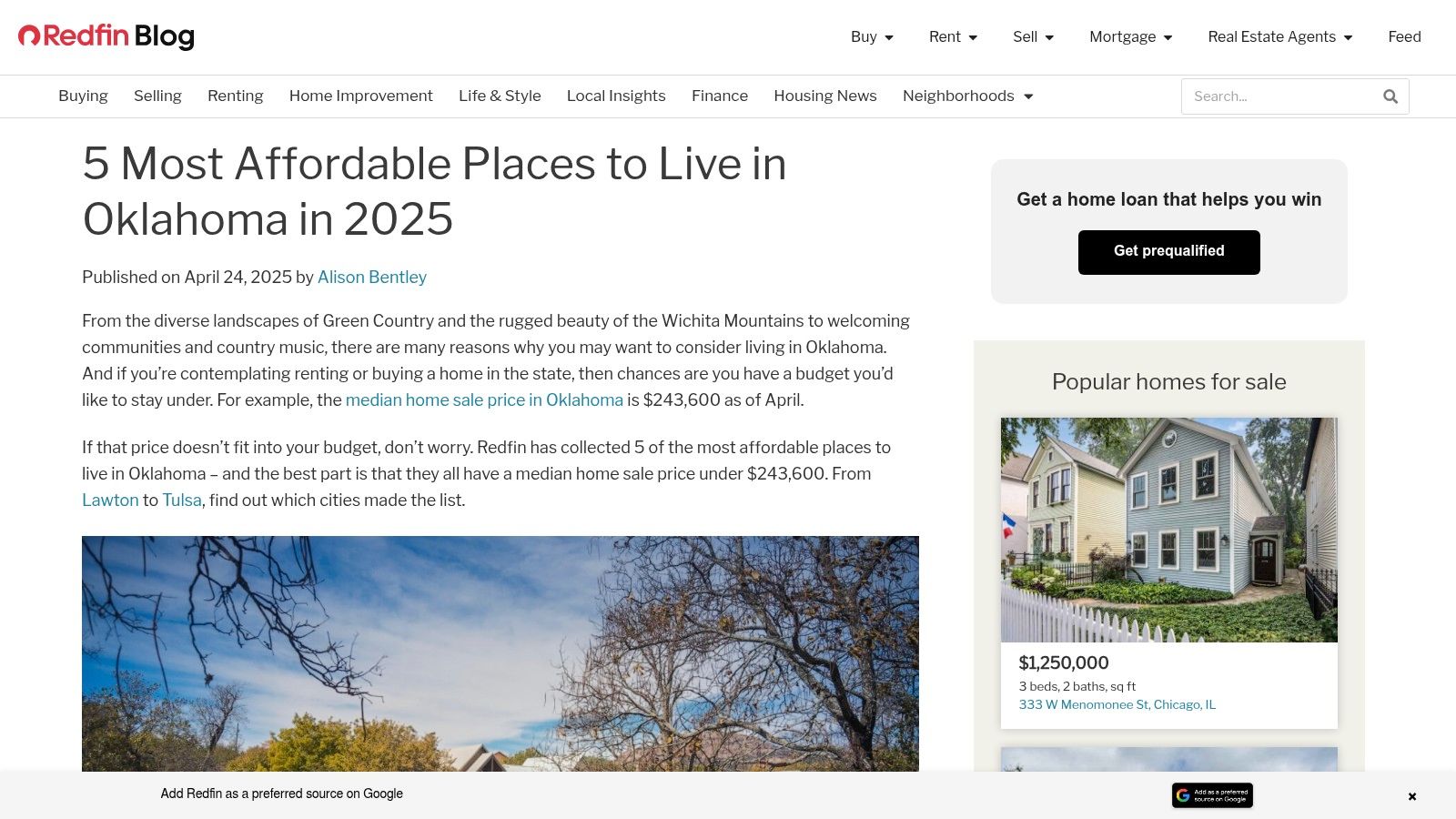
Redfin's Oklahoma affordability guide is most useful for buyers who want a fast, sale-price-led first pass. Its format highlights a limited group of Oklahoma cities with lower median sale prices and adds brief local context, which makes it easy to identify places to investigate before opening individual listings.
That focus gives Redfin a clear advantage. Sale-price data speaks directly to buyers who are comparing down payments, mortgage size, and likely renovation budgets. It also connects naturally to property searches, so a reader can move from a city-level idea to available homes without changing platforms.
The limitation is equally important. A sale-price roundup won't fully answer whether a renter can find a suitable lease, whether inventory exists in the neighborhoods you want, or whether the total cost of ownership remains manageable after insurance, utilities, taxes, repairs, and commuting. It can also miss small towns that look stronger under a cost-of-living or rent-to-income measure.
For this shortlist, use Redfin to test Enid, Lawton, Oklahoma City, and nearby metro options against actual listings. Then use the Oklahoma location context on ReloMaps to examine safety, strategic location, quality of life, and neighborhood conditions. Redfin tells you what is being offered. A location-intelligence tool helps you decide whether the surrounding place suits the household making the purchase.
3. Clever Real Estate
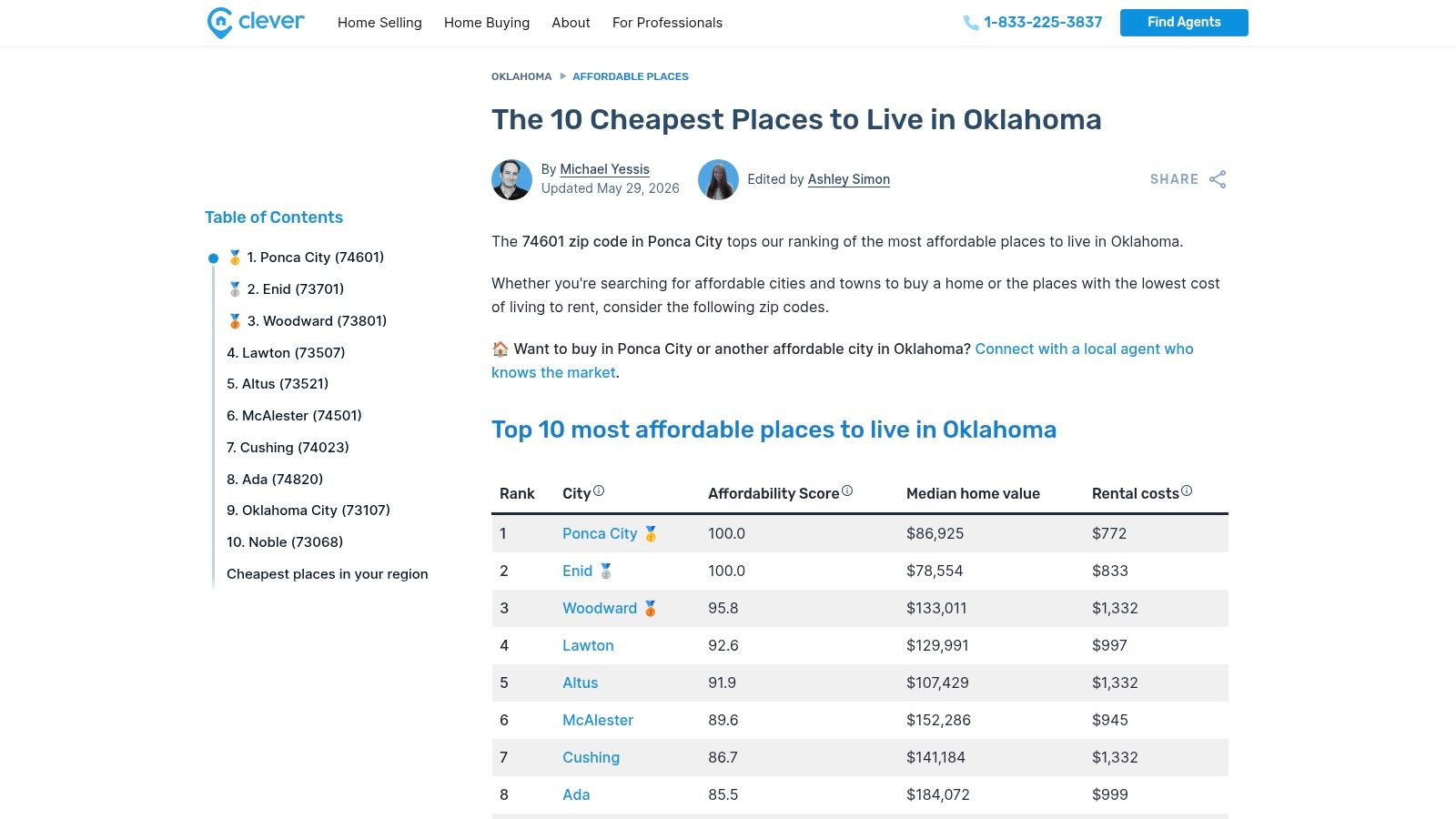
ListWithClever's Oklahoma affordability guide is valuable because it looks beyond a single city median and examines affordability at the ZIP-code level. That granularity can reveal why one part of a larger market deserves attention even when the city-wide reputation is too broad to guide a move.
Its approach balances renting and buying, which makes it more useful for households that haven't decided whether to lease first or purchase immediately. The supplied research identifies Ponca City as a leading affordability benchmark, with a median home value of $86,925, median rent of $772, and a home affordability ratio of 1.7. That ratio compares a typical home with median annual household income, making it more informative than a low sticker price alone.
Clever's strength is comparison. Enid and Ponca City show how extremely low housing values can coexist with moderate local incomes, while Lawton and McAlester demonstrate that a city can remain affordable even when its median home value is higher. McAlester's median home value is $152,286, according to the same supplied affordability research, so the headline ranking needs context rather than blind acceptance.
Where ZIP-level data can mislead
ZIP-level analysis can blur neighborhood differences and may not capture school quality, hazard exposure, employer concentration, or the daily experience of a particular street. It also may not show how quickly available homes or apartments disappear.
Use Clever to identify value pockets, then validate the exact neighborhood through property-level research. If you're comparing Ponca City or Enid with Oklahoma City, ask whether the cheaper market also supports your commute, healthcare needs, and long-term resale plan.
4. SoFi
SoFi's affordable Oklahoma cities guide works well for early-stage researchers who want readable comparisons instead of a dense data table. It combines city narratives with housing and cost-of-living context, including rent and home-value-to-income signals, so readers can form an initial shortlist quickly.
That format is useful for comparing different types of places. Tulsa and Oklahoma City may suit people who need more employment variety and services, while Norman can attract households willing to accept a different housing tradeoff for its broader urban and institutional setting. Midwest City deserves separate attention because a metro-adjacent location can change the value calculation even when the home itself appears inexpensive.
The important analytical point is that lower nominal prices don't settle the question. A buyer should compare the home-value-to-income relationship, recurring ownership costs, taxes, insurance, utilities, and expected maintenance. A renter should compare the lease payment with commute costs and the likelihood of finding a suitable unit near work, schools, or healthcare.
How to use readable guides responsibly
SoFi is a scouting tool, not a substitute for current property evidence. Its quick-hit summaries are easier to absorb than a full dataset, but readers should confirm the date and source behind each figure before making an offer or signing a lease. Different measures can produce different winners, especially when one source emphasizes home values and another emphasizes rents.
Use the guide to ask better questions: Is the low-cost city affordable for my income, or merely inexpensive in absolute terms? Does the location score well for safety and quality of life? Can I tolerate the commute if the cheaper home sits outside the job center?

5. Rent.com
Rent.com's Oklahoma rental guide is the most relevant source for people who aren't ready to buy. Its city-by-city rent comparisons include places such as Enid, Lawton, Norman, Midwest City, and Tulsa, giving renters a practical way to compare markets that may serve very different commute and lifestyle needs.
Rent-only analysis prevents one common mistake: assuming that a low median home value automatically creates a low-cost rental market. Owners and renters face different inventory conditions, and a town can rank well for home buyers while offering few suitable apartments. Rent.com's emphasis on typical rental costs helps bring that distinction into the shortlist.
Still, the guide is dated 2024, so its figures should be treated as historical reference points rather than a current lease quote. Rent changes by unit type, neighborhood, vacancy, utilities, pet rules, deposits, and fees. A renter comparing Lawton with Oklahoma City should request current availability in the exact area, not rely on a statewide reputation.
A dated rent ranking is useful for direction, but the lease you can sign today matters more than the average published in an earlier market snapshot.
For each finalist, calculate the full monthly housing burden. Include rent, utilities, parking, insurance, transportation, and deposits. Then compare commute exposure and safety context. A slightly higher rent in a better-connected neighborhood can cost less overall if it eliminates a long daily drive or reduces the need for multiple vehicles.
6. Niche
Niche's Oklahoma cost-of-living rankings broaden the search beyond familiar cities. Its statewide coverage includes smaller communities, which is why it can help identify a value candidate such as Holdenville rather than forcing every reader toward a metro.
The strongest evidence for Holdenville comes from a separate affordability roundup, which reports a $58,838 median home price and $665 median rent. Those figures make Holdenville a serious small-town candidate for a buyer or renter whose first constraint is housing expense. They don't establish that it is the best overall choice, because the household must still test employment access, healthcare, safety, social fit, and travel requirements.
Niche's relative-to-income framing is more useful than a simple list of low-dollar homes. A town with very cheap houses but limited wages may not be affordable for local workers, while a somewhat costlier market can produce a better housing-to-income balance. That distinction also matters for retirees and remote workers, whose income sources may not depend on the local labor market.
The small-town tradeoff
A small town can deliver more housing for less money, but it may also require longer drives for specialists, shopping, cultural activities, or airport access. Remote workers should verify broadband, backup connectivity, power reliability, and workspace suitability rather than assuming that a low purchase price supports a workable home office.
Use Niche to widen the candidate pool, then apply the cheap and safe towns filter on ReloMaps. Compare Holdenville with the larger shortlist using consistent ReloScore categories. The question isn't whether Holdenville wins a ranking. It's whether its savings compensate for the services and travel you'll use.
7. BudgetLeases
BudgetLeases' Oklahoma rental ranking isolates apartment costs and uses a month-stamped July 2026 snapshot. That makes it useful when the immediate question is not “Where should I retire?” but “Where can I find a lease at a manageable price right now?”
The narrow focus is its advantage. A rent-only list makes it easier to compare rental markets without mixing in purchase prices, mortgage assumptions, or homeowner taxes. It can help a renter test whether Enid, Lawton, Midwest City, Tulsa, Norman, or Oklahoma City has practical availability at the price level suggested by broader affordability guides.
The narrow focus is also the risk. Active apartment listings don't capture groceries, utilities, insurance, taxes, commute costs, school preferences, crime context, or disaster exposure. A low advertised rent can lose its advantage if the unit requires a long commute, carries substantial fees, or sits in an area that doesn't fit your safety threshold.
Turn a rent snapshot into a decision
Start with the current listing pool, then call or message properties directly. Confirm whether the quoted figure applies to the unit you want, whether utilities are separate, and whether deposits, application fees, pet charges, parking, or required insurance change the first-month cost.
BudgetLeases is best used alongside a broader location screen. A renter should compare the lease with household income, transportation, neighborhood safety, remote-work needs, and access to daily services. If the rent ranking and ReloScore point in different directions, investigate the conflict instead of choosing the cheaper number automatically.
Cheapest Places in Oklahoma, 7-Source Comparison
| Service | Implementation complexity | Resource requirements | Expected outcomes | Ideal use cases | Key advantages |
|---|---|---|---|---|---|
| ReloMaps | Low, web UI, no setup | Free browsing; paid reports/advertising options (not publicly priced) | Nationwide ReloScore + transparent sub-scores and neighborhood context | Homebuyers, families, remote workers, homesteaders needing deep local/policy context | Comprehensive scoring, civic/legal indicators, hazard exposure, Zillow/Redfin link parsing |
| Redfin | Very low, read article, click to listings | Free content + access to Redfin property search | Quick sale-price–anchored city snapshots and entry points to listings | Buyers wanting a fast shortlist tied to recent sale data | Brokerage-backed data and direct property search links |
| Clever Real Estate (ListWithClever) | Low, guide and ranked lists | Free statewide ZIP-level data; methodology notes | ZIP-code affordability rankings balancing rent and buy | Finding value pockets inside metros; renter vs buyer tradeoffs | Granular ZIP analysis and balanced rent/purchase metrics |
| SoFi | Low, consumer guide format | Free guide with quick stats; fewer raw tables | Readable city affordability blurbs with value-to-income figures | Early-stage scouting across multiple cities | Consumer-friendly summaries and quick affordability markers |
| Rent.com | Low, list and rent tables | Free renter-focused data; rent averages by unit type | City-by-city rental benchmarks and local employer/amenity notes | Renters prioritizing rental costs and local job context | Rent-focused benchmarks with broad city coverage |
| Niche | Low–medium, interpret composite scores | Uses Census & BLS; standardized methodology and profiles | Cost-of-living rankings relative to income with town profiles | Broad comparisons including small towns; normalize wages vs prices | Wide coverage, consistent methodology, relative-to-income framing |
| BudgetLeases | Low, aggregated listing tables | Live apartment listings; month-stamped snapshots | Up-to-date rental price rankings by city | Renters needing current market rent differentials | Timely rental figures from active listings |
Turn a Cheap Address Into a Defensible Shortlist
The best place for a renter isn't necessarily the best place for a buyer. Renters should prioritize current availability, total move-in cost, lease flexibility, commute burden, and the reliability of local services. Buyers should add property taxes, insurance, repairs, resale liquidity, hazard exposure, and the relationship between home value and household income.
Oklahoma's statewide numbers explain why the cheapest places to live in Oklahoma attract attention, but they don't eliminate local variation. Ponca City and Enid show how low home values and rents can create powerful entry points, while Lawton and McAlester show that a market can remain affordable at a higher price level. Holdenville demonstrates the opposite risk: a very low housing figure may come with a smaller service and employment base.
Use a four-step validation sequence before committing:
- Confirm current housing evidence: Check an active rent or sale listing, not just an older ranking. Verify the exact unit, neighborhood, property condition, fees, and availability.
- Estimate the complete monthly burden: Add taxes, insurance, utilities, maintenance, transportation, deposits, and recurring non-housing expenses.
- Test the actual travel pattern: Drive or simulate the commute at the times you'll actually travel. Remote workers should test internet reliability, backup options, and occasional trips to clients or offices.
- Compare location risks: Review safety, quality of life, demographics, hazard exposure, healthcare access, and strategic location before treating a low price as a win.
ReloMaps can make that process faster by filtering affordable Oklahoma locations, comparing ReloScore grades, and opening city-level context across the dimensions that listing portals often omit. When a Zillow or Redfin property looks promising, paste its URL into the platform's property-context lookup to assess the surrounding neighborhood and city rather than judging the listing in isolation.
Frequently Asked Questions
How much should I reserve for hidden relocation costs in a cheap Oklahoma town?
Reserve a separate moving fund for deposits, utility activation, transportation, insurance changes, repairs, and trips required for healthcare or shopping. The exact amount depends on the move, but the key test is whether your budget still works after adding costs that the advertised rent or sale price excludes.
When should a low housing price trigger a safety or commute check?
A low price should trigger both checks before you schedule a viewing or make an offer. Use the price gap as a reason to investigate, then compare neighborhood safety, commute exposure, hazard proximity, and access to essential services rather than assuming the discount is free.
How should renters use dated rent rankings?
Renters should use dated rankings to identify markets, then replace every benchmark with current unit-level evidence. Ask for the full monthly charge, utility responsibility, deposit, lease term, pet rules, and earliest move-in date, because those details can change the actual cost more than the headline average.
How can hybrid workers test commute exposure before choosing a low-cost town?
Hybrid workers should test the route on both office and remote-work days, including rush-hour travel, winter weather, school traffic, and backup destinations. They should also confirm broadband quality and the number of required office days, because an inexpensive town can become a poor fit when occasional travel is unpredictable or connectivity is weak.
Is a very low home value enough for a retiree to choose a town?
A very low home value isn't enough for a retiree to choose a town. Compare specialist healthcare access, emergency travel time, property taxes, insurance, maintenance needs, grocery access, social activities, and the distance to family before prioritizing the purchase price.
ReloMaps helps you compare Oklahoma cities and towns through ReloScore grades, affordability filters, safety and quality-of-life context, commute and demographic signals, and property-level intelligence for Zillow or Redfin links. Build a defensible shortlist for your budget and lifestyle by visiting ReloMaps before you choose the cheapest address.
Enjoying the blog? Subscribe to ReloMaps+ for premium area intelligence — and to keep us independent.
Subscribe today