Brierwood Hills Fort Wayne: Moving Guide
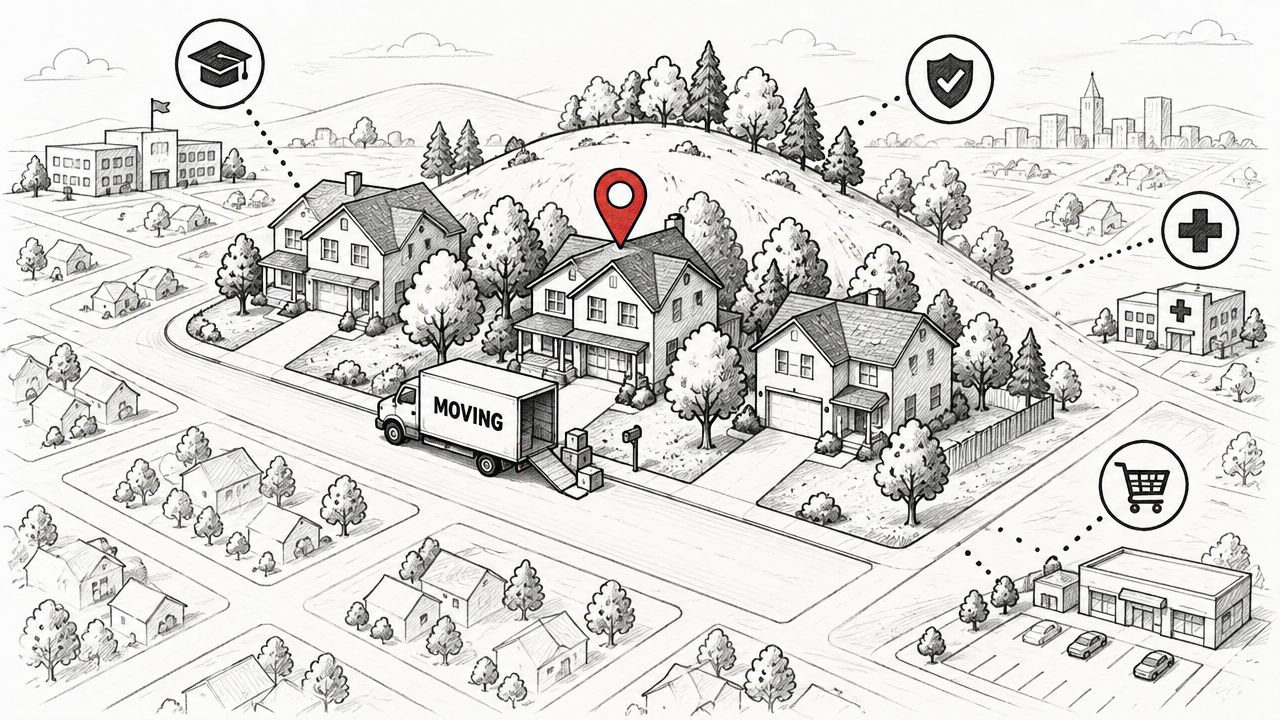
Brierwood Hills is a tightly governed suburban enclave of about 112 homes in Fort Wayne, trading HOA restrictions for efficient access to I-69, Times Corner, Coventry Village, and Lutheran Hospital. Its small scale, established housing stock, and connection to the Southwest Allen County school district make it a focused relocation choice, not a generic Fort Wayne subdivision.
That tradeoff defines the Brierwood Hills Fort Wayne decision. Buyers aren't choosing a house. They're choosing a compact neighborhood structure, a specific governance model, and a location that can reduce friction between residential life, healthcare, shopping, and regional travel. The right question is whether the enclave's rules and varied home ages fit your household better than the flexibility available elsewhere in the city.
Table of Contents
- Brierwood Hills Fort Wayne Market Context
- Housing Stock and Lot Dimensions
- Commute Efficiency and Corridor Access
- School Zones and Neighborhood Governance
- Evaluating Locations with ReloMaps
- Final Relocation Tradeoff Analysis
- Frequently Asked Questions
Brierwood Hills Fort Wayne Market Context
Brierwood Hills functions as a closed-loop suburban neighborhood, rather than a broad, continuously expanding subdivision. Its approximate 112-home scale creates a different market experience from larger Fort Wayne communities. A small inventory means each listing carries more local significance, while differences in renovation quality, lot configuration, and covenant compliance can matter more than a broad neighborhood label.
The neighborhood's value proposition is therefore based on location efficiency and governance. Residents get a defined residential setting with access to Times Corner, Coventry Village, I-69, and Lutheran Hospital. That convenience can appeal to healthcare workers, commuters, and households that want suburban separation without giving up access to major services. It also comes with less autonomy than an ungoverned neighborhood because exterior changes and other uses may be subject to recorded covenants and HOA administration.
Fort Wayne's broader market position
Brierwood Hills sits inside a city with measurable population expansion. Fort Wayne's Census population was 263,886 in 2020, compared with 273,203 in the July 1, 2024 population estimate, an increase of 9,317 residents, or about 3.5%, according to the Fort Wayne population profile. The same profile records growth from 253,691 in 2010 to 263,886 in 2020, an increase of 10,195 people, or about 4.0%.
Those figures don't prove that every Brierwood Hills home will appreciate or sell quickly. They do establish a broader setting where neighborhood demand, services, and employment relevance aren't shaped by a stagnant city. For a relocation comparison, review the Fort Wayne city profile alongside the subdivision itself.
Practical rule: Treat citywide growth as market context, not as a substitute for inspecting the individual property, reviewing covenants, and comparing nearby sales.
The neighborhood's small size makes that discipline especially important. A buyer shouldn't assume that a home in Brierwood Hills is automatically comparable with every nearby suburban property. The enclave's governance, access pattern, and mixed housing ages create a narrower comparison set.
Housing Stock and Lot Dimensions
Brierwood Hills has an established residential profile rather than a single, uniform construction period. A neutral neighborhood profile indicates that most residences were built between 1970 and 1999, with additional homes built from 2000 to the present. That roughly 30-year primary growth span provides a useful historical marker for evaluating maintenance cycles and renovation variation. See the Brierwood Hills neighborhood profile for the underlying development description.
A mixed build period changes how buyers should read listing photos. Two houses on the same loop may have different electrical, plumbing, roofing, insulation, window, and mechanical histories even when their exterior setting feels consistent. The key issue isn't age alone. It's whether major systems have been updated, documented, and maintained in a way that supports the asking price.
What the lot data reveals
One Brierwood Hills property on Rose Ann Parkway is identified as a site-built residential lot measuring 35,000 square feet, or 0.8 acres, with dimensions of 125 by 280 feet. The legal description identifies it as Lot 38 in the Brierwood Hills addition, as shown in the Rose Ann Parkway property record.
That parcel is a concrete example of the neighborhood's potential physical scale, but it shouldn't be treated as a universal specification for every home. Larger land areas can provide privacy, recreation space, and flexibility, yet they also expand the burden of mowing, drainage observation, tree care, fencing review, and exterior maintenance. HOA covenants may limit how owners can use that flexibility.
| Feature | Typical Specification | Buyer Implication |
|---|---|---|
| Primary residential growth | Most homes built from 1970 to 1999 | Expect variation in system age and renovation quality |
| Additional development | Homes also built from 2000 to the present | Review each home's construction and upgrade history separately |
| Example lot area | 35,000 square feet, or 0.8 acres | More outdoor space can mean more upkeep and covenant questions |
| Example dimensions | 125 by 280 feet | Evaluate access, drainage, fencing, and usable yard shape |
| Legal identity | Lot 38 in the Brierwood Hills addition | Match listing claims with recorded property documents |
A serious inspection should connect the structure's age with the lot's operational demands. Buyers who want a low-maintenance suburban property may prefer a renovated home on a manageable parcel. Buyers who value land should budget time and attention for the grounds, then confirm that intended improvements comply with the neighborhood documents.
Commute Efficiency and Corridor Access
Brierwood Hills' strongest practical argument is its compressed access to daily corridors. The enclave is associated with Times Corner, I-69, Coventry Village, and Lutheran Hospital, giving residents a way to remain in a defined suburban setting while staying connected to shopping, employment, healthcare, and regional road travel. That combination is more meaningful than a generic claim that a neighborhood is convenient.
The closed-loop layout can simplify the first and last part of a trip because residents return to a contained residential street network rather than navigating a large subdivision. It doesn't eliminate peak-hour congestion, weather delays, or the need to cross busy corridors. A short route to an interchange can still produce an unpredictable commute when traffic concentrates at entry points.
Compare the location by trip type
A medical professional may value the connection to Lutheran Hospital more than a remote worker who leaves home infrequently. A household with regular shopping needs may place greater weight on Times Corner and Coventry Village. A regional commuter may prioritize I-69 over local retail access. The same address can therefore produce different value depending on how often each household uses these destinations.
The broader Indiana location context can help buyers compare Fort Wayne's regional position with alternative markets, but a relocation decision still requires a test drive at the times you expect to travel. Check the route from the neighborhood entrance, not just the straight-line relationship shown on a map.
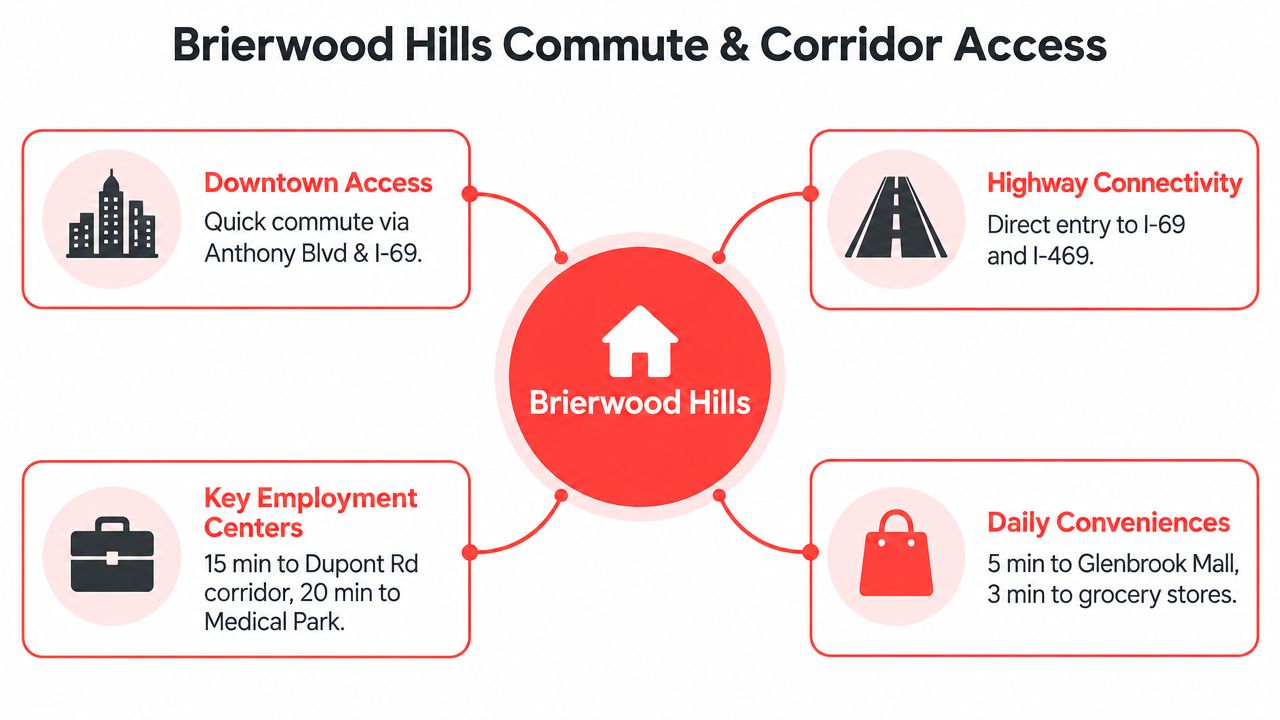
For hybrid workers, the tradeoff is straightforward. Brierwood Hills may reduce the inconvenience of occasional office travel while preserving a suburban home environment, but remote work doesn't remove school drop-offs, errands, medical appointments, or service visits. Evaluate the full weekly pattern rather than optimizing for one commute.
A practical route audit should include:
- Peak departure: Drive toward your principal employment or healthcare destination during the time you normally leave.
- Return reliability: Test the inbound trip, because access that feels easy in one direction may be less efficient during evening hours.
- Errand chaining: Combine grocery, pharmacy, school, and medical routes to see whether the location reduces or adds backtracking.
- Alternative access: Identify more than one route to I-69 and nearby services before treating the location as resilient.
School Zones and Neighborhood Governance
Listing descriptions tie Brierwood Hills to the Southwest Allen County school district, but a district label isn't the same as a complete school-zone analysis. Attendance boundaries, program availability, transportation arrangements, and future administrative decisions can affect a household differently. Buyers should verify the assigned schools for the exact address through current district resources and treat listing language as a starting point rather than final confirmation.
The more underappreciated issue is governance. In a small, tightly managed enclave, HOA covenants can protect a consistent appearance and clarify shared expectations, but they can also limit the owner's ability to make ordinary suburban changes. Public neighborhood pages and listing materials don't fully quantify the implications for parking, exterior alterations, or property modifications, so the buyer must obtain the governing documents.
What to verify before making an offer
The Brierwood Hills property listing and covenant information illustrates why a listing should trigger document review, not replace it. Ask for the declaration, amendments, rules, architectural standards, recent meeting materials if available, and any resale or status statement required by the association.
Focus on the changes most likely to affect your lifestyle:
- Parking and vehicles: Confirm rules for street parking, recreational vehicles, trailers, commercial vehicles, and guest overflow.
- Exterior projects: Check approval requirements for fences, sheds, decks, pools, additions, paint colors, roofing, and landscaping structures.
- Maintenance standards: Determine whether owners face deadlines or appearance requirements for lawns, siding, roofs, or visible storage.
- Financial exposure: Review assessments, transfer charges, unpaid balances, pending projects, and the association's process for enforcing violations.
The apparent benefit of uniformity is also a constraint on autonomy. A buyer who wants predictable streetscape standards may welcome the rules. A buyer planning extensive exterior work may regard the same rules as a material ownership limitation.
School access and HOA governance should be analyzed together. A household may value the district connection but still reject the property if the covenants conflict with parking needs, pets, home-based work, fencing plans, or future additions. The correct decision isn't whether Brierwood Hills has a positive reputation. It's whether the neighborhood's operating rules match the way you intend to live.
Evaluating Locations with ReloMaps
A listing portal can show the house, but it rarely answers whether the surrounding location fits your constraints. A structured comparison should begin with the address and expand outward, separating verified property facts from neighborhood assumptions.
A practical comparison workflow
Start with the exact property. Record the address, legal description when available, lot dimensions, construction period, visible renovation claims, and any HOA references. Don't compare an acreage-style parcel with a smaller suburban lot without adjusting your expectations for maintenance and privacy.
Check the neighborhood context. Use a property-context lookup tool that accepts a Zillow or Redfin URL. ReloMaps is one option that provides location intelligence through property reports and broader city or county context, rather than functioning as a listing marketplace. Its location exploration tools can support a wider comparison across Fort Wayne alternatives.
Filter by household priorities. Review categories such as affluence, cost of living, crime and safety, education, commute times, work-from-home rates, and homeownership. The point isn't to chase a single grade. It's to identify where Brierwood Hills matches your priorities and where its small, governed structure creates friction.
Compare like with like. Set the same evaluation criteria for another Fort Wayne neighborhood. Compare access, housing age, governance, school assignment, and property upkeep rather than relying only on visual appeal or listing price.
Validate the outliers. If a property appears unusually attractive or unusually restrictive, return to primary documents, the school district, municipal sources, and the title or closing professionals. A platform can organize context, but it can't replace covenant review or professional due diligence.
Use thresholds carefully
Metrics should support a decision rule. For example, a household that works remotely may assign greater weight to work-from-home prevalence and strategic access, while a family may give greater weight to school verification and parking restrictions. An investor may focus on resale comparability and neighborhood turnover instead.
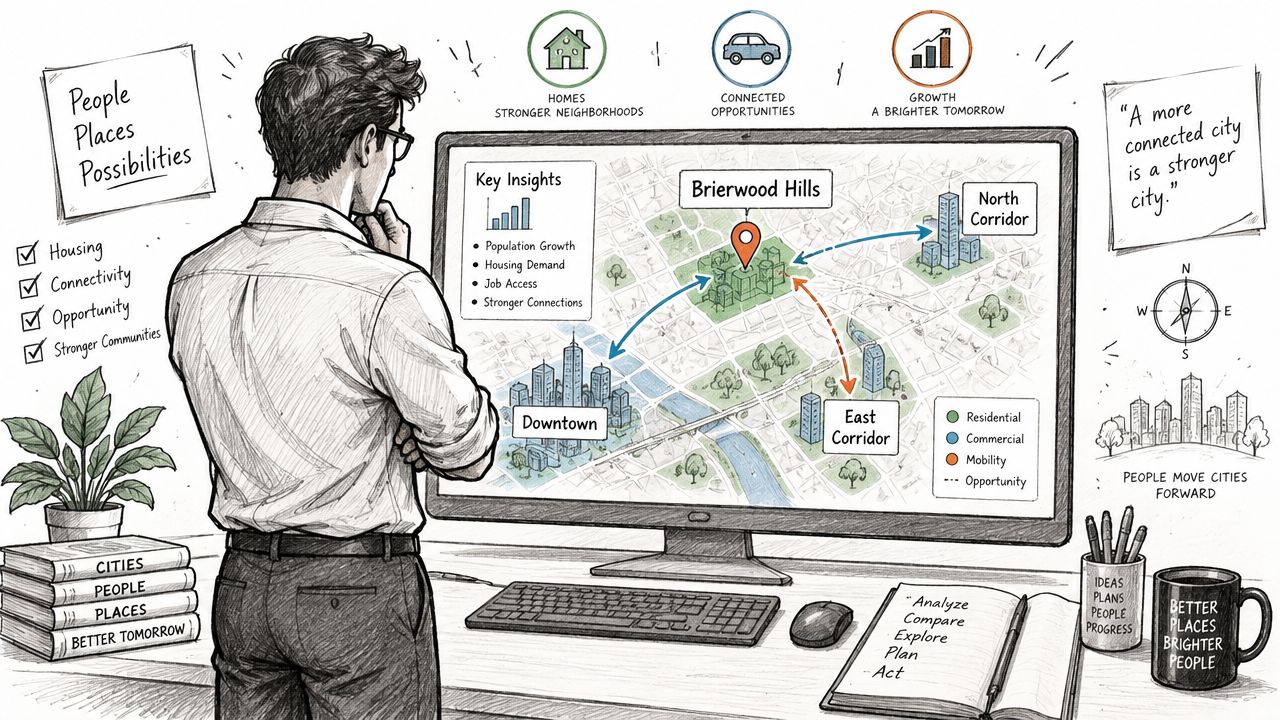
The strongest workflow produces a written pass or fail list before an offer. Include essentials such as permissible fencing, parking capacity, school assignment, commute route, and tolerance for maintaining a large lot. That process keeps the neighborhood's polished appearance from overshadowing restrictions that become visible only after closing.
Final Relocation Tradeoff Analysis
Brierwood Hills is a fit for buyers who want contained suburban organization with efficient corridor access. The neighborhood's approximate 112-home scale, access to I-69 and nearby services, and connection to Southwest Allen County schools create a focused proposition. Its established housing timeline also means buyers can choose among different renovation conditions, but they must inspect systems rather than infer quality from the surrounding streetscape.
The core tradeoff is clear:
| Priority | Brierwood Hills Advantage | Required Concession |
|---|---|---|
| Daily access | Efficient connection to major corridors and services | Peak traffic still requires route testing |
| Community appearance | HOA governance can support consistency | Exterior autonomy may be limited |
| Outdoor space | Some parcels can offer substantial land | Larger lots increase maintenance demands |
| Housing choice | Mixed build periods create varied options | Homes aren't automatically comparable |
| School planning | Listing descriptions connect the area with Southwest Allen County | Exact assignment requires verification |
The best candidate is a buyer who values location efficiency, accepts document-based oversight, and will complete a property-level inspection. The weaker fit is a buyer who expects unrestricted exterior projects, informal parking flexibility, or a uniform new-construction maintenance profile.
Evaluate Brierwood Hills as a micro-market, not as a slogan. Its strengths become meaningful when they match your commute and household routines. Its limitations become costly when you discover them after buying.
Frequently Asked Questions
How can buyers verify Brierwood Hills HOA restrictions before closing?
Buyers should obtain the recorded declaration, amendments, current rules, architectural standards, assessment information, and resale status documents before the inspection or financing deadlines expire. Have the title company or real estate attorney confirm that the documents match the parcel's legal description and identify any outstanding violations.
How should buyers compare resale value across mixed-age Brierwood Hills homes?
Buyers should compare homes by build period, renovation history, lot characteristics, and covenant compliance, not by neighborhood name alone. A 1970s-era home with documented system replacements may be more comparable to a later home than to an unrenovated property built in the same broad period.
Does Southwest Allen County automatically determine a household's school placement?
No, the exact street address determines the applicable attendance assignment and should be verified with the school district before closing. Ask about transportation, program eligibility, boundary updates, and enrollment procedures rather than relying solely on a listing description.
What property-tax questions should a Brierwood Hills buyer ask?
Buyers should request the current tax record, confirm the parcel classification, and ask the county assessor or closing professional how reassessment could affect the property after purchase. They should also separate property taxes from HOA assessments because the two obligations follow different rules and can change independently.
ReloMaps provides city, county, and property-context reports that help place a Brierwood Hills listing within broader Fort Wayne comparisons. Visit ReloMaps to evaluate neighborhood conditions, household priorities, and relocation tradeoffs before committing to a property.
Enjoying the blog? Subscribe to ReloMaps+ for premium area intelligence — and to keep us independent.
Subscribe today