Best States with No Income Tax: 9 Key Trade-Offs
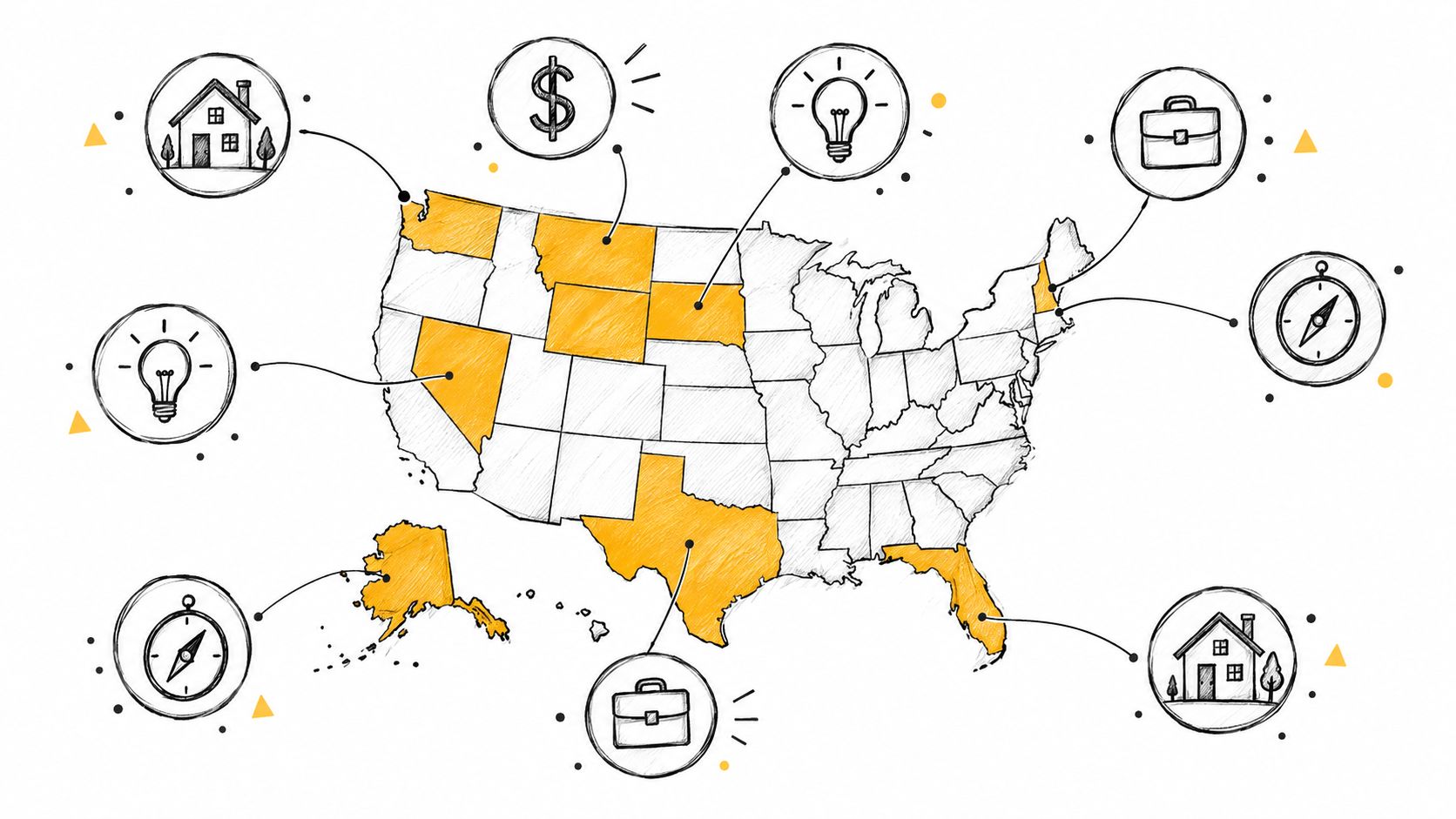
Nine states are commonly covered in no-income-tax comparisons: Alaska, Florida, Nevada, New Hampshire, South Dakota, Tennessee, Texas, Washington, and Wyoming. The best choice depends on your total taxes, housing, insurance, utilities, employment access, climate exposure, and lifestyle, because no-income-tax status doesn't guarantee lower living costs.
That distinction matters more than the headline. A state can remove tax from wages while shifting the bill toward property taxes, sales taxes, excise taxes, payroll taxes, business taxes, insurance, or local charges. Washington also requires special treatment because it doesn't tax wage income broadly but does tax certain long-term capital gains.
This ranking uses a relocation lens rather than an income-tax lens. It weighs state-level tax treatment, renter-versus-owner exposure, housing and consumption costs, climate and hazard risk, employment or remote-work fit, and the local context available through ReloMaps. City pages such as Austin, Texas on ReloMaps add context on affordability, safety, demographics, quality of life, strategic location, and commuting factors that state lists often miss.
The methodology is intentionally practical. Start with the income source, then model housing, taxable consumption, insurance, utilities, transportation, healthcare, and work access. Treat the ranking as a shortlist, not a universal verdict.
Table of Contents
- 1. Texas and the property-tax trade-off
- 2. Florida and the insurance question
- 3. Nevada for working-age movers
- 4. South Dakota and the remote-work requirement
- 5. Wyoming for maximum fiscal flexibility
- 6. Tennessee and the consumption-tax trade-off
- 7. Alaska and the cost of distance
- 8. New Hampshire and the homeowner calculation
- 9. Washington and the ninth-state complication
- Comparative trade-offs across the nine states
- 9-State No-Income-Tax Comparison, Key Tradeoffs
- Turn tax savings into a real relocation budget
- Frequently Asked Questions
- When does high property tax cancel no-income-tax savings?
- How does coastal insurance change a Florida relocation budget?
- Do remote workers need a metro in Wyoming or South Dakota?
- How can a hybrid worker test a Boston commute from New Hampshire?
- Which ReloMaps metrics expose neighborhood-level trade-offs?
- Which state is most suitable for a founder selling company stock?
- Should retirees compare Florida with New Hampshire?
- What should buyers verify before purchasing rural land?
1. Texas and the property-tax trade-off
Texas is one of the clearest examples of why zero state individual income tax doesn't equal a low overall tax burden. The state relies more heavily on sales and property taxation, and its average combined state and local sales-tax rate was reported as 8.20% by TaxAct (TaxAct's comparison of states with no income tax).
That structure can favor a high-income renter or remote worker whose largest financial exposure is earned income. It can be less attractive to a homeowner, because the tax calculation follows the property as well as the person. A household comparing Texas with an income-tax state should model its expected home value, assessed-value tax, taxable spending, insurance, and local charges instead of multiplying salary by a zero tax rate.
Texas also varies sharply by city and neighborhood. A technology worker may prefer Austin for its employment ecosystem and lifestyle, while a family may find a different balance of housing, commuting, schools, and safety in another Texas market. Houston offers a different employment and hazard profile from Dallas, while smaller cities can change the housing and commute equation again.
Practical rule: Compare the tax bill attached to the home you'd actually buy, not the state average attached to a hypothetical household.
Before choosing a city, examine cheaper cities in Texas and compare housing context with work access. ReloMaps' city and neighborhood indicators can help separate an affordable location from a lower-priced area with weaker amenities, longer commutes, or greater hazard exposure.
Texas ranks highly for households prioritizing income-tax savings and a large economy. It shouldn't rank first automatically for financed homeowners. The right answer depends on whether the income-tax benefit outweighs the property, consumption, insurance, utility, and transportation costs created by the specific move.
2. Florida and the insurance question
Florida remains a major destination for retirees and households seeking no individual income tax. Its fiscal model relies on other revenue sources, and the state's appeal changes substantially depending on whether you rent, buy inland, or purchase near the coast.
The retirement calculation is more nuanced than a simple tax-free label. A household with retirement distributions, investment income, or a home sale should verify how each income category is treated, then add property taxes, insurance, flood exposure, maintenance, and local costs. Coastal risk can make the insurance line more influential than the income-tax line, especially for homeowners.
Florida's sales tax also matters. The state has a 6% sales tax, with county additions that can raise the combined rate, according to the Tax Foundation's state income-tax data. A retiree who spends most income rather than saving it may feel consumption taxes more directly than a high-income household with a lower taxable-spending share.
Inland markets can offer a different budget from coastal metros, but a lower purchase price doesn't remove the need to check flood exposure, wind coverage, deductibles, evacuation routes, and insurer availability. Compare the complete ownership cost before making an offer. A home-insurance quote comparison guide can help structure that review.
For retirees, the best places to retire in America should be filtered by more than weather. Check healthcare access, neighborhood safety, demographic fit, quality of life, housing costs, and distance from major services. Florida can be an excellent fit for a retiree who values warmth and accepts insurance exposure. It can be a poor fit for a homeowner whose budget has little room for premiums, deductibles, or storm-related repairs.

3. Nevada for working-age movers
Nevada's no-income-tax advantage often appeals to working-age professionals, entrepreneurs, and remote workers rather than only retirees. The state's economy and lifestyle differ between Las Vegas, Reno, suburban communities, and rural desert locations, so the relocation decision should begin with employment and daily-life requirements.
The trade-off is consumption. Nevada uses sales and other revenue sources to fund public services, which means a household that spends a large share of its income may capture less benefit than a household that saves or invests more. The Tax Foundation's 2025 State Tax Competitiveness Index also shows why a binary no-income-tax filter is inadequate. States differ in payroll, corporate, sales, property, and other tax structures.
Housing adds another layer. Las Vegas and Reno can offer broader employment access and amenities, but the most desirable neighborhoods may not deliver the same value as smaller or peripheral markets. A remote worker can consider a wider geography, but that flexibility comes with checks for broadband, healthcare access, water availability, transportation, and distance from services.
Nevada's climate also affects the budget. Desert living can raise cooling demand and make water availability important for rural or off-grid buyers. Those costs don't appear on a paycheck, but they influence the monthly amount a household must reserve after tax.
Use a city-level comparison to test the lifestyle behind the tax claim. Look at commute patterns, home values, rents, work-from-home rates, safety, hazard exposure, and proximity to major cities. Nevada is strongest for people who can work independently of a narrow local job market and who prefer its regulatory and lifestyle environment. It's less compelling for households that need broad public services, mild utility costs, or a traditional employment market outside the major metros.
4. South Dakota and the remote-work requirement
South Dakota's income-tax advantage is straightforward, while the relocation calculation is not. The state has neither an individual income tax nor a corporate income tax, according to the Tax Foundation's 2025 State Tax Competitiveness Index. A household still needs to compare property taxes, sales taxes, insurance, utilities, housing, and travel costs before treating the headline saving as a real budget benefit.
The best fit depends heavily on location and work arrangement. Sioux Falls provides the state's broadest employment base, services, and amenities. Smaller communities may offer more space or a different housing profile, but regular trips for healthcare, education, shopping, or work can reduce those savings. ReloMaps city-level comparisons can help test housing, employment access, commuting, and proximity to larger service centers rather than treating South Dakota as one market.
Remote work expands the feasible geography, provided the employer approves the move and the home supports reliable daily operations. Check primary and backup internet, coworking or meeting options, airport access, and the time required to reach a major medical facility. A remote worker who travels frequently may value Sioux Falls or another connected location more than a cheaper rural property.
Winter also belongs in the relocation budget. Heating, snow removal, vehicle wear, road conditions, and reduced outdoor access can affect monthly costs and quality of life. Rural buyers should assess emergency response, healthcare distance, and winter maintenance before relying on a lower purchase price.
Entrepreneurs face a separate constraint: local customer access and staffing availability. A favorable tax structure does not create a large labor pool or replace in-person networks. South Dakota suits households that value lower density, business flexibility, and a seasonal climate. It is a weaker match for people who need a large local job market, frequent flights, or extensive urban amenities.
The practical test is whether location independence can support a stable daily routine after total living costs and winter risks are included.
5. Wyoming for maximum fiscal flexibility
Wyoming has the strongest broad tax-competitiveness profile among the no-income-tax states in the supplied research. The Tax Foundation's 2025 index ranks Wyoming first overall and places South Dakota near the top. Wyoming also has neither an individual nor a corporate income tax.
That combination makes Wyoming attractive to business owners, investors, remote workers, and households that prioritize regulatory and property-rights considerations. It doesn't make every Wyoming location financially attractive. Housing, healthcare, employment access, utilities, and travel costs vary significantly between a city such as Cheyenne and a high-demand mountain community.
The state's economic model also has a resource connection. Wyoming relies substantially on taxes and royalties linked to mineral production, which creates a different long-term fiscal profile from a state funded mainly by tourism or consumption. A buyer should consider how revenue volatility could affect public services, local employment, and future tax policy.
Rural land requires especially careful due diligence. Confirm road access, water rights, septic requirements, internet service, winter maintenance, emergency response, and the distance to healthcare. A property that looks inexpensive on a listing can require substantial investment before it functions as a year-round home.

Wyoming is one of the best states with no income tax for a household that values land, autonomy, and remote work more than a deep local labor market. It's a weaker choice for someone who needs specialized healthcare, dense cultural amenities, or a short commute to a large employer.
The relocation lens changes the ranking. Wyoming may win on fiscal flexibility, but a city with stronger infrastructure can produce a better practical outcome than an isolated parcel with a lower purchase price.
6. Tennessee and the consumption-tax trade-off
Tennessee's no-income-tax reputation reflects the completed phaseout of its former tax on investment income. The Hall Income Tax ended in 2021, while New Hampshire's separate tax on interest and dividends ended in 2025, according to the Tax Foundation's state tax data. The distinction matters because “no income tax” can describe different categories of income and different points in time.
Investors, retirees, and business owners should verify how their wages, dividends, interest, retirement distributions, and capital gains are treated before establishing residency. Legislative changes can alter the result, so a current state review belongs in the relocation budget.
Tennessee illustrates why income tax is only one part of total tax exposure. A household that spends most of its earnings may feel the state's sales-tax structure more sharply than a household that earns a high salary and saves a large share. Renters can receive the income-tax benefit more directly than homeowners, though rent still reflects property taxes, operating expenses, and local costs passed through by landlords.
City choice changes the calculation. Nashville offers a broad employment base, but housing pressure, traffic, and competition can reduce the practical value of tax savings. Knoxville and Chattanooga present different combinations of employment, outdoor access, housing, and commute time. Memphis has a distinct logistics and services economy, making neighborhood-level research more useful than a citywide assumption about safety or quality of life.
Use ReloMaps to compare work-from-home rates, commute times, home values, rents, education, safety, demographics, and location. Those city-level comparisons help separate a suitable remote-work base from a market where local employment or housing costs undermine the headline benefit.
Tennessee can suit a remote worker seeking a temperate setting and access to growing metros. It may fit less well when high household spending makes consumption taxes a dominant budget item. The state rewards a particular income and spending profile, rather than every household equally.
7. Alaska and the cost of distance
Alaska's tax advantage is real, but distance can determine whether it survives in a household budget. The state repealed its personal income tax in 1980, after exceptionally strong oil revenue improved its finances, according to the Tax Foundation's state income-tax overview. Alaska also has no state-level sales tax, although local taxes and operating costs still affect total tax exposure.
Relocation costs are shaped by climate, shipping, infrastructure, healthcare access, and employment concentration. Heating, vehicle maintenance, travel, and freight can matter more than the income-tax saving. Commodity dependence also creates exposure to changes in public revenue and the local economy.
Anchorage provides the state's widest access to jobs, services, and transportation. Smaller communities may offer privacy and outdoor access, but residents need practical plans for supplies, medical travel, connectivity, and emergency response. A household that needs specialized care or frequent flights should calculate those routes before buying or renting.
ReloMaps can add useful city-level context by comparing employment conditions, remote-work suitability, housing, commute patterns, services, and location. Those comparisons help distinguish an affordable base near Anchorage from a remote community where logistics and climate risk dominate the budget.
Remote workers should verify internet performance at the exact address, then check employer compliance, backup power, winter transportation, and the cost of moving equipment or household goods. A town's apparent connectivity may not reflect conditions at a particular property.
Alaska suits movers who actively value its environment and can accept isolation. It fits less well for households prioritizing convenience, predictable travel, or broad job choice. The state's headline tax benefit belongs in a wider comparison of housing, utilities, insurance, vehicles, healthcare access, and goods. For Alaska, lifestyle fit usually comes before tax savings.
8. New Hampshire and the homeowner calculation
New Hampshire's tax advantage depends heavily on housing status. In 2025, the state became the newest full member of the no-individual-income-tax group after repealing its Interest and Dividends Tax. Before that change, wages and salaries were generally exempt, while certain interest and dividend income remained taxable, distinguishing New Hampshire from states that imposed no individual income tax across major income categories (Tax Foundation state income-tax data).
The state also has no sales tax, which can reduce everyday tax exposure. That benefit may be offset for homeowners by comparatively significant property taxes, with the actual burden varying by municipality and property value. Renters and homeowners earning the same income can therefore face very different annual costs.
New Hampshire's location gives some households access to the broader Northeast employment market. It may work for a hybrid employee or remote worker who occasionally needs a major city, but the calculation should use the exact town, neighborhood, commute, parking costs, and office schedule. Winter conditions and traffic can turn a seemingly convenient location into an expensive or impractical weekly arrangement.
Municipal services form part of the ownership calculation. Buyers should compare school funding, emergency response, road maintenance, libraries, and local budgets because property taxes help support those services. A lower purchase price does not necessarily mean lower total ownership cost if taxes, heating, insurance, or maintenance are higher.
ReloMaps city-level comparisons can help evaluate Concord, southern communities, and smaller markets by housing, employment access, commute patterns, services, and remote-work fit. Neighborhood-level context matters more than the state label when two properties carry different tax and service profiles.
New Hampshire may suit a high-income renter, a remote worker, or a household that values Northeast access and no sales tax. A homeowner should first test whether the property-tax bill absorbs the income-tax savings. The state is therefore a location-and-housing strategy, not an automatic tax winner.
9. Washington and the ninth-state complication
Washington belongs in a nine-state comparison only with a clear qualification. It is often included in broader lists of states without a broad-based individual income tax, while the Tax Foundation's 2026 State Tax Competitiveness Index documents its separate treatment of certain long-term capital gains. Washington does not broadly tax wage and salary income, but its capital-gains rules can change the result for investors and business owners.
That makes Washington different from Alaska, Florida, Nevada, New Hampshire, South Dakota, Tennessee, Texas, and Wyoming. A salaried employee and a founder selling appreciated stock may describe the state in the same way yet face materially different tax outcomes.
The relevant test is income-specific. Identify which income is taxed, when the rule applies, whether it affects gains or earnings, and whether legislative changes could alter the calculation. A state tax index comparison, including the Tax Foundation's state tax index, is useful context, but it should not replace household-level modeling.
Relocation decisions also depend on housing, sales and property taxes, insurance, utilities, employment concentration, commute patterns, wildfire and flood exposure, and access to services. Washington may fit a high-earning employee who values its employment market and lifestyle. A portfolio-heavy household should model capital gains separately, while a remote worker should test housing and service costs against the income-tax benefit.
ReloMaps city-level comparisons can sharpen that analysis by contrasting Seattle, Spokane, Tacoma, and smaller markets through housing, employment access, commute patterns, hazards, and remote-work fit. Test W-2 wages, self-employment income, dividends, retirement distributions, a home purchase, and annual consumption.
Washington belongs on the list, but not as an equivalent substitute for the other eight states. Its headline advantage depends on the household's income mix.
Comparative trade-offs across the nine states
The nine options don't form one tax category in practice. They represent different fiscal models: resource revenue in Alaska and Wyoming, tourism and gaming in Nevada, consumption and property taxation in Texas, retirement and visitor-driven spending in Florida, and varied combinations of local and state revenue elsewhere.
The strongest broad tax-competitiveness profiles are also not interchangeable. Wyoming ranks first overall in the 2025 Tax Foundation index, while South Dakota sits near the top. Alaska combines no individual income tax with no state-level sales tax. Nevada's payroll-tax structure and Washington's capital-gains framework show why a binary filter can mislead (Tax Foundation's State Tax Competitiveness Index).
A practical shortlist looks like this:
- High-income remote worker: Compare Texas, Wyoming, South Dakota, Nevada, and Tennessee by housing, consumption, broadband, and employment independence.
- Retiree with portfolio income: Compare Florida and New Hampshire with special attention to property, insurance, healthcare, and investment-income treatment.
- Homebuyer: Treat Texas and New Hampshire as property-tax cases, then test the full ownership budget against a renter scenario.
- Founder or investor: Separate earned income, business income, dividends, and capital gains. Washington requires particular care.
- Off-grid or land-focused buyer: Evaluate Wyoming and Alaska by utilities, access, healthcare, connectivity, and hazard exposure before tax savings.
- Hybrid worker: Compare commute reliability and proximity to employment centers, not just distance on a map.
The most useful shortlist may come from low-tax cities, where city and neighborhood context can reveal trade-offs hidden by state averages. A low-tax location with weak broadband or limited healthcare may be less practical than a slightly more expensive city with better access and infrastructure.
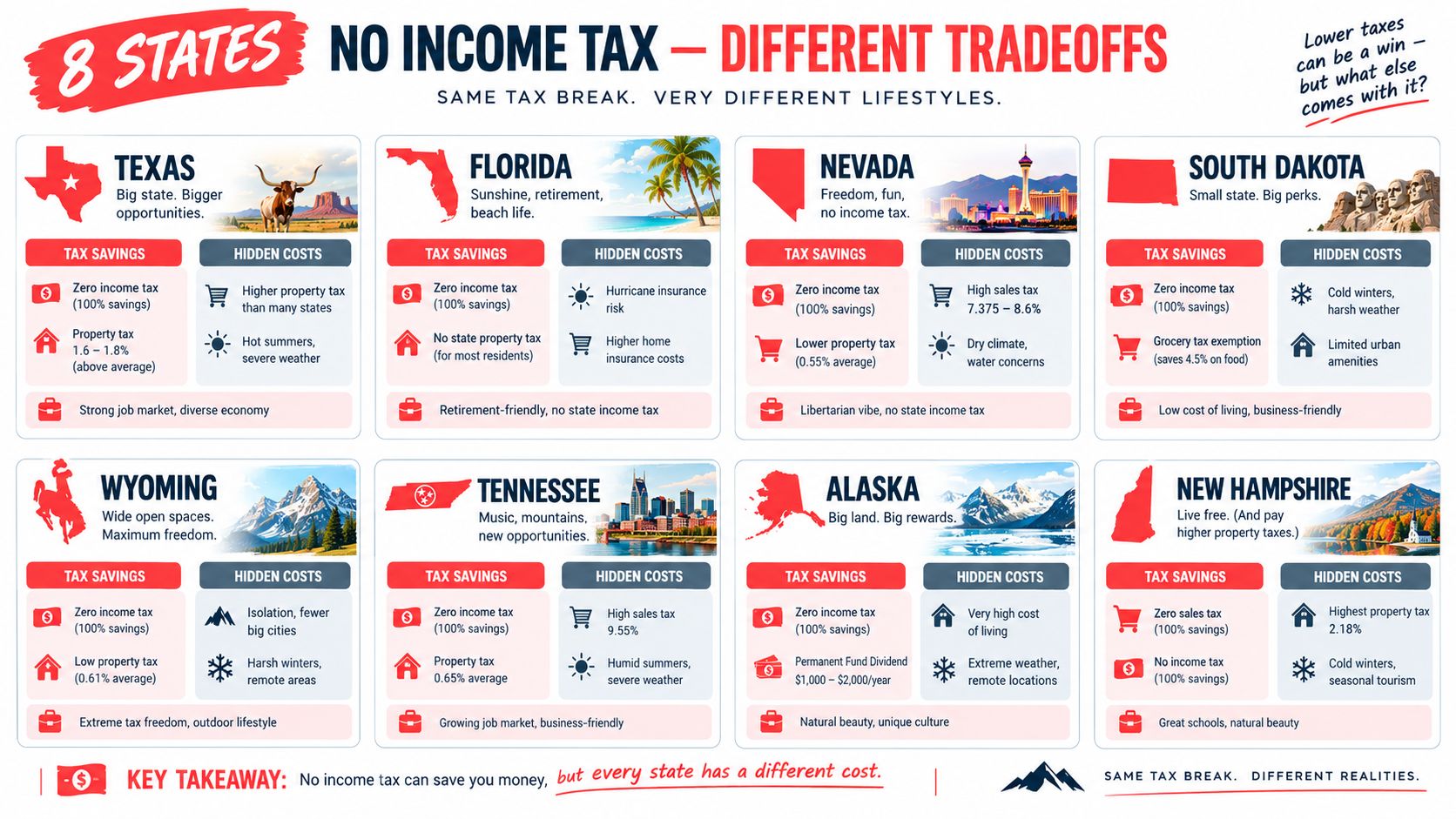
9-State No-Income-Tax Comparison, Key Tradeoffs
| State / Summary | Net Tax Impact | Cost & Resource Requirements | Expected Outcomes | Ideal Use Cases | Key Advantages | Key Trade-offs / Risks |
|---|---|---|---|---|---|---|
| Texas | No state income tax; high property taxes (1.6–1.8%); sales up to ~8.25%, net benefit depends on home value | Homeowners face $8k–$15k+ annual property tax on premium homes; higher cooling costs; varied housing costs by market | Rapid metro growth; home prices up 15–25% in major cities; strong job markets in tech/energy/finance | High earners, remote workers, entrepreneurs, retirees with liquid assets | Maximum income retention, business-friendly regulation, diverse housing options | High property-tax burden, gentrification, heat/humidity, car dependence, variable school quality |
| Florida | No state income tax; retirement income exempt; sales 6–7.5%, retirees gain most | Rising property values; hurricane insurance $1.2k–$2.5k+; flood insurance additional; cooling costs | Strong retiree inflows; coastal prices up 25–40%; infrastructure and insurance pressure | Retirees seeking tax-free retirement, warm-climate movers, second-home buyers | Retirement income fully tax-free, no estate tax, developed senior services | Hurricane/flood risk, rising insurance and property costs, shrinking affordability in coastal areas |
| Nevada | No income or capital gains tax; high sales tax (7.375–8.6%) offsets savings for many | Moderate housing in secondary markets; high consumption tax; desert cooling and water constraints | Business-friendly growth (Reno tech, Las Vegas diversification); urban appreciation ~20–30% | Entrepreneurs, investors, libertarian-leaning remote workers | Income & capital gains freedom, minimal regulation, business-friendly climate | Heavy reliance on gaming revenue, boom-bust cycles, desert heat, water scarcity |
| South Dakota | No income or capital gains tax; grocery sales tax exemption; moderate local sales tax | Affordable housing ($250k–$400k); low property tax (0.82–1.1%); winter heating costs | Low overall cost of living; limited local jobs outside Sioux Falls/Rapid City | Remote workers, entrepreneurs, families seeking low CoL | Lowest combined tax burden, grocery tax exemption, affordable housing | Limited job market, harsh winters, fewer cultural/healthcare amenities outside metros |
| Wyoming | No income/capital gains/corporate tax; strongest tax freedom | Abundant affordable land; higher heating/fuel costs; thin real-estate market; limited services | Attracts homesteaders, entrepreneurs; thin market liquidity; population sparse | Off-grid homesteaders, business owners, sovereignty seekers | Maximum tax & regulatory freedom, strong property rights, abundant land | Severe winters, geographic isolation, limited healthcare and jobs |
| Tennessee | No wage income tax; capital gains phased out; very high sales tax (~9.55%) | Rising home prices in metros; moderate utilities; high consumption tax burden | Strong job growth in Nashville/Memphis; housing up 20–30% in desirables | Workers seeking temperate climate plus job opportunities; middle/high earners | No wage income tax, growing metro job markets, temperate climate | Very high sales tax offsets savings, rising housing costs, school quality variance |
| Alaska | No state income tax + Permanent Fund Dividend (PFD); limited local sales taxes | Extremely high CoL: groceries 30–50% higher, fuel expensive, high heating and shipping costs; broadband costly | High effective income advantage but offset by cost-of-living; limited job diversity; isolation | Adventurers, remote workers comfortable with isolation, resource sector workers | PFD supplement, strong hunting/fishing/homesteading freedoms, no income tax | Extreme climate/isolation, high living costs, limited medical/education access |
| New Hampshire | No income or sales tax; very high property tax (2.18%) | Homeowners face large property bills; home prices rising near Boston; moderate utilities | Attracts Boston commuters; southern communities appreciating 15–25% | Renters, Boston-area commuters, those prioritizing no income/sales tax | No income & sales tax, Northeast proximity, strong schools in many towns | Very high property taxes negate homeowner savings, limited state services, winter maintenance costs |
| Comparative Summary | All listed states eliminate state income tax; offsets vary (property, sales, insurance, utilities) | Hidden costs common: property taxes, sales/consumption taxes, insurance, utilities; remote-work/broadband often required | Potential headline savings for high earners; desirable metros often see rapid price appreciation; job-market variance by state | Remote workers, high earners, entrepreneurs, and retirees (state-dependent) | Significant income-tax savings, diverse policy mixes for entrepreneurs/retirees, secondary markets offering value | Net savings frequently smaller than headline claims once hidden costs and climate/infrastructure risks are included |
Turn tax savings into a real relocation budget
The best state with no income tax is the one that leaves your household with the strongest combination of cash flow, stability, access, and quality of life. That could be Wyoming for a remote entrepreneur, Florida for a retiree who accepts insurance exposure, Texas for a high-income renter, or New Hampshire for a household that values Northeast access and no sales tax. It could also be none of them if property, consumption, insurance, or healthcare costs overwhelm the income-tax benefit.
Start with the income-tax calculation. Separate W-2 wages, self-employment income, dividends, interest, retirement distributions, business income, and capital gains. Washington demonstrates why income type matters, while New Hampshire demonstrates why a state's classification can change after legislation. Don't transfer a salary-based calculation to an investment-heavy household.
Next, build two housing scenarios. Model renting and buying separately, because a homeowner absorbs property tax, insurance, maintenance, and repair risk directly. A renter may avoid some ownership costs, but the landlord's expenses can still affect rent and future increases. For buyers, include the purchase price, assessed-value tax, insurance, flood or wildfire exposure, utilities, commuting, and expected maintenance.
Use a full monthly budget, not a tax-rate comparison. Zero-based budgeting for homebuyers can help assign every expected dollar before you compare locations. Add healthcare access and travel costs, especially for rural homes in Alaska, Wyoming, South Dakota, or Nevada.
Then test a primary metro against a secondary market. Compare work access, broadband, schools, safety, demographics, home values, rents, commute times, and proximity to hospitals. ReloMaps' Interactive Grid and Map can help filter cities by these dimensions, while city pages provide ReloScores and category grades for side-by-side review.
Finally, confirm the nonfinancial requirements. Check whether the neighborhood fits your safety needs, demographic preferences, school priorities, commute tolerance, hazard exposure, and lifestyle. Review the property context at the address level where possible, rather than relying on a state or metro label.
A tax-free paycheck can improve a move, but it can't compensate for an unsuitable neighborhood, an impossible commute, unreliable connectivity, or an ownership budget that fails under ordinary costs. Use the headline tax advantage as the first filter, then let the complete household model determine the ranking.
Frequently Asked Questions
When does high property tax cancel no-income-tax savings?
High property tax cancels the benefit when the annual ownership burden exceeds the state income tax you would otherwise pay, after accounting for differences in housing and spending. Calculate the alternative state's estimated income tax, then subtract the candidate state's property tax, insurance, sales tax, utilities, and commuting costs from the comparison.
How does coastal insurance change a Florida relocation budget?
Coastal insurance changes the budget by adding a recurring ownership cost that varies with location, flood exposure, construction, deductibles, and insurer availability. Request insurance estimates before making an offer, verify FEMA flood-zone information, and model a higher-deductible scenario so the move doesn't depend on an unrealistically low premium.
Do remote workers need a metro in Wyoming or South Dakota?
Remote workers don't necessarily need a major metro, but they do need reliable connectivity, healthcare access, supplies, transportation, and employer approval at the exact address. Test the property's internet options, backup connection, nearest hospital, airport access, and winter travel conditions before choosing a rural location.
How can a hybrid worker test a Boston commute from New Hampshire?
A hybrid worker should test the commute from the actual neighborhood on the days and times they'd travel, including winter conditions, parking, transfer points, and schedule variability. Compare more than one town along the route, because a short map distance doesn't guarantee a reliable weekly commute.
Which ReloMaps metrics expose neighborhood-level trade-offs?
ReloMaps can expose trade-offs through ReloScore category grades, home values, rents, crime and safety, demographics, commute times, work-from-home rates, education, hazard proximity, and strategic-location indicators. Its property-context lookup can also add local information to a Zillow or Redfin listing, helping buyers assess the neighborhood rather than only the home.
Which state is most suitable for a founder selling company stock?
No single state is best for every founder because the answer depends on whether the relevant income is salary, business income, dividends, or capital gains. Washington requires particular caution because its no-wage-tax status coexists with a tax on certain long-term capital gains, so founders should model a potential sale separately from ordinary annual earnings.
Should retirees compare Florida with New Hampshire?
Retirees should compare Florida and New Hampshire by income source, ownership status, insurance, healthcare, property taxes, weather tolerance, and access to family. Florida may offer a warmer lifestyle, while New Hampshire combines no state sales tax with a property-tax-heavy model. The better choice depends on the retiree's spending and housing profile.
What should buyers verify before purchasing rural land?
Buyers should verify legal road access, water, septic feasibility, utility connections, broadband, emergency response, healthcare distance, insurance availability, and year-round maintenance. A low purchase price doesn't establish affordability if the property requires major infrastructure work or long recurring trips for essential services.
Visit ReloMaps to compare cities and neighborhoods through ReloScores, category grades, tax and cost indicators, commute data, demographics, safety context, and hazard factors. Use the Interactive Grid and Map to turn the nine-state shortlist into a practical relocation decision based on your household's actual priorities.
Enjoying the blog? Subscribe to ReloMaps+ for premium area intelligence — and to keep us independent.
Subscribe today