Best Areas to Live in Tucson Arizona: 9 Picks
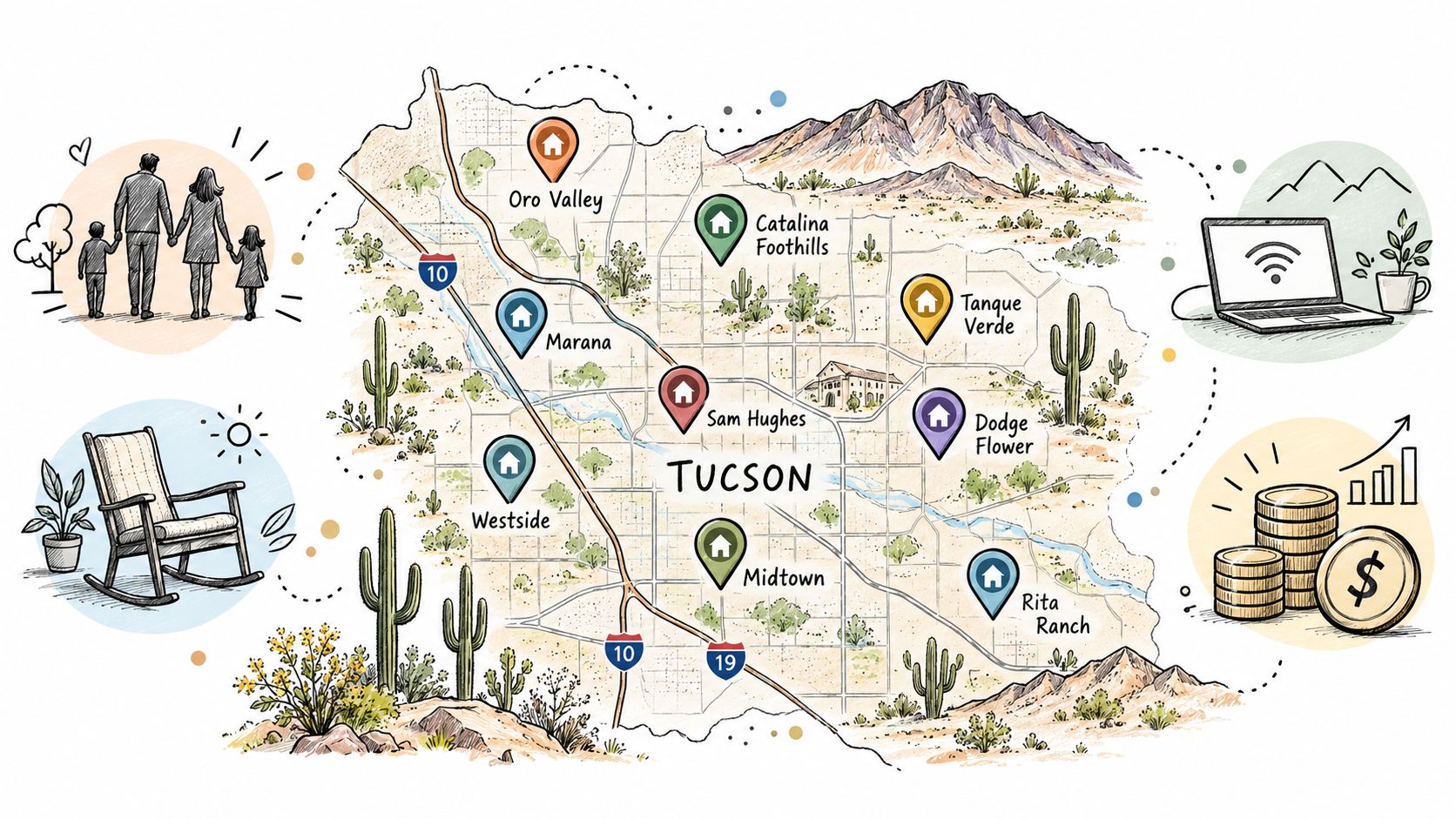
Oro Valley is a strong starting point for families and retirees seeking suburban amenities, Sam Hughes suits university-oriented and walkable living, and Vail or Sahuarita deserve attention from buyers prioritizing space and newer construction. Yet Tucson's metropolitan median home value of $319,700 doesn't tell you which of those areas will be affordable after commuting, cooling, insurance, and maintenance.
That benchmark comes from the Tucson metropolitan housing and demographic data, not a neighborhood price comparison. A central bungalow and an outer-suburban house can have similar asking prices while creating very different monthly expenses.
The best areas to live in Tucson, Arizona depend on whether you prioritize schools and outdoor access, centrality, retirement infrastructure, or a lower-cost balance of space and convenience. The following shortlist treats nine areas as different solutions to those priorities, rather than pretending there's a universal winner.
Compare the same dimensions, not just the overall score
Use ReloScore and category grades as a consistent framework for affordability, safety, education, amenities, commute friction, and long-term livability. No verified neighborhood scores are supplied here, so the recommendations below are editorial fits, not invented numerical rankings.
Healthcare access, housing condition, and desert heat belong alongside those grades. For a home with uncertain ventilation or cooling performance, investigating indoor air quality services for Tucson homes can help you identify questions to raise with an HVAC professional before purchasing.
Table of Contents
- Compare the same dimensions, not just the overall score
- 1. Catalina Foothills
- 2. Oro Valley
- 3. Marana and Dove Mountain
- 4. Sam Hughes
- 5. Armory Park
- 6. Downtown Tucson and 4th Avenue
- 7. Vail and Rita Ranch
- 8. Green Valley
- 9. Sahuarita
- Best Areas to Live in Tucson: 9-Community Comparison
- Turn the Shortlist Into the Right Tucson Move
- Frequently Asked Questions
- Which hidden costs should I check before calling a Tucson home affordable?
- How can I verify a school assignment before making an offer?
- Can a home outside a mapped flood zone still need drainage investigation?
- How should hybrid workers test a Tucson-area commute?
- What evidence makes cooling costs a neighborhood-selection issue?
- What should renters investigate beyond the advertised rent?
- Can a citywide safety grade establish whether a specific address is safe?
1. Catalina Foothills
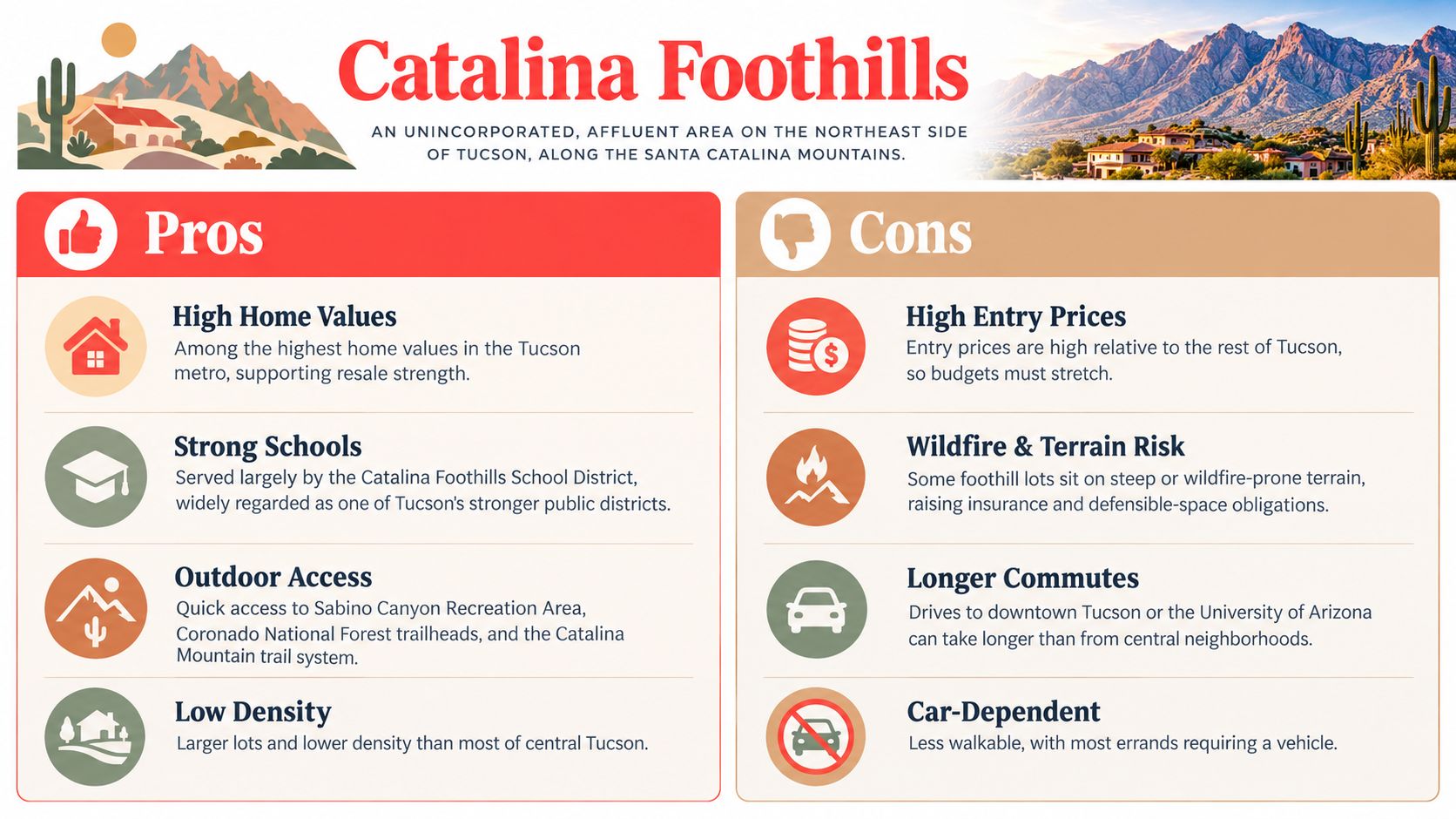
Best fit for families who want to investigate school access, larger lots, and mountain-oriented recreation together. Catalina Foothills deserves consideration when those features matter more than walking to everyday destinations.
A family comparing a foothills property with a central Tucson house should separate the price premium into tangible benefits. Does the actual listing provide usable outdoor space, the desired school assignment, appealing views, and a manageable work trip? A prestigious area name isn't enough.
Test the premium against the property
The Southern Arizona residential market report recorded a 2025 regional median sale price of $355,000, with buyers purchasing at an average of 2% below asking price. Those regional figures provide context for negotiations, not a Catalina Foothills valuation or an automatic discount.
- Affordability and livability: Compare insurance quotes, cooling equipment, lot maintenance, and any HOA obligations before deciding that the purchase price fits.
- Safety and site risk: Request address-specific incident information and check flood exposure, drainage, slope conditions, and wildfire insurance availability.
- Schools and amenities: Confirm attendance boundaries directly and drive the routes to the schools, healthcare facilities, and recreation you'll use.
For a household choosing between Tucson and another Arizona destination, the best places to live in Arizona comparison can broaden the search. Within the Foothills, however, the decisive evidence still comes from the individual property.
2. Oro Valley
A retiree and a family may both shortlist Oro Valley, but they should evaluate it differently. The retiree may prioritize specialist access and recreation, while the family needs school assignments, childcare logistics, and reliable access to work.
Oro Valley is a suburban starting point, not a blanket promise of low crime or superior schools. Compare its ReloScore category grades with the other finalists, then verify the specific neighborhood and service providers.
For example, a relocating couple considering a golf-community home should test whether the amenities justify the recurring costs. A household with children should compare the school run and after-school travel with the same routines from a non-golf subdivision.
A suburban amenity is valuable only if you can reach it conveniently and expect to use it.
Check the service geography
Confirm whether the address falls within the town or a surrounding unincorporated area. Ask the relevant authorities about permitting, services, and taxes rather than assuming neighboring listings operate under identical rules.
Affordability should include HOA charges and any separate recreation obligations. Safety requires local incident context rather than reputation. Education requires an address-level assignment, while amenities and commute friction require actual trips to your destinations.
For long-term livability, consider how the home would work if driving became less convenient. A property that suits an active retiree today may be a weaker choice later if essential appointments and groceries require difficult journeys.
3. Marana and Dove Mountain
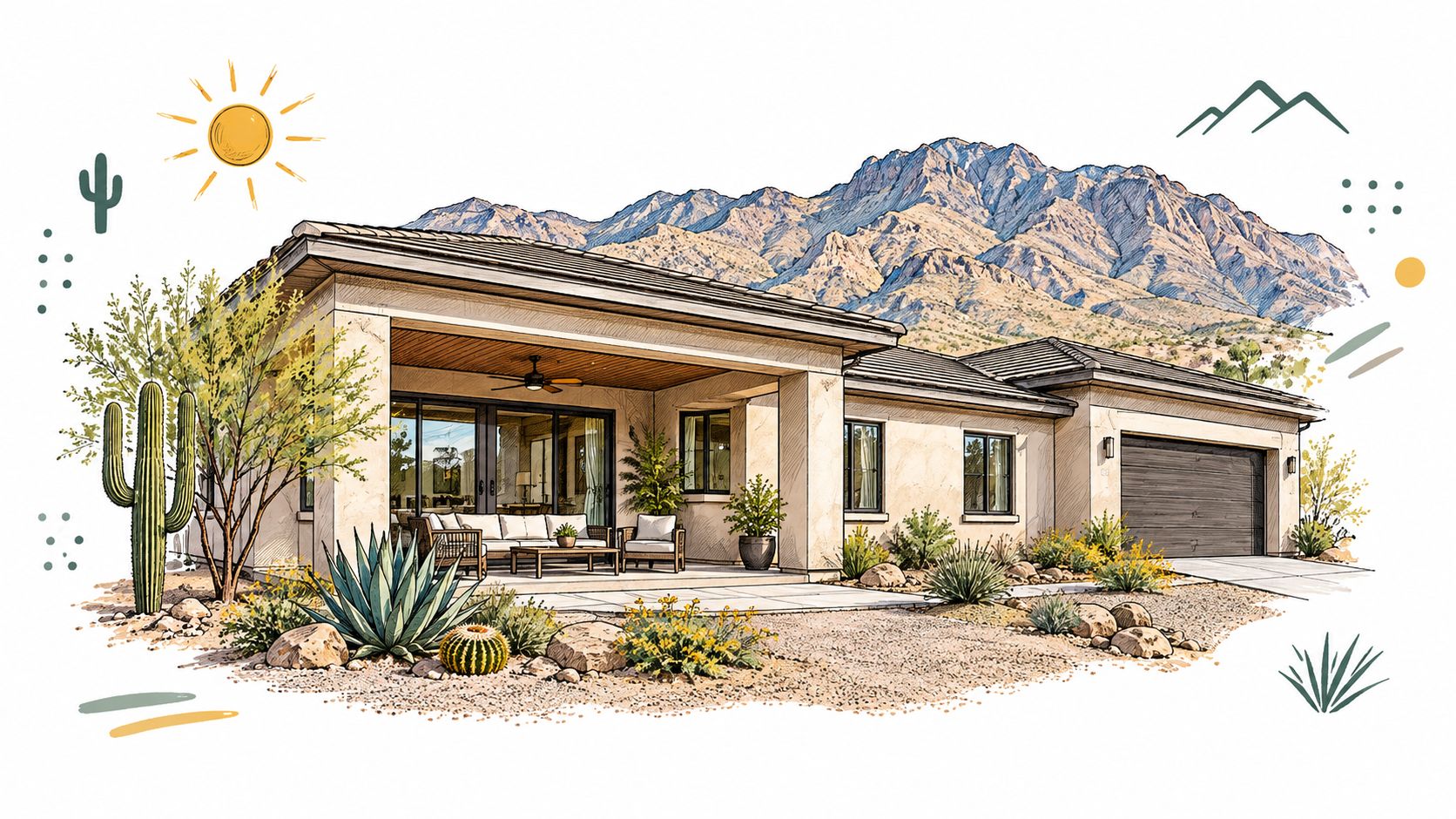
Start with the house, then challenge the location. Marana and Dove Mountain belong on the shortlist for buyers exploring planned communities, newer construction, and more space, but those preferences don't prove that any particular listing offers better value.
An out-of-state buyer might prefer a newly built home over an older central property because renovation feels less predictable. That's a reasonable preference, provided the buyer also investigates unfinished infrastructure, community obligations, and the route to work.
Distinguish the model home from daily life
- Affordability: Compare the completed purchase cost, including upgrades, landscaping, window coverings, and HOA charges. Don't treat the advertised base price as your finished budget.
- Schools and amenities: Request written information about existing facilities and proposed infrastructure. A planned school or road isn't equivalent to an operating one.
- Commute and safety: Test the work journey during your required arrival window and inspect access routes, nearby incidents, and property-specific hazards.
- Long-term livability: Review HOA budgets, reserve information, construction warranties, drainage, and the maintenance demands of the lot.
A remote worker may reasonably accept greater distance from central Tucson. A worker with frequent office attendance needs a different calculation, even if both buyers like the same floor plan.
Use the best places for families in the Southwest to compare broader alternatives. Then check whether the actual Marana-area community delivers the family services behind your preferred category grades.
4. Sam Hughes
Sam Hughes is a central, university-oriented candidate for buyers who value established character and everyday access over a newer suburban floor plan. It's especially worth investigating when reaching campus is part of your regular routine.
Tucson's historic-preservation guidance identifies historically established central alternatives, including Sam Hughes, and distinguishes the city's preservation framework from broader historic recognition. Don't assume every historic-looking property carries the same restrictions.
A faculty member choosing between Sam Hughes and an outer suburb should compare more than the drive to campus. Walking routes, bicycle access, maintenance needs, and the ability to complete errands without another car trip can materially change the decision.

Price the building as carefully as the location
Inspect wiring, sewer condition, roofing, foundations, insulation, and cooling equipment. Verify whether proposed exterior changes require preservation review before budgeting for them.
For the ReloScore comparison, amenities and commute access deserve attention, but they shouldn't cancel weaknesses in affordability or housing condition. Verify schools and nearby incidents independently, and walk the actual routes you'd use rather than relying on a broad walkability description.
A well-maintained older home may suit a buyer who dislikes daily driving. A home needing major repairs may not, even on an appealing street.
5. Armory Park
An Armory Park purchase can be both a housing decision and a restoration project. This area suits buyers seeking historic character near Downtown who are comfortable investigating building condition and renovation constraints.
Armory Park is among Tucson's formally designated Historic Preservation Zones, as established by the preservation guidance cited above. That distinction matters when your plans include exterior alterations, not just when you admire the architecture.
Consider a hybrid worker evaluating an adobe home here. Proximity to Downtown may be attractive, but the buyer still needs to know whether the building can support a comfortable home office through summer and whether repairs fit the budget.
Practical rule: Don't count a historic home's renovation potential as a benefit until you've confirmed both the permitted work and its likely scope.
Let inspections determine affordability
- Housing condition: Have qualified inspectors assess moisture intrusion, roof drainage, settling, electrical systems, and cooling performance.
- Preservation: Confirm the property's designation and approval requirements before commissioning exterior work.
- Safety and amenities: Review nearby incidents, then visit at different times to assess traffic, lighting, noise, and the routes to daily services.
In the ReloScore framework, Armory Park's centrality should be weighed against the specific home's operating costs. School fit requires separate verification, while commute convenience depends on the destination rather than being near Downtown.
The right buyer may welcome careful restoration. Someone who needs predictable move-in costs should be more selective, even if the neighborhood otherwise matches their preferences.
6. Downtown Tucson and 4th Avenue
Choose Downtown Tucson and Fourth Avenue when access matters more than private outdoor space. These areas warrant investigation for people who want a central home base and intend to use nearby cultural destinations and transportation options.
The Downtown Tucson and Fourth Avenue Commercial District historic designations noted earlier establish their cultural significance. They don't establish that every building is quiet, affordable, or convenient for every work schedule.
This video offers an additional visual introduction to the area.
Measure the transportation benefit honestly
Nearby urban access can be meaningful: the Rincon Heights neighborhood analysis reports that 37.2% of residents walked to work and 55.7% of commuters traveled less than 15 minutes one way. Those figures describe Rincon Heights, not Downtown or Fourth Avenue, and shouldn't be transferred to a prospective listing.
For example, a Downtown employee considering an apartment should test the complete door-to-door journey. Confirm streetcar or bus schedules, the walk from the stop, and whether service works for evening shifts.
Compare affordability after parking charges and building fees; safety using nearby incidents and lighting; and amenities through the destinations you'll visit. Families should verify school assignments rather than treating central access as an education indicator.
For long-term livability, visit at night and on weekends. A lively location can suit one buyer while creating an unacceptable sleep or home-office environment for another.
7. Vail and Rita Ranch
Vail and Rita Ranch are candidates for households putting suburban space and school logistics ahead of central-city access. The important comparison isn't about "north versus southeast." It's whether the home works for the whole household's weekly travel.
Suppose parents like a newer house but work in different parts of the Tucson area. The school run, after-school activities, and separate office trips may matter more than the apparent simplicity of the highway connection.
Treat school access as an address-level decision
Verify the assigned district and school, enrollment procedures, available capacity, and transportation arrangements directly. Don't interpret a listing's school reference as confirmation that your child can attend the preferred campus.
- Affordability and housing: Compare actual listings, HOA obligations, cooling condition, and inspection findings. Don't assume southeast housing is cheaper than every northern alternative.
- Commute friction: Drive Houghton Road and Interstate 10 during the times your household would use them.
- Safety and hazards: Check nearby incident records and flood information for the lot, especially around drainage corridors.
- Amenities and livability: Map grocery trips, healthcare, recreation, and school activities as a connected routine.
A home that supports remote work may remain practical with an occasional office trip. The same address may be less suitable for a household with daily cross-city obligations.
Use the ReloScore category grades to flag strengths and weaknesses, then let verified school assignments, route tests, and the property inspection determine whether the apparent fit holds up.
8. Green Valley
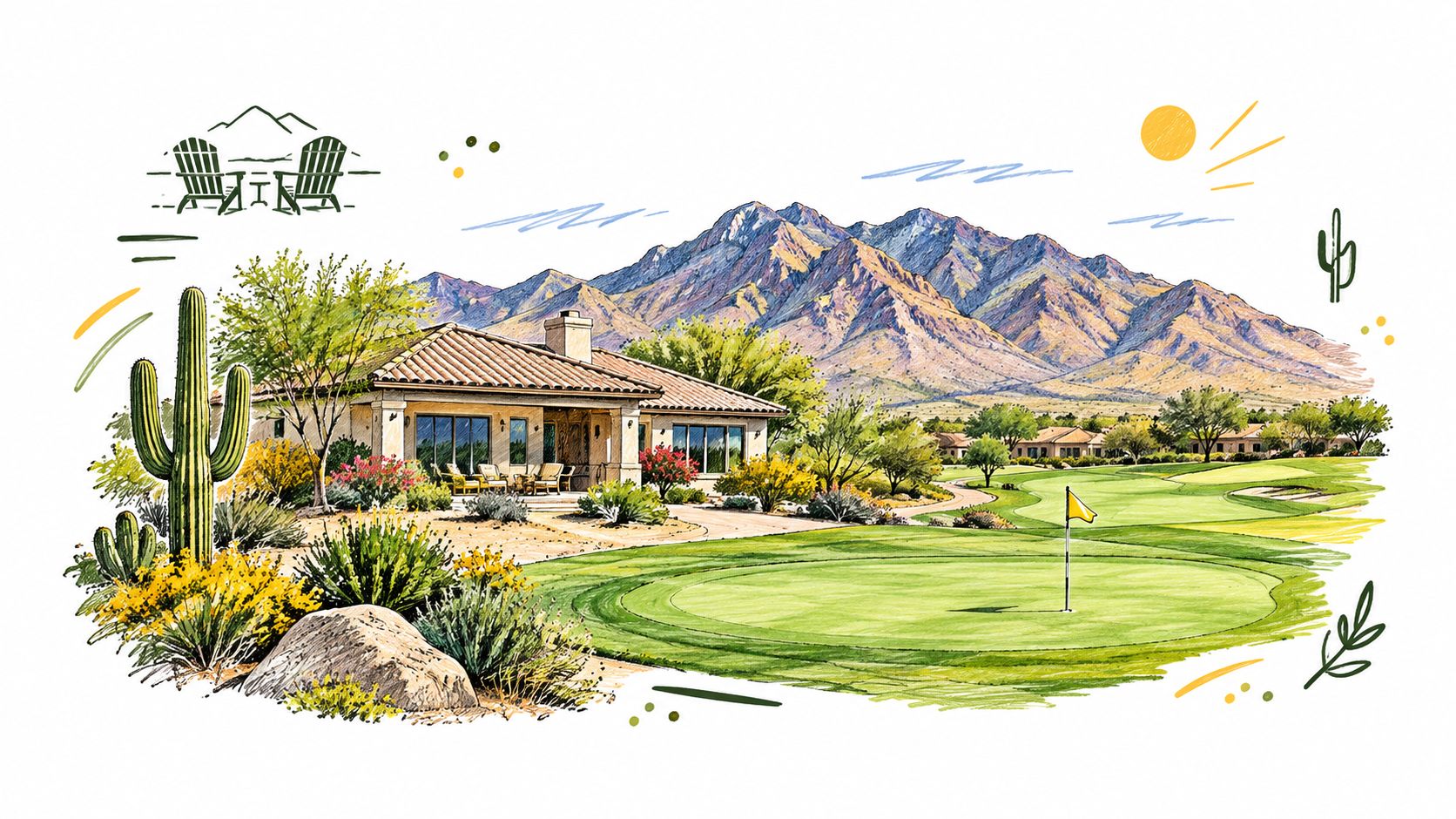
Retirement-focused buyers should evaluate Green Valley through recreation participation, healthcare access, and the ability to remain comfortable at home. A golf-oriented setting is only useful if its costs and routines match the retirement you expect to lead.
A relocating retiree might prefer organized activities and a smaller maintenance burden over central Tucson's urban access. Another may prioritize frequent specialist appointments and find the medical journey more important than community amenities.
Separate retirement amenities from retirement affordability
Ask for the actual HOA and recreation membership obligations attached to the property. Confirm any age restrictions, participation rules, and costs that continue even when you're away.
Choose the home for an ordinary week of appointments, shopping, and summer weather, not just a pleasant winter visit.
In a ReloScore-centered comparison, education may receive less personal weight, but affordability, safety, healthcare access, and strategic location still require attention. Drive to your preferred hospital and specialists, inspect cooling equipment, and evaluate shaded outdoor space and accessible interior layouts.
Long-term livability also includes what happens when driving becomes harder. Identify practical alternatives for groceries, appointments, and social participation before committing.
The best places to retire in the Southwest can help compare Green Valley with other retirement candidates. Your shortlist should reflect the services you need, not the presence of golf or a retirement-oriented identity.
9. Sahuarita
Sahuarita merits consideration for families and remote workers exploring newer homes and a suburban routine south of Tucson. Its strongest fit is a household that can make the travel pattern work without overlooking infrastructure and recurring community costs.
A remote-working family might accept a more distant Tucson office journey in exchange for a preferred floor plan. That decision becomes less attractive if school transport, childcare, medical appointments, and office attendance all require separate drives.
Verify what's operating today
Request information about public roads, utilities, and proposed amenities before purchasing in a developing subdivision. Confirm which facilities are completed and which remain plans.
- Affordability: Compare the finished-home price with landscaping, HOA charges, insurance, and expected maintenance.
- Schools and amenities: Verify assignments and capacity directly, then test access to groceries, healthcare, parks, and activities.
- Safety and site conditions: Examine local incidents, drainage, flood exposure, and the exact property's surroundings.
- Commute and livability: Test Interstate 19 and Interstate 10 during your real travel windows, including the return journey.
Don't automatically label Sahuarita a lower-cost alternative. That conclusion requires comparable listings and a full household budget, not a regional stereotype.
Its ReloScore and category grades can help identify whether economic, safety, or location indicators merit closer inspection. The final decision should depend on the house, functioning infrastructure, and how often you'll need to travel beyond the community.
Best Areas to Live in Tucson: 9-Community Comparison
| Area | Housing and Cost | Lifestyle and Access | Key Advantages | Considerations and Ideal Fit |
|---|---|---|---|---|
| Catalina Foothills | Upscale custom homes; large lots; high entry prices | Mountain views, Sabino Canyon trails, and strong local school reputation; car-dependent | Outdoor access, lower density, and strong resale potential | Best for families or buyers seeking space and schools; consider wildfire risk, terrain, and longer commutes |
| Oro Valley | Suburban homes, including golf communities; costs above the metro average | Parks, trails, retail, and Northwest Medical Center; mostly car-dependent | Municipal services, generally low crime, and convenient healthcare | Best for families, retirees, or remote workers; verify school boundaries and HOA fees |
| Marana and Dove Mountain | Newer homes and master-planned communities; often more affordable than Oro Valley or the Foothills | Retail near I-10, growing amenities, and access to desert trails | Modern housing, lower relative prices, and highway access | Best for buyers seeking newer construction and space; consider commute times, infrastructure timelines, and cooling costs |
| Sam Hughes | Historic bungalows and Spanish Colonial homes; smaller lots | Highly walkable and bikeable; close to the University of Arizona and streetcar | Historic character, central location, and short campus commutes | Best for university-area residents and urban-lifestyle seekers; older homes may need repairs and parking can be limited |
| Armory Park | Historic adobe and early-20th-century homes, plus newer infill | Near Downtown, the streetcar, and cultural venues | Central access, historic character, and relatively lower entry prices than some central neighborhoods | Best for buyers seeking historic housing near downtown; inspect for maintenance needs and assess block-by-block traffic |
| Downtown Tucson and 4th Avenue | Apartments, lofts, and historic homes; condo fees may apply | Strong walkability and streetcar access; dining, nightlife, and events nearby | Reduced car dependence and convenient access to employers and culture | Best for residents who value an urban lifestyle; consider nightlife noise, parking, and association fees |
| Vail and Rita Ranch | Newer subdivisions with relatively affordable options and larger lots | Parks, newer schools, desert access, and I-10 connections | Family-oriented setting, outdoor access, and quieter surroundings | Best for families seeking space and newer homes; consider longer cross-town commutes and seasonal flood risk |
| Green Valley | Many single-story homes; housing often costs less than in north Tucson | Golf, recreation centers, clubs, and access to Madera Canyon | Retiree-focused amenities, social activities, and a quieter pace | Best for retirees seeking recreation and community; Tucson healthcare trips can be long, and fees and cooling needs matter |
| Sahuarita | Newer homes in master-planned communities; often less costly than north Tucson | Suburban amenities, local schools, and I-19 access | Modern schools, quieter surroundings, and access to southern Arizona recreation | Best for families or remote workers seeking newer housing; consider Tucson commute times and growing infrastructure demands |
Turn the Shortlist Into the Right Tucson Move
Match the area to the household before matching the house to the budget. Catalina Foothills and Oro Valley are starting points for families prioritizing schools, recreation, and established suburban services. Green Valley deserves attention from retirees seeking social and recreation infrastructure, subject to healthcare and membership checks.
Sam Hughes, Armory Park, and Downtown Tucson suit buyers prioritizing centrality and the possibility of less driving. Marana, Vail, and Sahuarita suit households investigating newer homes, larger lots, or lower-cost space, but those benefits must be demonstrated by the listings.
Compare the complete weekly routine
The Census Reporter Tucson comparison lists a mean work trip of 21.7 minutes for the city, compared with 24.8 minutes for the metropolitan area. These averages are useful context, not predictions for a particular address or office route.
Compare finalists using the same assumptions: your commute destination, school needs, healthcare providers, maintenance tolerance, and summer comfort requirements. A strong overall score shouldn't override a weak category that affects your household every day.
If you're considering acreage rather than a conventional subdivision, review 2026 Arizona land buying tips alongside property-specific questions about utilities, access, drainage, and buildability. More land doesn't automatically mean lower operating costs or fewer restrictions.
The practical next step is to compare each finalist's ReloScore and category grades, then paste a Zillow or Redfin listing URL into ReloMaps to inspect the neighborhood and city context before touring. Keep inspection results and official address-level checks alongside that comparison.
Frequently Asked Questions
Which hidden costs should I check before calling a Tucson home affordable?
Include mortgage-related costs, insurance, cooling, maintenance, HOA obligations, and any separate recreation or parking charges. The Census Bureau's Tucson housing benchmarks report 2019–2023 median monthly owner costs of $1,433 with a mortgage and $500 without one, demonstrating that mortgage-free ownership still carries expenses.
Request the property's actual obligations rather than applying those citywide medians to your budget.
How can I verify a school assignment before making an offer?
Obtain address-specific confirmation directly from the district. Ask separately about attendance boundaries, enrollment eligibility, capacity, transportation, and transfer rules, since an assigned school and admission through an optional program aren't interchangeable.
If the school is essential to the move, resolve those questions before removing relevant purchase contingencies.
Can a home outside a mapped flood zone still need drainage investigation?
Yes, a flood-map designation doesn't replace a property-level drainage assessment. Inspect grading, roof runoff, nearby washes, access roads, and evidence of water entry, and ask an inspector which concerns require a drainage specialist.
For undeveloped land or a sloped lot, establish access and buildability before assuming the site can support your planned home.
How should hybrid workers test a Tucson-area commute?
Test the journey during the actual arrival and departure windows required by your employer. Include parking, the final walk, school drop-offs, and any transit connection rather than timing only the drive.
Check the return trip separately, and evaluate the schedule you would face if office attendance increased.
What evidence makes cooling costs a neighborhood-selection issue?
Tucson's heat exposure makes cooling reliability and housing condition essential affordability checks. The city's heat-season report recorded 46 days above 100°F in 2025 and identified high-need ZIP codes using health, social-vulnerability, and tree-canopy information.
Request summer electricity bills, equipment service records, and inspection findings; a ZIP-level vulnerability indicator should prompt investigation, not automatically disqualify every home there.
What should renters investigate beyond the advertised rent?
Check utility exposure, renewal terms, repair responsiveness, and pressure to relocate. In University of Arizona community research, 44% of renters among the interviewed low-income residents felt pressure to move, highlighting a concern that a low advertised rent alone won't resolve.
Ask who pays for cooling and how maintenance requests are handled before signing.
Can a citywide safety grade establish whether a specific address is safe?
No, citywide grades can't establish conditions around an individual property. Tucson reported 3,231 Part I violent-crime incidents in 2025, a 16% decrease from 2024, in its annual city performance summary, but that trend isn't a neighborhood rate.
Review nearby incidents by type and location, then inspect lighting, access, and surrounding land uses at the address.
ReloMaps brings ReloScore, category grades, and location data together so you can compare Tucson-area choices beyond the listing price. Visit ReloMaps, shortlist the areas that fit your household, and paste a Zillow or Redfin listing URL to investigate its local context before scheduling a tour.
Enjoying the blog? Subscribe to ReloMaps+ for premium area intelligence — and to keep us independent.
Subscribe today